In the high-stakes world of automotive and aerospace engineering, precision, safety, and efficiency are non-negotiable. Whether you’re designing an ADAS module for an electric vehicle or a flight control system for an unmanned aerial vehicle, one development approach has risen to the top:
✅ Model-Based Development (MBD)
In this article, we’ll explore why MBD is essential for automotive and aerospace systems, how it improves safety, compliance, and innovation, and which tools and practices are shaping the future of these industries.
🔍 What is Model-Based Development (MBD)?
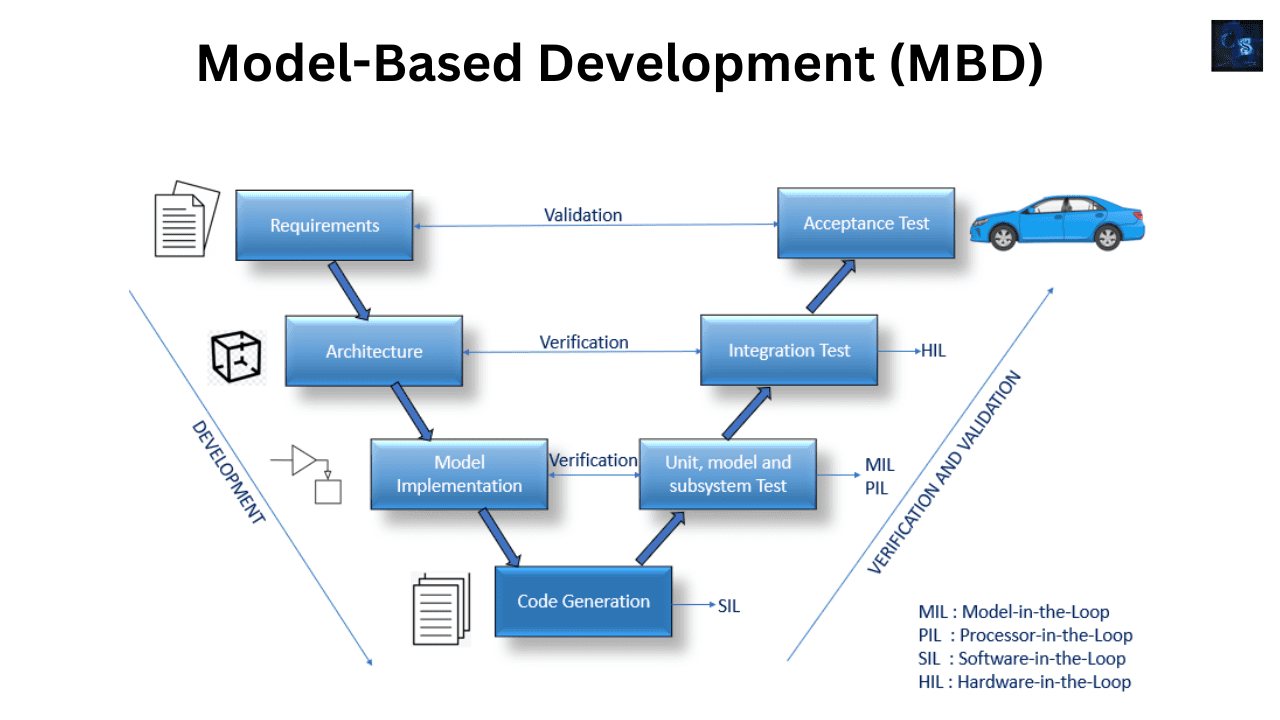
Model-Based Development (MBD) is a software engineering approach where system behavior, logic, and algorithms are designed using graphical models—typically in tools like MATLAB/Simulink, SCADE, or TargetLink.
From these models, engineers can:
- Simulate and validate system behavior
- Automatically generate embedded code
- Perform Hardware-in-the-Loop (HiL) testing
- Link requirements to test results and certification artifacts
🎮 Analogy: MBD is like building and flying a virtual prototype of a car or aircraft before you manufacture a single part—think of it as a digital wind tunnel for your logic and control systems.
🧠 Why MBD is Critical for Automotive & Aerospace
1. System Complexity is Exploding
Modern vehicles and aircraft feature:
- 100+ ECUs per car
- 1,000,000+ lines of embedded code
- Multiple redundant safety systems
- Advanced sensors and communication protocols
Without MBD, managing this complexity is error-prone and unsustainable.
2. Safety Standards Demand Traceability
- Automotive: ISO 26262 (Functional Safety for Road Vehicles)
- Aerospace: DO-178C (Software Certification for Avionics)
MBD tools support requirement traceability, test coverage, and certified code generation, making compliance simpler and audit-friendly.
3. Simulation Saves Time and Money
Traditional development waits for hardware to begin testing. MBD allows teams to:
- Simulate edge cases and fault conditions
- Detect errors before physical integration
- Refine control algorithms in hours, not weeks
🧪 In aerospace, simulating flight turbulence or actuator failure in MBD is far safer than mid-air testing.
🚗 Model-Based Development in the Automotive Industry
Key Use Cases:
- Advanced Driver-Assistance Systems (ADAS)
- Electric Motor Control (Inverter, BMS)
- Transmission and Powertrain Control
- Autonomous Driving Algorithms
- Vehicle Dynamics and Suspension Systems
Real-World Example:
A Tier-1 supplier developing a lane-keeping assist system used Simulink to:
- Model and simulate lane detection logic
- Perform Model-in-the-Loop (MiL) and Software-in-the-Loop (SiL) testing
- Generate AUTOSAR-compatible C code with Embedded Coder
- Achieve ISO 26262 ASIL-B compliance in under 6 months
💡 Result: 50% faster development with a 60% reduction in post-integration bugs.
✈️ Model-Based Development in the Aerospace Sector
Key Use Cases:
- Flight Control Systems (FCS)
- Autopilot and Navigation
- Landing Gear and Brake Control
- Engine Control Units (ECU)
- Satellite Attitude and Orbit Control
Real-World Example:
An aerospace R&D team working on a fly-by-wire system used SCADE Suite to:
- Design formally verified control laws
- Generate DO-178C Level A certifiable C code
- Simulate actuator failures using HiL setups
- Meet FAA certification timelines with traceable documentation
✈️ Result: Reduced development time by 40% and passed certification audit with zero major findings.
🔧 Tools Commonly Used in Automotive & Aerospace MBD
📋 Best Practices for MBD in Automotive & Aerospace
✅ 1. Design for Code Generation
- Use discrete-time logic
- Avoid unsupported blocks
- Stick to embedded-friendly data types (
int16,uint8,float32)
✅ 2. Build Modular, Reusable Models
- Use subsystems, libraries, and model references
- Modular design = better scalability, testability, and reuse
✅ 3. Simulate Early & Often
- Perform MiL, SiL, and HiL
- Test under nominal, fault, and edge cases
✅ 4. Link Requirements to Models
- Use traceability tools to connect model blocks to system requirements
- Essential for ISO 26262, DO-178C, and ASPICE audits
✅ 5. Automate Testing & CI Pipelines
- Integrate with Jenkins/GitLab CI
- Run nightly simulations and regression tests
⚠️ Common Pitfalls to Avoid
❌ Modeling for Simulation Only
Models designed only for simulation often require heavy rework before code generation.
Fix: Design with the target hardware in mind.
❌ Ignoring Sample Time Conflicts
Mismatched sampling rates can lead to unexpected delays or unstable behavior.
Fix: Use rate transition blocks and define fixed-step solvers.
❌ Poor Requirement Traceability
Without traceability, certification becomes painful.
Fix: Leverage tools like Simulink Requirements or IBM DOORS from Day 1.
🧭 Future Trends in MBD for Automotive & Aerospace
- AI-accelerated modeling and simulation
- Cloud-based MBD collaboration platforms
- Digital twin integration with real-time MBD
- Unified MBD and DevOps pipelines
- Code generation for RISC-V and next-gen embedded architectures
🌐 As industries move toward autonomy and connectivity, MBD will evolve into the backbone of system-of-systems engineering.
✅ Final Takeaway
Model-Based Development is not just a tool—it’s a mindset shift.
For automotive and aerospace engineering, it’s the key to building:
- Smarter control systems
- Safer embedded software
- Faster go-to-market solutions
- Certifiable and traceable systems
If you’re still relying on manual coding, spreadsheets, and late-stage testing, it’s time to rethink your development pipeline.