In today’s era of fast-paced development, engineering teams are under pressure to deliver smarter systems faster—without compromising on quality or safety. This is especially true in industries like automotive, aerospace, and industrial automation, where embedded systems grow increasingly complex.
So how do you integrate Model‑Based Development (MBD)—a traditionally sequential engineering approach—into Agile and DevOps workflows designed for speed and iteration?
This blog post explores exactly that: how to bring models, simulations, and auto-generated code into the modern CI/CD pipeline, making your embedded systems development as lean and adaptive as your software team.
🧠 Quick Recap: What is Model‑Based Development (MBD)?
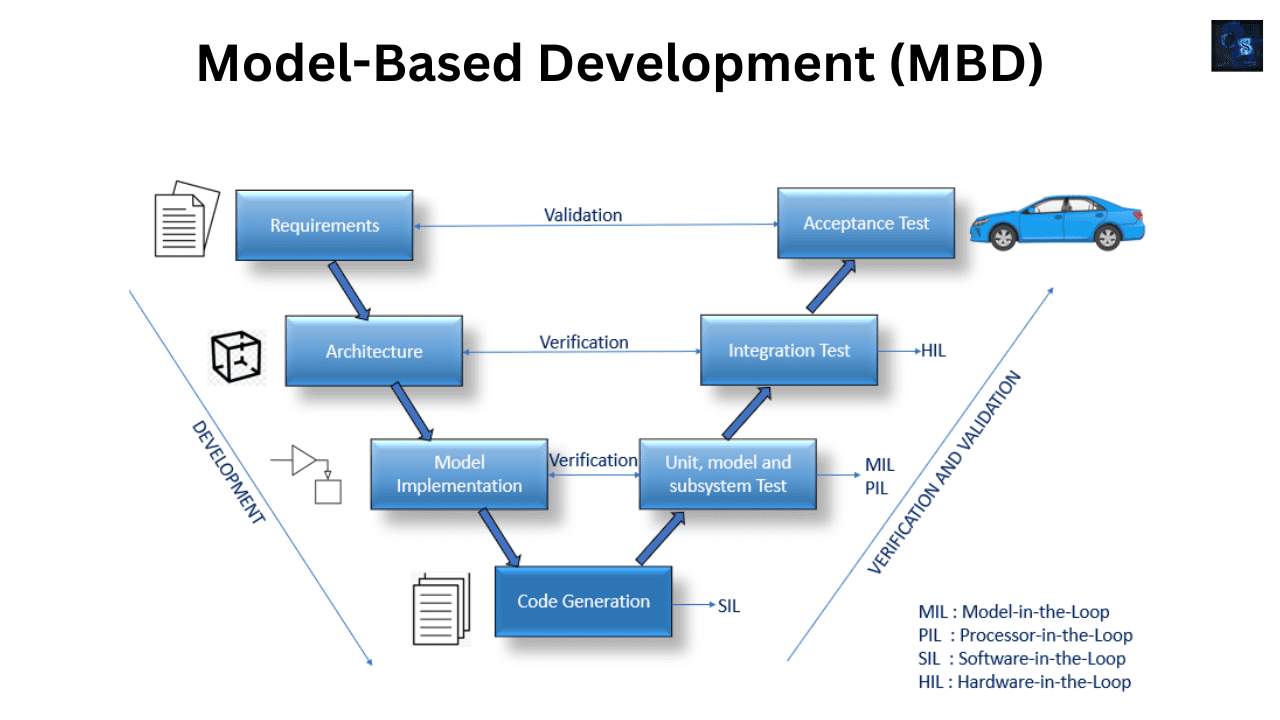
Model‑Based Development uses graphical models (e.g., Simulink, SCADE) to design, simulate, and generate embedded software. Instead of writing code line-by-line, engineers build models that are:
- Simulated for correctness
- Automatically translated into code
- Tested against requirements
🧩 Think of MBD as the “Lego Technic” of software design: you build logic from functional blocks, test it virtually, and deploy it directly.
🤝 The Challenge: MBD Meets Agile & DevOps
Traditionally, MBD has been associated with waterfall-like workflows:
- Model first → test → generate code → integrate → verify
Agile and DevOps, by contrast, focus on:
- Rapid iterations
- Continuous integration
- Incremental deliveries
- Cross-functional collaboration
At first glance, these paradigms seem at odds. But integrating MBD into Agile/DevOps workflows isn’t just possible—it’s transformative.
🚀 Why Integrate MBD with Agile & DevOps?
- Faster Feedback: Catch issues in model logic and simulations early
- Traceability: Link requirements, models, and tests in one CI pipeline
- Automation: Auto-generate and test embedded code in every sprint
- Scalability: Coordinate large teams across control, software, and systems engineering
🎯 Your control algorithm isn’t “done” when the model works—it’s done when it runs on hardware and passes tests. DevOps closes that loop.
🛠️ How to Integrate MBD into Agile/DevOps: A Step-by-Step Blueprint
✅ 1. Modularize Your Models for Iterative Development
Break large Simulink or SCADE models into logical subsystems:
- Control loops
- Diagnostic modules
- Interface layers
Benefits:
- Enables incremental testing
- Allows parallel development across teams
- Simplifies version control
🧩 Like microservices in software, modular models make updates safer and faster.
✅ 2. Use Version Control (Git, SVN) for Models
Even though MBD tools use graphical UIs, their underlying files are text-based or XML.
Best practices:
- Use .SLX, .MDL or .SCADE formats with version control
- Use model differencing tools (e.g., Simulink Compare)
- Store test harnesses, data files, and simulation configs with your model
🔁 Version control makes model evolution transparent—and recoverable.
✅ 3. Automate Testing with CI Tools
Set up Continuous Integration (CI) pipelines using:
- Jenkins
- GitLab CI
- Azure DevOps
- Bamboo
In each commit or merge:
- Run Model-in-the-Loop (MiL) simulations
- Execute Software-in-the-Loop (SiL) validation
- Compare outputs with baselines
- Generate code coverage and test reports
🧪 Treat your model like code: test it every time it changes.
✅ 4. Use Scripting for Automation (MATLAB, Python)
MBD tools support scripting interfaces:
- MATLAB scripts for Simulink automation
- Python wrappers for simulation runs
- Batch code generation and model validation
Use them to:
- Run batch simulations
- Check for model guideline compliance
- Trigger code generation and deploy artifacts
📜 Scripts are your glue between MBD tools and CI pipelines.
✅ 5. Deploy Auto-Generated Code to Real Hardware
Don’t stop at simulation. Use:
- Simulink Real-Time, Speedgoat, dSPACE, or custom boards
- Processor-in-the-Loop (PiL) and Hardware-in-the-Loop (HiL) frameworks
Benefits:
- Validate timing constraints
- Test real sensor feedback and actuation
- Measure execution time and memory
💡 Shift-left testing meets physical validation—no surprises at integration time.
✅ 6. Integrate Requirements and Traceability
Use tools like:
- Simulink Requirements
- IBM DOORS Next
- Polarion ALM
To:
- Link model blocks to textual requirements
- Track test results against specifications
- Generate audit-ready compliance reports for ISO 26262, DO-178C
📋 In safety-critical systems, traceability is not optional—it’s mandatory.
✅ 7. Involve Cross-Functional Teams Early
Agile is all about collaboration.
Tips:
- Invite controls, software, test, and hardware engineers into model reviews
- Use Simulink Review Manager or equivalent to comment on model versions
- Share simulations as video clips, plots, or web interfaces
👥 Don’t keep your models siloed—make them a living part of the product backlog.
🔄 DevOps Pipeline Example with MBD
Here’s what a modern DevOps pipeline for model-based embedded development might look like:
- Code Commit (Git): Model or requirement is updated
- Build Triggered (Jenkins/GitLab)
- Model Checks: Guidelines, data types, solver settings
- Simulation (MiL, SiL): Run tests and compare outputs
- Code Generation: Generate embedded C code (via Embedded Coder or TargetLink)
- Unit Testing & Code Analysis: Run Polyspace, static analysis
- PiL/HiL Deployment: Test generated code on target hardware
- Feedback & Reports: Push results to dashboards, notify engineers
📈 From model edit to real-time testing in minutes—not months.
🔧 Tools That Support Agile + MBD
⚠️ Pitfalls to Avoid
❌ Modeling in Isolation
Failing to consider integration early leads to rework. Fix: Involve software/hardware teams in model design.
❌ Manual Code Generation & Deployment
Manual steps break automation. Fix: Use scripts and CI tools to automate everything.
❌ Monolithic Models
Hard to test or integrate iteratively. Fix: Design modular, testable model components.
🎯 Final Takeaway: MBD and DevOps Are Not Mutually Exclusive
Model-Based Design may look like an old-school, top-down method—but when combined with Agile practices and DevOps automation, it becomes a powerful enabler for:
- Faster release cycles
- Safer systems
- Scalable embedded development
- Better collaboration across disciplines
It’s time to stop thinking in silos. Models are code—treat them like any other software artifact.