ECU Remapping for Smoother Power Delivery
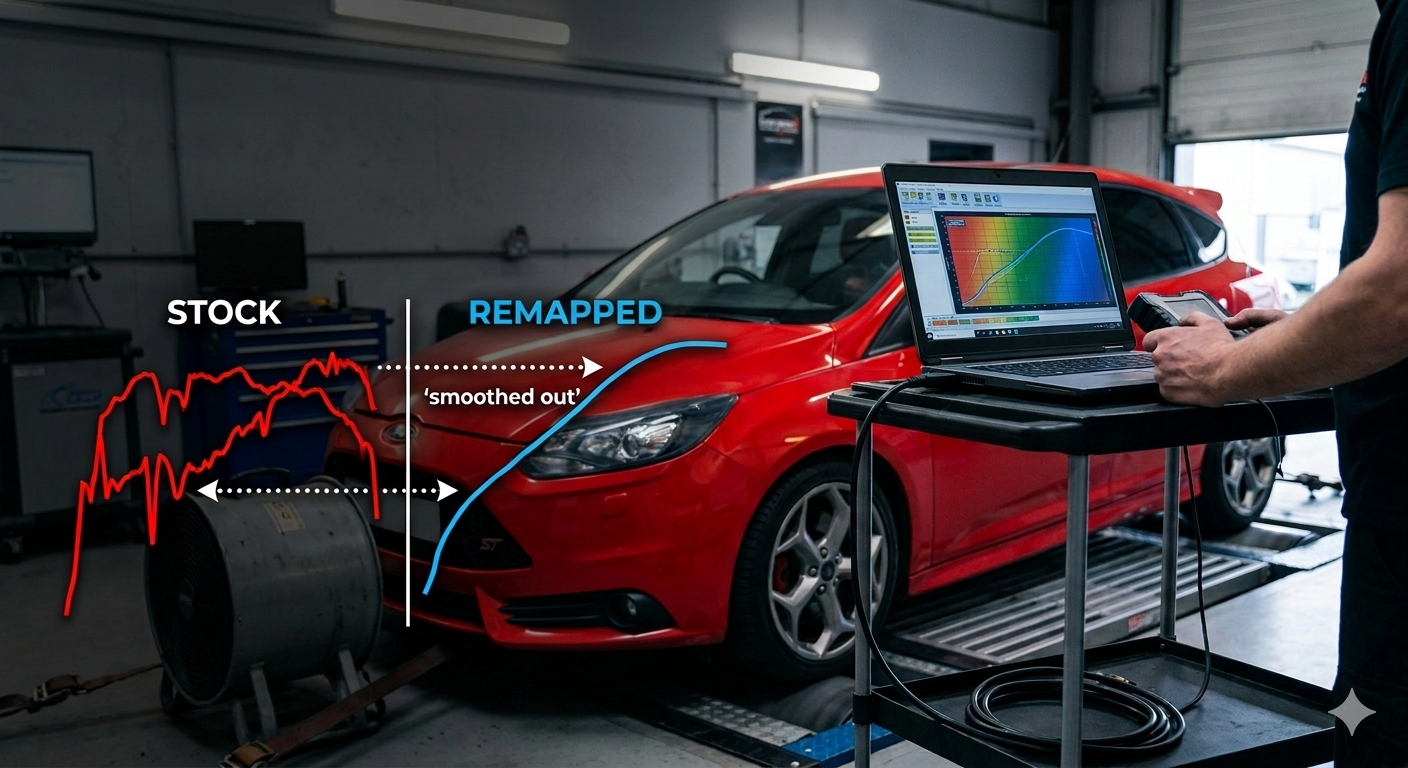
One of the most transformative yet understated benefits of ECU remapping is the potential to achieve smoother, more linear power delivery. While peak horsepower and torque figures often dominate marketing materials and discussions, the character of power delivery—how that power is distributed across the rev range and how predictably it responds to throttle inputs—arguably has a more profound impact on the driving experience. This comprehensive guide explores how ECU remapping can refine power delivery for more enjoyable, controlled, and confidence-inspiring performance.
Understanding Power Delivery Characteristics
Before diving into remapping strategies, it’s essential to understand the elements that constitute “smooth power delivery” and why factory calibrations sometimes fall short of ideal.
Defining Smooth Power Delivery
Smooth power delivery encompasses several interconnected qualities:
Linearity – The proportional relationship between throttle input and power output, creating predictable response across the pedal’s range of motion.
Progressive Torque Curve – A torque curve that builds in a consistent, gradual manner without abrupt spikes or dips.
Throttle Resolution – The precision with which small throttle adjustments translate to appropriate power changes.
Transient Response – How the engine manages momentary changes in load, such as quick throttle adjustments or gear changes.
Consistency – Reliable power characteristics regardless of conditions like temperature, altitude, or fuel quality.
Why Factory Calibrations Often Compromise Smoothness
Several factors lead manufacturers to implement calibrations that compromise optimal power delivery:
Emissions Compliance – Meeting stringent emissions standards often requires compromises in fueling and timing that create dips or flat spots in the power curve.
Conservative Safety Margins – Manufacturers build in substantial safety buffers to account for varying fuel quality, maintenance practices, and operating conditions.
Diverse Market Requirements – Global platforms must function acceptably across widely varying markets with different fuel qualities and environmental conditions.
Production Tolerances – Factory tunes must accommodate manufacturing variations between individual engines.
Cost Considerations – Economic pressure to use standardized components that may not be optimal for specific engine variants.
These constraints often result in power delivery that feels artificially restrained, inconsistent across the rev range, or unnecessarily peaky rather than progressive and linear.
Analyzing Power Delivery Before Remapping
A methodical approach to improving power delivery begins with comprehensive analysis:
Diagnostic Data Collection
Before making any changes, thorough data collection establishes a baseline:
Dynamometer Testing
- Full power runs to map the stock torque curve
- Step tests at fixed RPM points to assess throttle response
- Partial throttle sweeps to evaluate part-load behavior
Real-World Data Logging
- Acceleration runs through each gear
- Roll-on tests from various speeds
- Transient response during quick throttle changes
- Part-throttle cruising in different conditions
Subjective Assessment
- Driver feedback on throttle predictability
- Identification of specific problem areas (flat spots, hesitation)
- Evaluation of drivability in various scenarios
- Comparative analysis against similar vehicles
Common Power Delivery Issues
Several issues typically emerge during baseline testing:
Torque Dips – Noticeable depressions in the torque curve, often around emissions-critical operating points.
Throttle Mapping Nonlinearity – Disproportionate relationship between pedal position and actual throttle opening.
Boost Delivery Issues – In turbocharged applications, uneven boost building or sharp spikes in pressure.
Overrun Hesitation – Momentary hesitation when transitioning from closed to open throttle.
Inconsistent Part-Throttle Response – Unpredictable power delivery during light or moderate acceleration.
Torque Management Intervention – Excessive power reduction during gear changes or throttle transitions.
ECU Parameters Affecting Power Delivery
Several key ECU parameters directly influence the character of power delivery:
Throttle Mapping
The relationship between pedal position and actual throttle opening fundamentally shapes how power feels to the driver:
Standard Mapping Approaches
- Linear maps create a 1:1 relationship between pedal and throttle position
- Progressive maps accelerate throttle opening in the middle of pedal travel
- Regressive maps delay throttle opening until later in pedal travel
- Multi-segment maps create varying rates of change throughout pedal movement
Advanced Mapping Strategies
- RPM-dependent maps that vary based on engine speed
- Gear-specific throttle maps tailored to each transmission ratio
- Mode-selective maps that change based on driver-selected programs
- Accelerator rate-sensitive maps that respond differently to quick vs. gradual inputs
Ignition Timing Control
How spark timing is managed across the rev range significantly impacts torque characteristics:
Static Timing Maps
- Base timing tables establish fundamental advance values
- Load-based timing adjustments modify advance under varying demands
- Temperature compensation ensures consistent timing across operating conditions
Dynamic Timing Strategies
- Transient timing adjustments during throttle changes
- Anti-lag timing strategies that maintain boost pressure
- Cylinder-specific timing optimization for balanced combustion
- Adaptive timing that learns from knock sensor feedback
Fueling Parameters
Fuel delivery precision directly affects power smoothness:
Air-Fuel Ratio Targeting
- Stoichiometric (14.7:1) for emissions and economy
- Slightly rich (12.5-13.5:1) for maximum power
- Leaner mixtures (15-16:1) for cruise efficiency
- Transitional enrichment during acceleration
Injector Control Refinement
- Injector latency compensation at varying voltages
- Multiple injection events for improved atomization
- Injector flow matching for cylinder-to-cylinder consistency
- Acceleration enrichment optimized for transient response
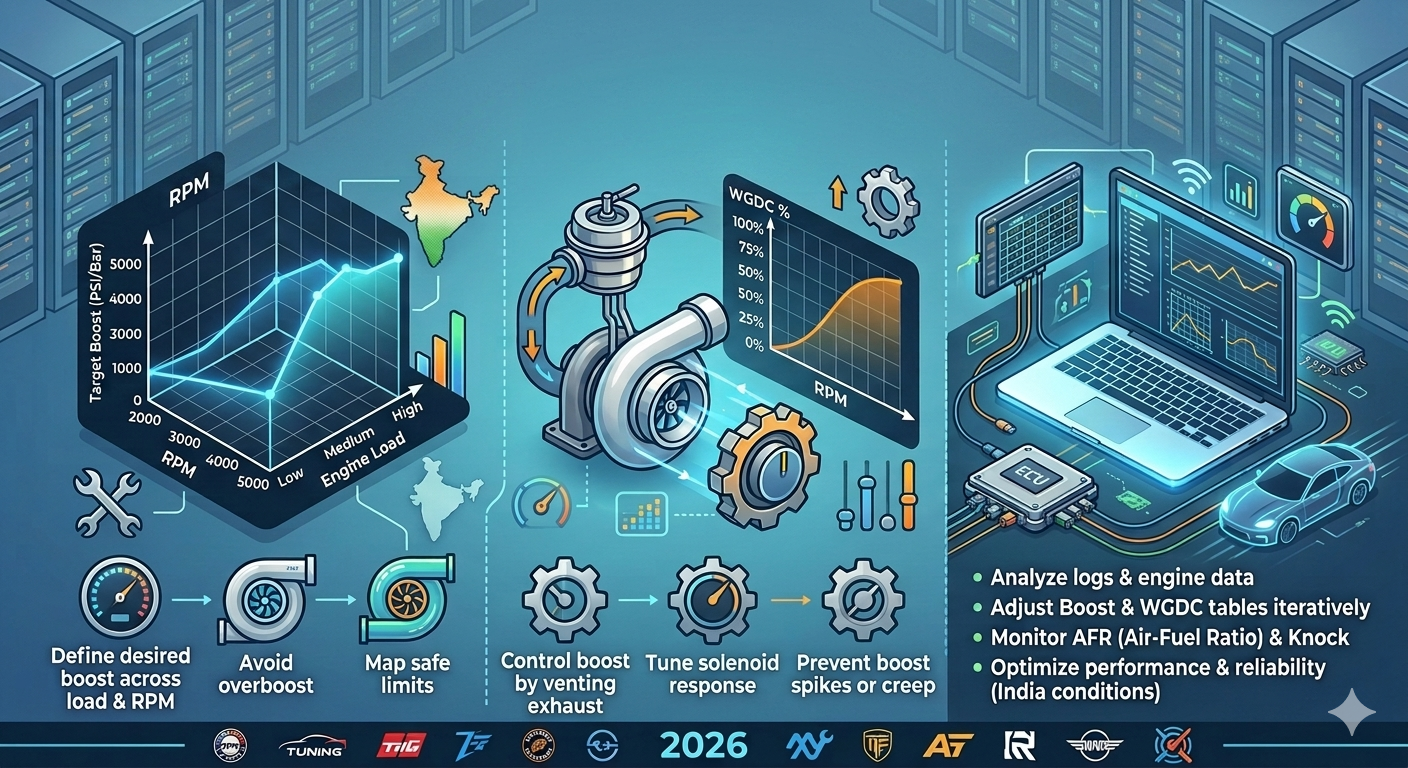
Boost Control (Forced Induction)
For turbocharged and supercharged engines, boost management is critical:
Boost Target Strategies
- Graduated boost curves that build progressively with RPM
- Load-dependent boost limiting for drivability
- Gear-specific boost targets for balanced acceleration
- Temperature-dependent boost mapping for consistency
Wastegate/Bypass Control
- PID controller tuning for boost stability
- Preemptive wastegate positioning for faster response
- Anti-overshoot algorithms to prevent boost spikes
- Integrated control with throttle position for cohesive response
Torque Management Integration
Modern ECUs actively manage torque output for transmission protection and stability:
Traditional Torque Limiting
- Maximum torque ceilings based on gear position
- Timing retard to reduce torque during shifts
- Fuel reduction for transient torque control
- Throttle closure during critical events
Sophisticated Torque Strategies
- Predictive torque reduction before shift events
- Progressive torque restoration after intervention
- Situational torque management based on vehicle dynamics
- Driver-preference adaptation for sporting or comfort bias
Remapping Strategies for Smoother Power
With baseline analysis complete and key parameters identified, several remapping strategies can dramatically improve power delivery:
Linearizing Throttle Response
Creating a more intuitive connection between foot and engine:
Initial Throttle Takeup
- Remove artificial “dead zones” in first 5-10% of pedal travel
- Create precise control for small throttle openings
- Implement subtle progressive curve for enhanced maneuverability
Mid-Range Proportionality
- Establish consistent relationship between pedal position and power
- Remove artificial steps or plateaus in the throttle map
- Create natural “feel” that builds driver confidence
Full-Throttle Transition
- Smooth the transition to wide-open throttle
- Eliminate abrupt power delivery at the end of pedal travel
- Create predictable full-power response
Smoothing Torque Curves
Eliminating irregularities in the torque curve creates more consistent acceleration:
Identifying Torque Dips
- Locate specific RPM ranges with torque depressions
- Analyze fueling and timing parameters at these points
- Determine if emissions constraints are creating limitations
Remediation Approaches
- Adjust ignition timing to fill torque depressions
- Optimize fueling specifically at problem RPM ranges
- Modify cam timing (if variable) to improve mid-range torque
- Revise boost targets to eliminate turbo lag or boost holes
Transition Smoothing
- Focus on areas between power bands in multi-cam or variable valve engines
- Create seamless transitions between operating modes
- Eliminate perceptible steps in power delivery
Enhancing Transient Response
Improving engine behavior during throttle transitions:
Accelerator Pump Effect
- Implement electronic equivalent of carburetor accelerator pumps
- Create momentary enrichment proportional to throttle movement rate
- Tailor enrichment duration to prevent flat spots
Ignition Timing Strategies
- Advance timing momentarily during throttle opening
- Create timing maps specific to acceleration events
- Implement rate-of-change sensitivity in timing algorithms
Anti-Lag Implementation
- Mild anti-lag strategies for street applications
- Maintain turbocharger speed during brief throttle closure
- Create seamless boost restoration after gear changes
Refining Part-Throttle Operation
Enhancing the driving experience during normal, everyday operation:
Cruise Optimization
- Create specific mapping for common highway speeds
- Optimize for smoothness rather than maximum economy
- Eliminate hunting or surging sensations at steady throttle
Light Acceleration Mapping
- Develop precise control for 25-50% throttle operation
- Create natural, progressive power build-up
- Eliminate “on-off” sensation common in drive-by-wire systems
Load Transition Improvement
- Smooth the transition between vacuum and boost
- Eliminate hesitation when accelerating from cruise
- Create predictable response to small throttle adjustments
Implementing Vehicle-Specific Strategies
Tailoring approaches to different engine and vehicle types:
Naturally Aspirated Engines
- Focus on ignition timing optimization across the rev range
- Create volumetric efficiency improvements through mapping
- Implement precise throttle control strategies
- Revise VTEC/VVT/VANOS transition points for smoothness
Turbocharged Applications
- Develop progressive boost build-up curves
- Create seamless transitions between off-boost and on-boost operation
- Implement subtle anti-lag for improved drivability
- Focus on boost stability under varying conditions
Diesel Engines
- Optimize injection timing for smoother torque delivery
- Refine pilot injection quantity and timing
- Create smoother EGR integration
- Implement torque-smoothing strategies during DPF regeneration
Real-World Tuning Process
A methodical approach to remapping for smoother power delivery involves several key phases:
- Comprehensive Baseline Analysis
Before making changes:
- Conduct full power runs on a load-bearing dynamometer
- Create detailed log files of stock operation across various scenarios
- Identify specific areas requiring improvement
- Establish objective metrics for measuring success
- Targeted Parameter Modification
Begin with the most impactful parameters:
- Start with throttle mapping adjustments for immediate drivability improvement
- Address any obvious torque dips or flat spots
- Implement basic transient enrichment enhancements
- Create preliminary boost control revisions (if applicable)
- Incremental Testing and Validation
After initial changes:
- Evaluate subjective feedback from test drives
- Analyze data logs for improved metrics
- Identify any unintended consequences
- Refine the most successful modifications
- Comprehensive Integration
With primary issues addressed:
- Create cohesive integration between throttle, timing, and fueling maps
- Develop synchronized strategies for transient conditions
- Implement conditional mapping for different operating scenarios
- Fine-tune for consistency across varying conditions
- Final Validation and Documentation
Before delivery:
- Conduct extensive testing across various driving conditions
- Create comparative data to demonstrate improvements
- Document all changes for future reference
- Establish maintenance recommendations for sustained performance
Conclusion
ECU remapping for smoother power delivery goes far beyond chasing peak performance figures—it’s about refining how power feels, responds, and integrates into the driving experience. By focusing on throttle linearity, torque curve consistency, transient response, and part-throttle behavior, tuners can transform a vehicle’s character into something far more intuitive, controlled, and enjoyable. Whether the goal is daily drivability, confidence-inspiring handling, or optimized responsiveness, a thoughtful, data-driven remap can unlock a level of refinement that factory calibrations often leave untapped. In the hands of a skilled tuner, smoother power delivery isn’t just possible—it’s one of the most rewarding upgrades a driver can experience.
📺 Watch a real battery testing demo here: Reynlab YouTube Channel
🌐 Explore our automotive training programs: www.reynlab.com/our-courses