Turbocharger Tables: Easy and Essential Guide for Boost Pressure Tuning
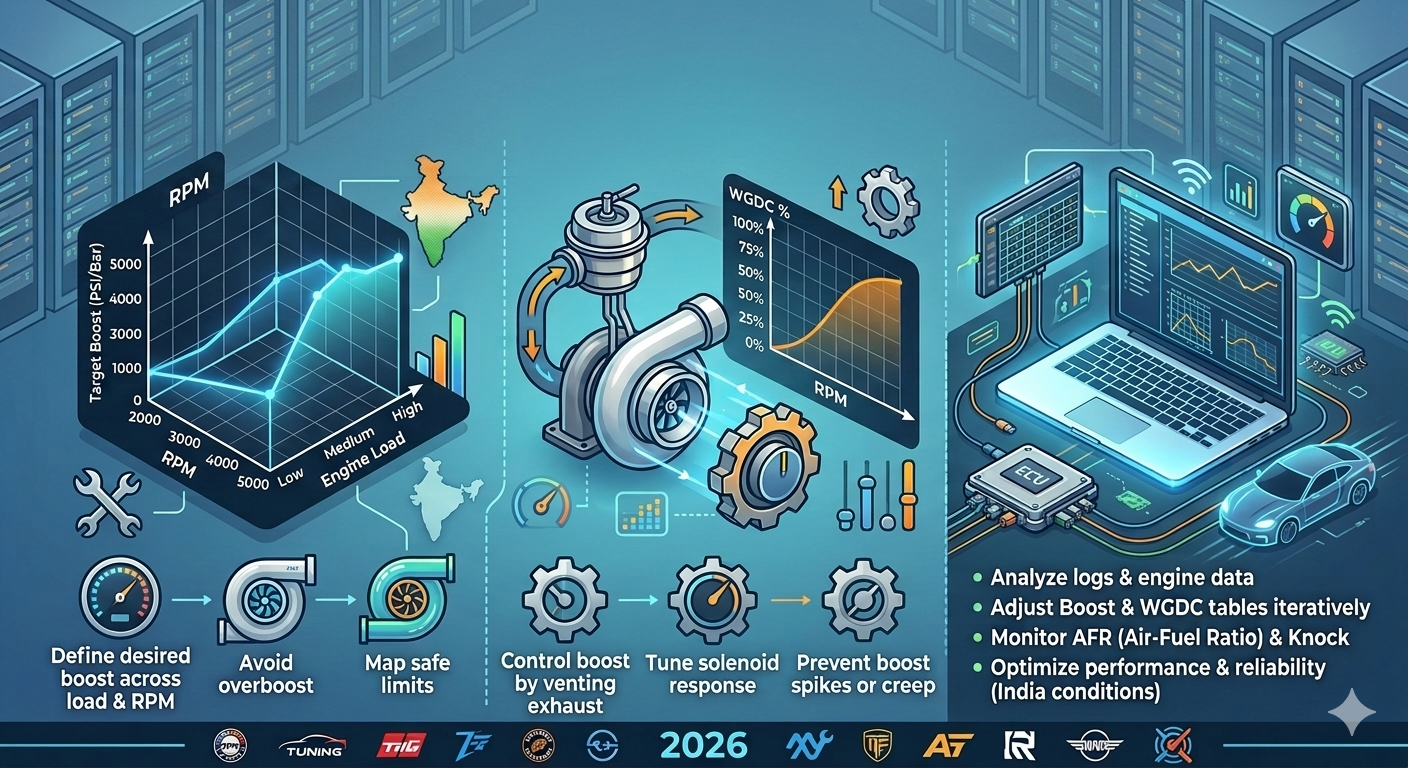
Turbocharged engines are at the heart of modern performance vehicles. From small hatchbacks to high-performance luxury cars, turbocharging lets engines produce more power with better efficiency.
The real control of a turbo system lies inside the ECU, in the Turbocharger Tables (Boost Control Maps). This guide explains how turbochargers work, what turbo tables are and how they are used in ECU tuning.
What is a turbocharger?
A turbocharger is a mechanical device that increases the amount of air entering the engine. Its purpose is to increase engine power, improve efficiency and reduce fuel consumption. More air plus more fuel means more power.
How does a turbocharger work?
A turbocharger has two main components.
1. Turbine
The turbine is driven by exhaust gases and converts exhaust energy into motion.
2. Compressor
The compressor compresses incoming air and forces more of it into the engine.
The working process runs as follows:
- The engine produces exhaust gases.
- The exhaust spins the turbine.
- The turbine rotates the compressor.
- The compressor pushes air into the engine.
- More air allows more fuel, which gives more power.
The turbine and compressor are connected by a shaft.
What is an intercooler?
Turbocharged air becomes hot. The intercooler cools the compressed air, improves efficiency and prevents engine knock, which makes it essential for turbo engines.
What is a wastegate?
The wastegate controls turbo pressure. It regulates boost pressure and prevents overboost, and it is controlled by the ECU.
Advantages of turbochargers
- Increased power: small engines produce high output.
- Better fuel efficiency: less throttle is needed.
- Reduced emissions: combustion is more efficient.
- Energy efficiency: the turbo uses exhaust gases.
This is why turbochargers are widely used in modern cars.
Disadvantages of turbochargers
- Turbo lag: there is a delay before boost arrives.
- Heat generation: operating temperatures are high.
- Limited boost range: boost is available only at certain RPM.
These are important tuning considerations.
What are turbocharger tables?
Turbocharger tables are ECU maps that control boost pressure, turbo behaviour and wastegate operation. They ensure safe operation and optimal performance.
Main turbo tables in the ECU
1. Turbo pressure table (boost map)
- Function: defines the desired boost pressure.
- Axes: RPM (X-axis) and load (Y-axis).
- Units: hPa.
- Purpose: controls the boost level.
This is the core turbo tuning table.
2. Turbo pressure limiter table
This table sets the maximum allowed boost and prevents engine damage. It works as a safety mechanism.
3. Wastegate duty cycle table
This table controls wastegate opening and closing. A high duty cycle gives more boost and a low duty cycle gives less boost. It is the key turbo control map.
How wastegate duty cycle works
- Low RPM: high duty gives faster spool.
- High RPM: lower duty gives stable boost.
How turbo tables work together
- The ECU reads RPM and load.
- It refers to the boost table.
- It checks the limiter.
- It adjusts the wastegate.
- It controls boost.
Turbo tables in ECU tuning
Editing turbo tables lets a tuner increase boost pressure, improve turbo response, reduce turbo lag and enhance power output.
Risks of improper turbo tuning
- Overboost, which can damage the engine
- Turbo failure
- High temperature
Software used for turbo tuning
- WinOLS
- ECM Titanium
- Swiftec
Turbocharged cars in India
- Hyundai Turbo
- Volkswagen / Skoda TSI
- BMW / Audi
Turbo tuning in India
Common work includes Stage 1 tuning, Stage 2 upgrades and performance builds. The challenges are fuel quality, high temperatures and BS6 restrictions.
Turbo tuning cost in India
Turbo tuning costs ₹8,000 – ₹50,000+.
Who should learn turbo tables?
- ECU tuners
- Automotive engineers
- Performance enthusiasts
Important tips before turbo tuning
- Monitor AFR.
- Check boost limits.
- Use proper cooling.
- Tune gradually.
Summary
Turbocharger tables are the backbone of turbo engine tuning. They control boost pressure, manage turbo behaviour and keep the engine safe. Understanding them matters for anyone involved in ECU tuning.
For Indian tuners, the best approach is to learn turbo fundamentals, use proper tools and tune responsibly.
Watch our workshop videos on the Reynlab YouTube Channel, or explore our automotive training programs at www.reynlab.com/our-courses.
For blog on Ecu tuning & remap
For course on Ecu tuning & remap
MAF Sensor Removal: Easy and Essential MAF Delete in India
ECU Cloning Explained: Easy and Essential Guide for Technicians in India
TVA Removal Explained: Easy and Essential Valve Fix in India