Tuning ECU for Different Altitude and Climate Conditions
In the world of automotive performance, enthusiasts often focus on extracting maximum power and efficiency from their engines through ECU tuning. However, one critical aspect that deserves more attention is how environmental conditions—specifically altitude and climate—affect engine performance and how proper ECU tuning can compensate for these variables. This article delves into the science behind these environmental effects and explores the nuanced approaches to optimizing your vehicle’s performance across diverse geographical and meteorological conditions.
The Science of Atmospheric Effects on Engine Performance
Altitude Effects
As vehicles climb in elevation, they encounter progressively thinner air. This decrease in air density has several significant impacts on engine performance:
Reduced Oxygen Content At sea level, the atmospheric pressure is approximately 14.7 psi (101.3 kPa). For every 1,000 feet (305 meters) of elevation gain, this pressure drops by about 4%. At 5,000 feet (1,524 meters), the air pressure is already roughly 17% lower than at sea level. Since internal combustion engines require oxygen for combustion, this reduction directly impacts power output.
Performance Degradation Naturally aspirated engines typically lose about 3% of their power output for every 1,000 feet of elevation gain. This means that at Denver’s altitude (5,280 feet), an engine could produce nearly 16% less power than at sea level—turning your 300 horsepower engine into something closer to 252 horsepower without compensation.
Altered Air-Fuel Ratio With less oxygen available but the same fuel delivery, engines naturally run richer at higher altitudes. While modern factory ECUs attempt to compensate for this, their adaptations often prioritize emissions compliance over optimized performance.
Climate and Temperature Effects
Temperature variations also substantially impact engine performance through several mechanisms:
Air Density Fluctuations Cold air is denser than warm air. At 32°F (0°C), air is approximately 10% denser than at 86°F (30°C). This density difference directly affects the mass of oxygen available for combustion.
Fuel Dynamics Fuel evaporates differently at varying temperatures. Cold temperatures can lead to poor fuel atomization, while very hot conditions may cause vapor lock or other fuel delivery issues.
Combustion Efficiency Temperature affects the combustion process itself. Cold engines typically experience less efficient combustion, while extremely high temperatures can increase the risk of detonation or pre-ignition.
Humidity Impact Water vapor in the air displaces oxygen molecules. On a humid day (80% relative humidity), the oxygen content can be 2-3% lower than on a dry day, affecting combustion and power output.
Stock ECU Adaptation Limitations
Modern factory ECUs do incorporate some adaptability to environmental conditions, but these adaptations have significant limitations:
Limited Adaptation Range
Most factory ECUs are programmed with adaptation capabilities that work well within a “normal” range of conditions but struggle at extremes. For instance, a vehicle designed primarily for sea-level operation might have limited compensation capabilities above 7,000 feet of elevation.
Conservative Calibration
Manufacturers must balance performance with reliability, emissions compliance, and fuel economy across a wide range of driving conditions. This necessity leads to conservative base calibrations that leave performance on the table, especially in challenging environments.
Slow Response Times
Stock adaptation algorithms often react relatively slowly to changing conditions, particularly during rapid altitude changes or quick weather shifts. This lag can result in periods of sub-optimal performance.
One-Size-Fits-All Approach
Factory tunes rarely account for regional differences in fuel quality, which can compound environmental challenges. The same gasoline grade can vary significantly in composition and quality between different regions and seasons.
ECU Tuning Strategies for Altitude Compensation
Naturally Aspirated Engines
For non-forced induction engines, altitude compensation tuning focuses on:
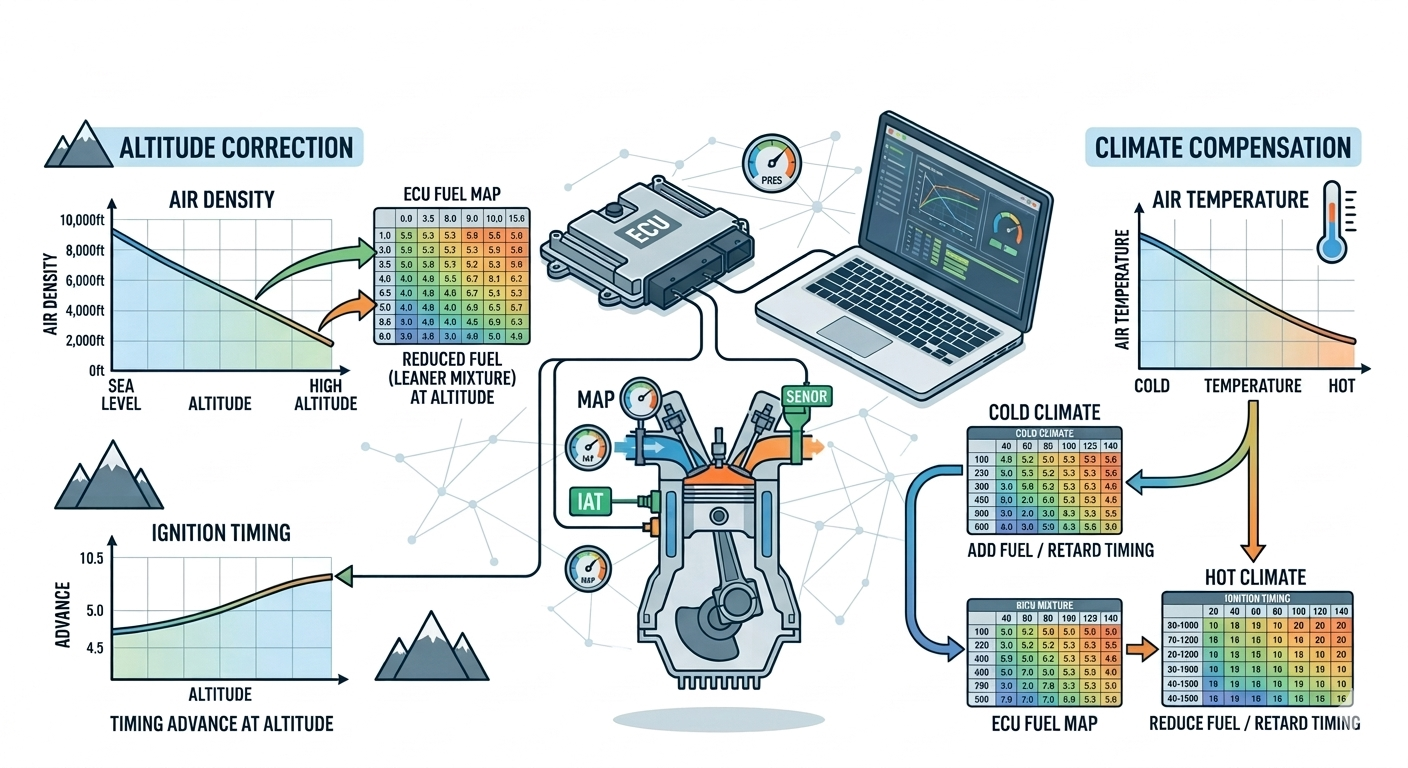
Optimized Air-Fuel Ratios At higher elevations, leaner air-fuel ratios (within safe limits) can help compensate for reduced oxygen availability. A custom tune might target an AFR of 13.2:1 at high altitude versus 12.8:1 at sea level under full load.
Ignition Timing Adjustments With less oxygen and altered combustion characteristics, ignition timing can be advanced more aggressively at altitude without risking detonation. A properly tuned ECU might add 2-4 degrees of timing at 5,000+ feet compared to sea level settings.
Altered VVT/VCT Operation For engines with variable valve timing or cam timing systems, modified actuation maps can optimize intake and exhaust flow characteristics for reduced atmospheric pressure.
Revised Torque Management Adjusting throttle mapping to provide more aggressive throttle opening at altitude can help compensate for power loss and improve drivability.
Turbocharged Engines
Forced induction provides unique opportunities for altitude compensation:
Boost Pressure Scaling One of the most effective strategies involves increasing boost pressure at higher altitudes. For example, a tune might target 15 psi of boost at sea level but increase to 17-18 psi at 5,000 feet to maintain consistent performance.
Wastegate Control Optimization Refined wastegate duty cycle maps can ensure the turbocharger spools appropriately for the ambient conditions, maintaining optimal boost onset and control.
Charge Temperature Management As turbochargers work harder at altitude, they generate more heat. Advanced tunes can implement more aggressive intercooler fan control strategies and enriched fuel mixtures to manage intake temperatures.
Compressor Efficiency Targeting Tuning for altitude often means operating turbochargers in different regions of their compressor maps. Optimized tunes will ensure the turbocharger operates in its most efficient range despite changing ambient conditions.
Direct Injection Engines
Modern direct injection systems offer additional tuning parameters for altitude compensation:
Injection Timing Refinement The optimal moment to inject fuel changes with altitude. At higher elevations, earlier injection timing can improve fuel atomization and mixture formation.
Multiple Injection Strategies Implementing more sophisticated multi-pulse injection strategies can improve combustion efficiency in thin air conditions.
Rail Pressure Adaptation Increasing fuel rail pressure at altitude can compensate for reduced air density and maintain proper atomization.
Climate-Specific Tuning Approaches
Cold Weather Optimization
Cold Start Enrichment Custom tunes can provide more aggressive cold start fueling curves optimized for specific regional winter conditions, improving drivability and reducing warm-up time.
Ignition Refinement Cold air allows for more aggressive timing advance. Winter-specific tunes might incorporate 1-3 degrees more timing advance during normal operation than summer tunes.
Idle Control Strategies Enhanced idle control parameters can maintain stable operation in extreme cold, preventing stalling and improving warmup characteristics.
Throttle Response Mapping Modified throttle sensitivity maps can compensate for the sluggish throttle response common in very cold conditions.
Hot Weather Calibration
Heat Protection Strategies Summer-specific tunes can incorporate more aggressive fan control, richer air-fuel ratios under load, and temperature-based timing retard to protect against heat-related detonation.
Intake Temperature Compensation Advanced intake temperature compensation tables can provide better real-time adjustments to timing and fueling based on incoming air temperature.
Reduced Overlap Timing In hot conditions, reducing valve overlap can help maintain cylinder pressure and combat the effects of less dense air.
Humidity Compensation Sophisticated tunes can incorporate humidity sensors or regional humidity patterns to further refine air-fuel ratios based on moisture content.
Advanced Altitude and Climate Adaptation Techniques
Barometric Pressure-Based Maps
The most sophisticated approach to altitude tuning involves creating multiple calibration maps based on barometric pressure ranges:
Multi-Map Switching Rather than trying to stretch a single calibration across all conditions, advanced tunes can implement discrete maps for different pressure ranges (e.g., sea level, 2,000-4,000 feet, 4,000-7,000 feet, 7,000+ feet).
Dynamic Parameter Scaling Each parameter in the tune (timing, fueling, boost, etc.) can have its own scaling factor based on the barometric pressure reading, allowing for precise adaptation.
Transition Smoothing Sophisticated tunes incorporate “blending zones” between different map regions to ensure smooth transitions as altitude changes.
Location-Based Tuning
For vehicles that regularly traverse significant elevation changes:
GPS Integration Some advanced aftermarket ECUs can use GPS data to determine altitude and automatically apply the appropriate calibration adjustments.
Predictive Algorithms By analyzing routes and historical data, smart tunes can anticipate altitude changes and begin adaptation before the barometric sensor even detects the change.
Learning Algorithms Machine learning approaches can help the ECU understand specific vehicle behavior across different conditions and refine its compensation strategies over time.
Seasonal Tune Switching
For regions with dramatic seasonal temperature variations:
Switchable Maps Creating summer and winter maps that can be selected by the driver or shop based on seasonal conditions.
Temperature-Triggered Adaptation Programming automatic calibration switching based on ambient temperature patterns over multiple drive cycles.
Fuel Quality Compensation Incorporating adjustments for seasonal fuel formulation changes that occur in many regions.
Implementation Methodology
Data Acquisition and Analysis
Effective altitude and climate tuning begins with comprehensive data collection:
Environmental Condition Logging Recording barometric pressure, ambient temperature, humidity, and altitude alongside traditional engine parameters during testing.
Performance Comparison Testing Conducting standardized performance tests (acceleration runs, dyno pulls) at different altitudes and temperatures to establish baseline effects.
Drivability Evaluation Systematically evaluating throttle response, idle quality, and cold start behavior across varied conditions.
Virtual Dyno Techniques
For those without access to testing facilities at various altitudes:
Pressure Chamber Testing Some advanced development facilities can simulate altitude conditions in controlled environments.
Mathematical Modeling Using computational fluid dynamics and thermodynamic models to predict performance at different conditions.
Correction Factor Validation Verifying the accuracy of standard correction factors (e.g., SAE J1349) for specific engine configurations and conditions.
Field Testing Requirements
The most reliable approach combines controlled testing with real-world validation:
Mountain Road Testing Conducting back-to-back runs on the same mountain roads at different altitudes to validate adaptation strategies.
Seasonal Verification Returning to test the same vehicle in both summer and winter conditions to confirm calibration effectiveness.
Extreme Condition Seeking Deliberately seeking out temperature extremes and elevation changes to stress-test the calibration’s adaptation capabilities.
Case Studies: Real-World Applications
High-Altitude Performance Vehicles
Pikes Peak Race Cars Vehicles competing in the famous Pikes Peak International Hill Climb face perhaps the most extreme altitude challenge in motorsports, starting at 9,390 feet and finishing at 14,115 feet. Successful competitors utilize:
- Extremely aggressive boost control strategies that increase pressure continuously throughout the climb
- Oxygen sensor compensation maps that account for the decreasing accuracy of narrowband sensors at extreme altitude
- Fuel pressure ramping strategies that increase rail pressure with altitude
- Special attention to coolant and oil temperature management as air density decreases
Denver-Based Daily Drivers Enthusiasts living in the Mile High City often report 40-50 wheel horsepower gains from proper altitude-specific tuning compared to generic tunes developed at sea level. Effective Denver tunes typically include:
- Base calibrations developed at actual altitude rather than simply “correcting” sea-level tunes
- Specific idle and cold-start strategies for the combination of altitude and cold winter temperatures
- Compensation for the unique fuel formulations required in Colorado’s high-altitude regions
Climate Extremes
Arctic Region Vehicles In places like Alaska, northern Canada, and Scandinavia, vehicles must contend with temperatures that can reach -40°F or lower. Specialized tunes for these regions often feature:
- Extended cranking fuel pulses that can be up to 40% longer than standard cold-start sequences
- Accelerated throttle warmup maps that compensate for increased mechanical resistance in extreme cold
- Idle speed increases of 150-300 RPM over standard specifications
- Aggressive alternator load compensation to handle the increased electrical demands
- Battery voltage-based adaptation strategies that adjust timing and fueling as electrical systems struggle in extreme cold
Desert Performance Vehicles operating in extremely hot environments like Arizona, Nevada, or the Middle East require specialized calibration approaches:
- Fuel enrichment strategies that activate at higher coolant and intake air temperatures
- More conservative ignition timing maps that pull timing more aggressively as temperatures rise
- Modified cooling fan control that activates at lower temperatures and runs longer after key-off
- Oil temperature-based power limiting to protect engine internals
- Special attention to preventing vapor lock through fuel pressure management
Tropical and High-Humidity Environments
Vehicles operating in tropical regions like Florida, Thailand, or Brazil face unique challenges from the combination of heat and extreme humidity:
Moisture Management
- Modified cold start strategies that account for higher baseline humidity in the intake tract
- Adjusted air mass calculations that compensate for the oxygen displacement caused by water vapor
- Special attention to sensor calibration as some sensors (particularly MAF sensors) can be affected by moisture
Anti-Condensation Strategies
- Altered warm-up parameters that minimize condensation formation within the intake and exhaust
- Extended post-drive fan operation to reduce moisture accumulation
- Crankcase ventilation adaptations to prevent oil contamination from increased water vapor
Practical Implementation for Enthusiasts
Options for Enthusiast-Level Implementation
Flash Tuning Solutions For most modern vehicles, flash tuning provides the most accessible way to implement altitude and climate-specific calibrations:
- Off-the-shelf maps are available for many popular platforms, often with region-specific options
- Custom remote tuning allows collaboration with experienced tuners familiar with your specific region
- Self-tuning with consumer-level software is increasingly viable with proper education and caution
Piggyback Controllers For older vehicles or those with limited direct ECU access:
- Piggyback devices can apply offset corrections based on altitude and temperature sensors
- More sophisticated units offer barometric pressure-based compensation maps
- Some modern units incorporate GPS data for location-based adjustments
Complete Engine Management Systems For competition vehicles or extreme builds:
- Standalone ECUs offer the most comprehensive environmental adaptation capabilities
- Advanced systems allow for automatic map switching based on conditions
- Data logging integration enables continuous refinement of environmental adaptation strategies
DIY vs. Professional Tuning Considerations
When to Choose DIY:
- Your vehicle operates in conditions close to what factory calibrations expect
- You have access to proper scanning and logging tools
- You understand the fundamentals of how altitude and climate affect combustion
- You’re making incremental changes rather than comprehensive recalibrations
When to Seek Professional Help:
- Your vehicle operates in extreme environments (very high altitude, extreme temperatures)
- You’ve installed significant modifications that compound environmental effects
- You lack access to testing facilities or data interpretation skills
- You need optimizations across multiple types of environments
Data Logging Best Practices
Effective environmental tuning requires comprehensive data collection:
Essential Parameters to Log:
- Barometric pressure
- Intake air temperature
- Ambient temperature
- Humidity (if sensors available)
- Altitude (via GPS)
- Air-fuel ratios
- Ignition timing
- Knock sensor activity
- Boost pressure (for forced induction)
Testing Protocol:
- Establish baseline runs in multiple conditions
- Use standardized testing routes or procedures
- Allow sufficient adaptation time when changing conditions
- Document subjective driveability alongside data metrics
- Verify results across multiple testing sessions
Looking Forward: Advanced Environmental Adaptation
Connected Vehicle Possibilities
As vehicles become increasingly connected, new approaches to environmental adaptation become possible:
Cloud-Based Tuning Updates Future systems might download location-specific tune adjustments automatically based on where the vehicle is operating or forecasted to operate.
Predictive Adaptation By combining weather forecasts, route information, and historical performance data, next-generation ECUs could predictively adapt to changing conditions.
Fleet Learning Anonymized data from vehicles operating in similar conditions could inform better adaptation strategies through collective intelligence approaches.
Emerging Sensor Technologies
New sensor technologies promise to improve environmental adaptability:
Direct Air Mass Measurement Advanced sensors that directly measure air molecule count rather than inferring it from pressure, providing more accurate data regardless of altitude or temperature.
Multi-Parameter Environmental Sensors Combined sensors that simultaneously measure temperature, pressure, humidity, and air quality for more holistic adaptation.
Virtual Sensors Using existing sensor data and advanced algorithms to “virtually” sense parameters that aren’t directly measured, allowing more sophisticated adaptation without additional hardware.
Conclusion: The Competitive Advantage of Environmental Adaptation
While many enthusiasts focus exclusively on extracting maximum sea-level horsepower, those who understand and implement proper altitude and climate-specific tuning gain a significant competitive advantage—whether on the track, the trail, or in daily driving.
A well-executed environmental tuning strategy offers:
- Consistent performance regardless of conditions
- Enhanced reliability through appropriate adjustments that protect engine components
- Improved drivability across diverse operating environments
- Better fuel economy from optimized combustion in challenging conditions
- Reduced emissions through more precise control of the combustion process
In a world where vehicles increasingly operate across diverse geographies and climate conditions, environmental adaptability in ECU tuning is no longer a luxury—it’s a necessity for true performance optimization. Whether you’re conquering mountain passes, enduring arctic winters, or battling desert heat, proper ECU adaptation ensures your vehicle performs at its best regardless of what Mother Nature throws at it.
📺 Watch a real battery testing demo here: Reynlab YouTube Channel
🌐 Explore our automotive training programs: www.reynlab.com/our-courses