Complete Guide to ECU Fuel Maps and Their Modification
Introduction
The modern automobile is a complex mix of mechanical and electronic components working together. At the heart of the electronics is the Engine Control Unit (ECU), a sophisticated computer that manages various aspects of engine performance. Among the ECU's most important functions is fuel management, which is primarily controlled through what tuners call "fuel maps". These digital blueprints determine how much fuel is delivered to your engine under various operating conditions.
For performance enthusiasts and professional tuners alike, understanding and modifying these fuel maps is one of the most effective ways to unlock hidden potential in virtually any vehicle. If you want to increase power, improve fuel economy, or fix drivability issues, ECU fuel map modification, commonly known as "remapping" or "tuning", lets you tailor your vehicle's performance to your specific needs.
This post explains what ECU fuel maps are, how they function, and the methods and considerations involved in modifying them for improved performance.
What Exactly Are ECU Fuel Maps?
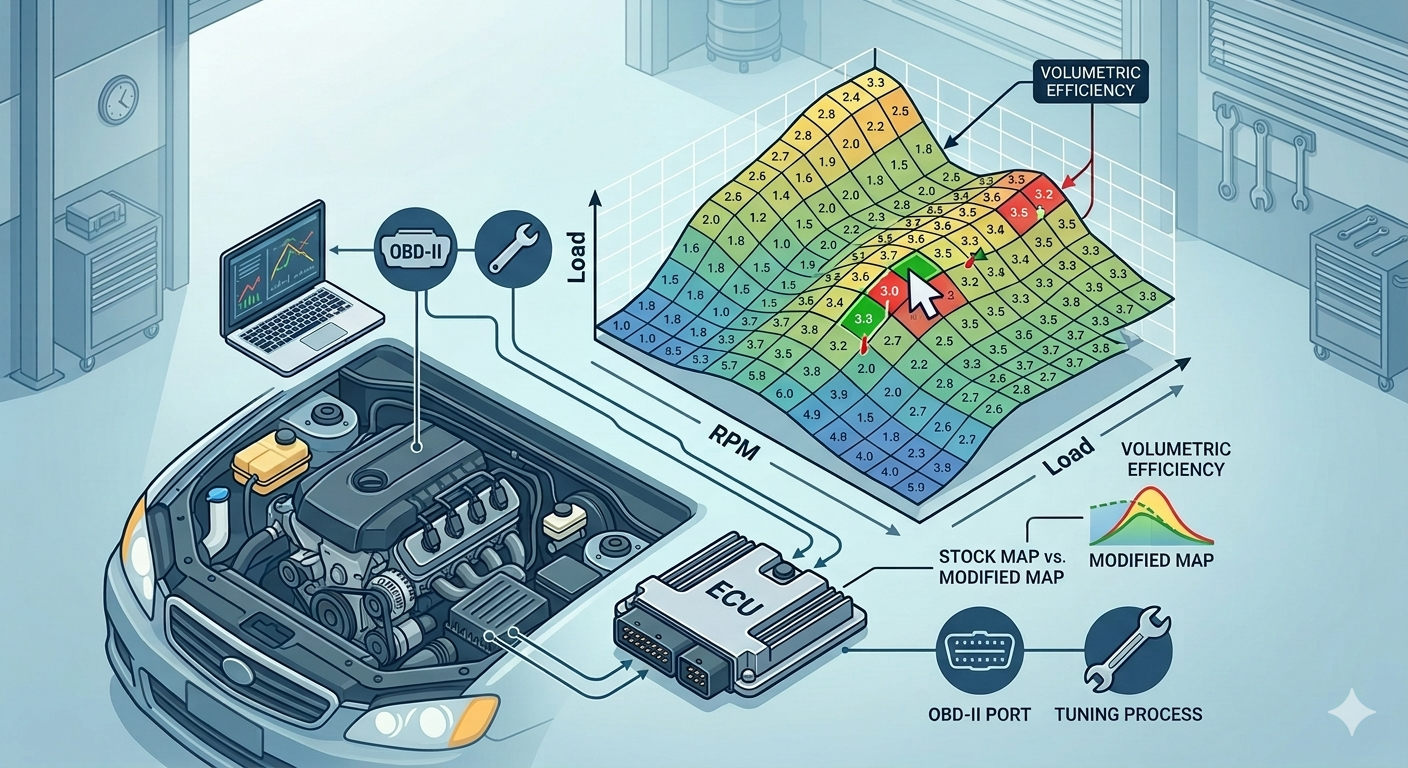
In simplest terms, a fuel map is a three-dimensional data table stored in the ECU that tells the engine how much fuel to inject under different operating conditions. Think of it as a detailed instruction manual that the ECU consults thousands of times per minute to make fueling decisions.
These maps are typically represented as three-dimensional tables where:
- The X-axis usually represents engine RPM (revolutions per minute)
- The Y-axis typically represents engine load (often measured by manifold absolute pressure or throttle position)
- The Z-axis (the values within the table) indicates the fuel injection quantity or duration
Modern ECUs contain dozens of maps controlling various aspects of engine operation, but the primary fuel map is among the most important for performance tuning. This map essentially tells the injectors how long to stay open (pulse width) under specific combinations of engine speed and load.
How Fuel Maps Control Engine Performance
When you press the accelerator pedal, several events occur in rapid succession:
- The throttle body opens wider, allowing more air into the engine
- The ECU detects changes in airflow and engine load
- The ECU consults its fuel map to determine the appropriate fuel quantity
- Fuel injectors receive signals to inject the prescribed amount of fuel
- The air-fuel mixture is compressed and ignited, producing power
This process happens continuously as you drive, with the ECU constantly referencing various maps and making adjustments. The base fuel map provides the foundation for fueling decisions, while other compensatory maps make adjustments for factors like:
- Engine temperature
- Intake air temperature
- Atmospheric pressure
- Battery voltage
- Engine timing
The precision of these maps directly impacts engine performance, fuel economy, emissions, and reliability. Factory fuel maps are developed by manufacturers to balance these considerations while accommodating variations in fuel quality, environmental conditions, and aging components.
Why Modify Fuel Maps?
Factory ECU programming typically incorporates significant safety margins and compromises to accommodate:
- Regional differences in fuel quality
- Extreme weather conditions
- Emissions regulations across different markets
- Manufacturing tolerances in engine components
- Long-term reliability goals
- Cost considerations
These conservative settings often leave substantial performance potential unrealized. By modifying fuel maps, tuners can recalibrate the engine management system to:
- Increase power output by optimizing air-fuel ratios for maximum power rather than economy
- Improve throttle response by adjusting fuel delivery timing and quantity for more immediate power delivery
- Enhance fuel economy by fine-tuning fueling for efficiency in common driving conditions
- Accommodate modifications by recalibrating fuel delivery to match aftermarket components like larger injectors, high-flow intakes, or exhaust systems
- Remove performance limitations by eliminating artificial power restrictions sometimes incorporated by manufacturers
Methods of Fuel Map Modification
There are several approaches to modifying ECU fuel maps, each with different levels of complexity, precision, and risk.
Plug-and-Play Tuning Devices
Products like "chip tuners" or "power programmers" offer the simplest entry point to ECU modification. These devices typically connect to the vehicle's OBD-II port and overwrite factory maps with pre-programmed alternatives. While convenient, these one-size-fits-all solutions rarely deliver optimal results for heavily modified vehicles.
On the plus side, they are easy to install and use, relatively inexpensive, and often reversible. On the downside, they offer limited customization, may be unsuitable for modified engines, and take a generic tuning approach.
Flash Tuning
This more sophisticated approach involves reading the ECU's current programming, modifying specific maps using specialized software, and then "flashing" (uploading) the modified program back to the ECU. Flash tuning allows for targeted adjustments to specific parameters while leaving others unchanged.
It offers greater customization than plug-and-play devices, can be tailored to specific modifications, and is relatively accessible to enthusiasts. However, it requires specialized hardware and software, some expertise, and there is potential for errors.
Professional Dyno Tuning
The gold standard of fuel map modification involves real-time adjustments made while the vehicle runs on a dynamometer (dyno). This approach allows tuners to monitor engine performance across the entire RPM range and make precise adjustments for optimal results.
It gives maximum precision, is tailored to your specific vehicle, can account for all modifications, and provides real-time performance feedback. It is also expensive, requires professional equipment and expertise, and is time-consuming.
Standalone Engine Management Systems
For heavily modified vehicles, replacing the factory ECU with an aftermarket standalone system offers unlimited customization potential. These systems feature fully customizable maps and additional inputs for sensors that may not be supported by factory ECUs.
They give complete control over all engine parameters, support extensive modifications, and add advanced features like launch control or anti-lag. They are also the most expensive option, with complex installation and setup, and may require professional tuning.
The Science of Fuel Map Optimization
Effective fuel map modification is not just about adding more fuel; it is about precision. Modern engine tuning is a scientific process that balances several factors.
Air-Fuel Ratios (AFR)
The relationship between air and fuel in the combustion mixture matters a great deal:
- Stoichiometric ratio (14.7:1 for gasoline): The theoretically perfect ratio for complete combustion
- Rich mixture (below 14.7:1): More fuel relative to air, typically used for maximum power
- Lean mixture (above 14.7:1): Less fuel relative to air, used for improved economy
Different driving conditions call for different AFRs:
- Idle: Slightly rich (13.5-14.2:1) for stability
- Cruise: Lean (14.8-15.5:1) for efficiency
- Full throttle: Rich (11.5-13.0:1) for maximum power
- Acceleration: Temporarily enriched for responsiveness
Professional tuners target specific AFRs across the entire operating range to balance power, efficiency, and reliability.
Ignition Timing Coordination
Fuel map changes must be coordinated with ignition timing adjustments. Advanced timing can improve efficiency and power but may cause detonation (knock) if fuel quality is insufficient or if the air-fuel mixture is too lean. Modern tuning typically addresses both fuel and timing maps simultaneously.
Knock Detection and Prevention
Engine knock (detonation) occurs when the air-fuel mixture ignites prematurely or spontaneously due to excessive heat or pressure. This damaging condition must be avoided through careful map calibration and by using the ECU's knock detection system.
Risks and Considerations
Fuel map modification is not without risks. Before proceeding with any ECU modifications, consider the following.
Reliability Impacts
Aggressive tuning that prioritizes maximum power can reduce engine longevity. Heat generation, increased mechanical stress, and higher cylinder pressures can accelerate wear on engine components. A responsible tune balances performance gains with reliability considerations.
Emissions Compliance
In many jurisdictions, ECU modifications that affect emissions systems are illegal for street-driven vehicles. Professional tuners can often create maps that maintain emissions compliance while improving performance, but extreme modifications may render a vehicle unsuitable for public roads.
Warranty Implications
Most manufacturers will void powertrain warranties if they detect ECU modifications. Some tuning methods leave detectable traces even after reverting to stock programming. Consider warranty status before modifying any newer vehicle.
Fuel Quality Requirements
Modified fuel maps often assume premium fuel usage. Using lower-octane fuels in an engine tuned for premium can result in knock, reduced performance, and potential engine damage.
Best Practices for Fuel Map Modification
If you are considering fuel map modifications, these best practices help ensure successful outcomes:
- Research thoroughly: Understand the specific characteristics of your engine platform and common tuning approaches
- Start conservatively: Begin with modest adjustments and gradually refine as you gather data
- Use proper monitoring: Install wide-band oxygen sensors and gauges to monitor AFRs and other critical parameters
- Choose qualified professionals: Work with experienced tuners who specialize in your specific vehicle platform
- Prioritize appropriately: Decide whether maximum power, drivability, fuel economy, or reliability is your primary goal
- Address supporting modifications: Ensure adequate fuel delivery, cooling, and intake capacity before seeking significant power increases
- Document everything: Keep detailed records of changes and results to guide future modifications
Summary
ECU fuel map modification is a powerful way to customize vehicle performance. By understanding the fundamental principles behind fuel delivery management and approaching modifications methodically, enthusiasts can unlock significant improvements in power, efficiency, and drivability.
Whether you choose a simple plug-and-play solution or invest in professional dyno tuning, knowledge is your most valuable tool. As automotive technology continues to advance, the art and science of ECU tuning grows more sophisticated, yet the fundamental goal remains the same: to make the best use of every drop of fuel.
Responsible tuning respects the engineering limits of your engine while removing unnecessary constraints. When done correctly, fuel map optimization changes not only how your car performs but how it feels to drive, creating a more responsive, efficient, and enjoyable connection between driver and machine.
Watch our workshop videos on the Reynlab YouTube Channel. Explore our automotive training programs at www.reynlab.com/our-courses.