Introduction
Engine braking is one of those aspects of vehicle performance that often flies under the radar in discussions about automotive tuning. While enthusiasts typically focus on horsepower gains, torque improvements, and fuel efficiency, the ability of your vehicle to effectively slow down using engine resistance can significantly impact both driving experience and safety. ECU (Engine Control Unit) remapping presents a sophisticated way to enhance this often-overlooked performance characteristic.
Engine braking occurs when you release the accelerator pedal and allow the engine’s natural compression resistance to slow the vehicle. This process reduces wear on your brake pads, enhances control during descent, and can improve overall driving dynamics. However, most factory ECU settings prioritize comfort and emissions compliance over optimized engine braking performance.
In this comprehensive guide, we’ll explore how ECU remapping can transform your vehicle’s engine braking capabilities, the technical aspects involved, and the real-world benefits you can expect from this modification.
Understanding Engine Braking
The Mechanics Behind Engine Braking
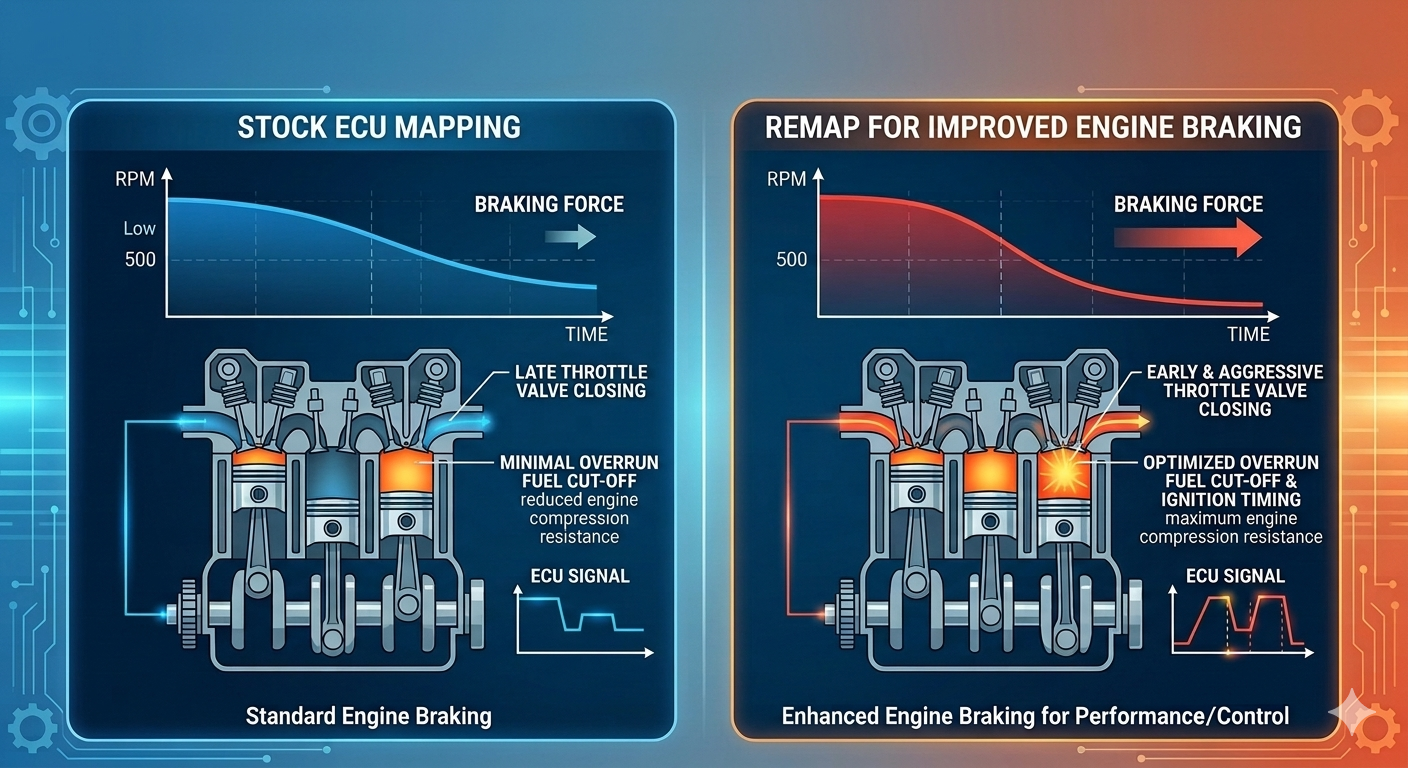
Before diving into ECU modifications, it’s essential to understand what’s happening during engine braking. When you lift off the throttle, several processes occur simultaneously:
- Fuel Cut-Off: Modern ECUs typically reduce or completely cut fuel delivery to the cylinders during deceleration.
- Intake Restriction: The throttle plate remains partially closed, creating vacuum as the pistons try to draw in air.
- Compression Resistance: The engine must work against compressing air in the cylinders without the energy return from combustion.
- Drivetrain Drag: The rotational mass of the engine components resists deceleration.
These combined factors create the engine braking effect that helps slow the vehicle without applying the brakes.
Factory Limitations
Stock ECU configurations generally implement conservative engine braking profiles for several reasons:
- Comfort Priority: Manufacturers aim to provide smooth deceleration rather than aggressive engine braking.
- Emissions Compliance: Certain engine braking characteristics can affect emissions during deceleration.
- Component Protection: Factory settings often protect the engine and transmission from excessive strain.
- Universal Application: Default maps must work acceptably across various driving conditions and driver preferences.
These limitations create an opportunity for performance enhancement through targeted ECU modifications.
ECU Remapping for Enhanced Engine Braking
Key Parameters for Modification
When remapping an ECU to improve engine braking, tuners focus on several critical parameters:
- Fuel Cut-Off Thresholds
Stock ECUs typically implement fuel cut-off during deceleration to improve fuel economy. Remapping can modify:
- RPM Thresholds: Adjusting at which engine speeds fuel cut occurs
- Throttle Position Parameters: Changing how quickly fuel cut engages after throttle release
- Temperature Conditions: Modifying how engine and transmission temperatures affect fuel cut behaviors
By optimizing these parameters, a tuner can create more aggressive fuel cut-off strategies that enhance engine braking while maintaining drivability.
- Throttle Plate Management
The throttle body position during deceleration significantly impacts engine braking:
- Closed Throttle Position: Many stock ECUs don’t fully close the throttle plate during deceleration to maintain comfort. Remapping can adjust this position to increase vacuum and braking effect.
- Rate of Closure: How quickly the throttle closes after pedal release affects the immediacy of engine braking.
- Anti-Surge Protection: Custom maps must balance increased braking against potential compressor surge in turbocharged engines.
- Ignition Timing Adjustments
While less commonly discussed, ignition timing during deceleration can influence engine braking:
- Retarded Timing: Implementing slightly retarded timing during deceleration can increase resistance in certain engine configurations.
- Cylinder Deactivation Integration: In vehicles with cylinder deactivation technology, remapping can optimize when and how cylinders deactivate during deceleration.
- Transmission Control Integration
For vehicles with electronic transmission control, comprehensive remapping should include:
- Downshift Aggression: Earlier downshifts during deceleration increase engine braking effect.
- Torque Converter Lock-Up: Modifying when the torque converter remains locked during deceleration.
- Gear-Specific Parameters: Creating different engine braking profiles for each gear.
Vehicle-Specific Considerations
Engine braking optimization varies significantly across vehicle types:
Performance Cars
Performance-oriented vehicles benefit from more aggressive engine braking profiles that enhance control during spirited driving:
- Sharper throttle response when lifting off
- More pronounced deceleration for better corner entry setup
- Quicker downshift mapping in automatic transmissions
Diesel Vehicles
Diesel engines have inherently stronger engine braking due to higher compression ratios and can benefit from:
- Optimized exhaust brake integration where applicable
- Fuel cut-off refinement to balance emissions and performance
- Turbocharger pressure management during deceleration
Turbocharged Petrol Engines
Turbo engines require special consideration:
- Anti-lag strategy integration with deceleration maps
- Wastegate control during engine braking
- Boost threshold adjustments for re-acceleration
Real-World Benefits
Enhanced Driving Control
Improved engine braking offers tangible control advantages:
- Corner Approach Precision: More predictable vehicle weight transfer when setting up for corners
- Reduced Brake Fade: Less reliance on friction brakes during technical driving or descents
- Smoother Speed Modulation: More intuitive speed control without constant brake application
Technical Driving Applications
For performance driving enthusiasts, optimized engine braking transforms driving technique:
- Trail Braking Enhancement: Better control during the critical transition from braking to cornering
- Balance Adjustment: Using throttle lift to adjust vehicle balance mid-corner
- Rev-Matching Support: More consistent engine response during downshift rev-matching
Everyday Driving Improvements
Even for daily driving, enhanced engine braking provides benefits:
- Reduced Brake Wear: Less reliance on friction brakes extends service intervals
- Improved Confidence: Better control on descents and in adverse conditions
- Enhanced Towing Performance: Critical for maintaining control with heavy loads
Implementation Approaches
Professional ECU Remapping
The most comprehensive approach involves professional remapping services:
- Diagnostic Analysis: Assessment of current engine braking characteristics
- Custom Map Development: Creation of vehicle-specific calibration
- Dyno Validation: Testing and refinement under controlled conditions
- Road Testing: Real-world validation across various conditions
- Integration With Other Performance Maps: Ensuring compatibility with other performance modifications
Plug-and-Play Options
For those seeking simpler solutions, several options exist:
- Tuning Boxes: External devices that modify signals between the ECU and engine sensors
- OBDII Programmers: Consumer-level tools that adjust certain parameters
- Manufacturer-Approved Tunes: Some manufacturers offer performance-oriented ECU updates
These options typically provide more modest improvements but with lower implementation complexity.
Potential Drawbacks and Considerations
Drivability Impact
Enhanced engine braking isn’t always desirable:
- Daily Comfort: More aggressive engine braking can make smooth driving more challenging
- Passenger Comfort: Increased deceleration forces may be unpleasant for passengers
- Low-Traction Conditions: Stronger engine braking can increase wheel slip risk on slippery surfaces
Technical Limitations
Several factors may constrain implementation:
- Emissions Compliance: Modified deceleration fuel cut strategies may affect emissions testing
- Warranty Considerations: ECU modifications typically void manufacturer warranties
- Transmission Heat Generation: Increased engine braking can generate additional heat in the transmission
Vehicle-Specific Challenges
Not all vehicles respond equally to engine braking modifications:
- Drive-by-Wire Limitations: Some electronic throttle systems have built-in limitations
- Automatic Transmission Constraints: Some transmissions have fixed torque converter lock-up parameters
- Engine Architecture Factors: Naturally aspirated vs. forced induction, cylinder count, and displacement all affect potential improvement
Conclusion
ECU remapping for improved engine braking represents one of the more nuanced but rewarding aspects of vehicle performance tuning. While not as immediately noticeable as horsepower gains, the enhanced vehicle control, reduced brake wear, and improved driving experience make it a valuable modification for enthusiasts and technical drivers.
When properly implemented with consideration for your specific vehicle characteristics and driving needs, engine braking optimization creates a more responsive and intuitive connection between driver inputs and vehicle behavior. This deeper integration transforms not just how your vehicle accelerates, but how it transitions between driving states—creating a more cohesive and satisfying driving experience.
Whether you’re a track enthusiast looking for that extra edge in corner approach, a mountain road driver seeking better control on descents, or simply someone who appreciates thoughtful vehicle dynamics, ECU remapping for engine braking deserves serious consideration in your performance enhancement strategy.
Remember that optimal results come from comprehensive tuning approaches that consider engine braking as part of a holistic performance profile rather than an isolated modification. Consult with experienced tuners who understand the intricate balance between various ECU parameters and can create a solution tailored to your specific driving needs.
📺 Watch a real battery testing demo here: Reynlab YouTube Channel
🌐 Explore our automotive training programs: www.reynlab.com/our-courses