Introduction
Turbochargers have revolutionized the automotive industry, enabling manufacturers to extract impressive power figures from relatively small displacement engines. This “downsizing” trend has dominated vehicle development over the past two decades, with even exotic sports cars embracing turbocharged powerplants for their combination of performance and efficiency. However, turbochargers come with an inherent challenge that has frustrated drivers since their inception: turbo lag.
Turbo lag—that momentary delay between pressing the accelerator and feeling the surge of power—represents one of the few remaining drawbacks of forced induction. While manufacturers have implemented various hardware solutions to combat this phenomenon, one of the most effective and accessible remedies lies in the electronic realm: ECU remapping. This process allows for substantial improvements in turbocharger response without requiring mechanical modifications, making it an attractive option for enthusiasts seeking a more responsive driving experience.
This article explores how ECU remapping can specifically target and reduce turbocharger lag, the technical principles behind these improvements, and what owners of turbocharged vehicles should know before pursuing this modification.
Understanding Turbocharger Lag
Before discussing solutions, it’s essential to understand what causes turbo lag in the first place. A turbocharger consists of two primary components: a turbine wheel driven by exhaust gases and a compressor wheel that pressurizes intake air. Both wheels are connected by a shaft, creating a simple but effective forced induction system.
The Physics Behind the Delay
Turbo lag occurs because of several physical limitations:
- Rotational Inertia: Turbocharger assemblies have mass that requires energy to accelerate. The heavier the turbo components, the more exhaust energy is needed to spin them up to speed.
- Exhaust Gas Volume: At low engine speeds or during sudden acceleration demands, there may not be enough exhaust flow to quickly spool the turbine.
- Thermodynamic Delay: Heat transfer and pressure changes don’t occur instantaneously in the exhaust system.
- Boost Threshold: Turbochargers are designed to operate efficiently within specific RPM ranges, often leaving a “dead zone” at lower engine speeds.
Measuring Lag
Turbo lag can be quantified in several ways:
- Time-to-Torque: The delay between throttle application and reaching a specified percentage of maximum torque
- Boost Response Time: How quickly boost pressure builds after throttle input
- Transient Response: The rate of torque increase during acceleration events
Modern turbocharged vehicles typically experience lag ranging from 0.5 to 2.0 seconds, depending on engine design, turbocharger size, and electronic controls.
Traditional Hardware Solutions
Manufacturers have implemented numerous mechanical solutions to combat turbo lag:
- Twin-scroll Turbochargers: Separating exhaust pulses to maintain exhaust gas velocity
- Variable Geometry Turbines (VGT): Adjustable vanes that optimize exhaust flow at different engine speeds
- Twin-turbo Setups: Using smaller turbos that spool more quickly
- Sequential Turbocharging: Activating different sized turbos based on engine speed
- Electric Turbochargers: Adding electric motors to assist spooling
- Anti-Lag Systems: Ignition timing manipulation and fuel injection to maintain turbine speed
While effective, these hardware solutions are often expensive or already optimized from the factory within certain constraints.
ECU Remapping: The Software Approach
This is where ECU remapping enters the picture. By modifying the software controlling your engine, significant improvements in turbocharger response can be achieved without mechanical changes. Modern engines are controlled by dozens of maps and parameters that determine everything from fuel injection to boost control, and these settings are typically conservative from the factory.
What is ECU Remapping?
ECU remapping (also called “flashing” or “tuning”) involves modifying the parameters and maps stored in your vehicle’s engine control unit. This process alters how the engine responds to driver inputs and changing conditions. For turbocharged applications, several specific areas can be targeted to reduce lag.
Key ECU Parameters Affecting Turbo Response
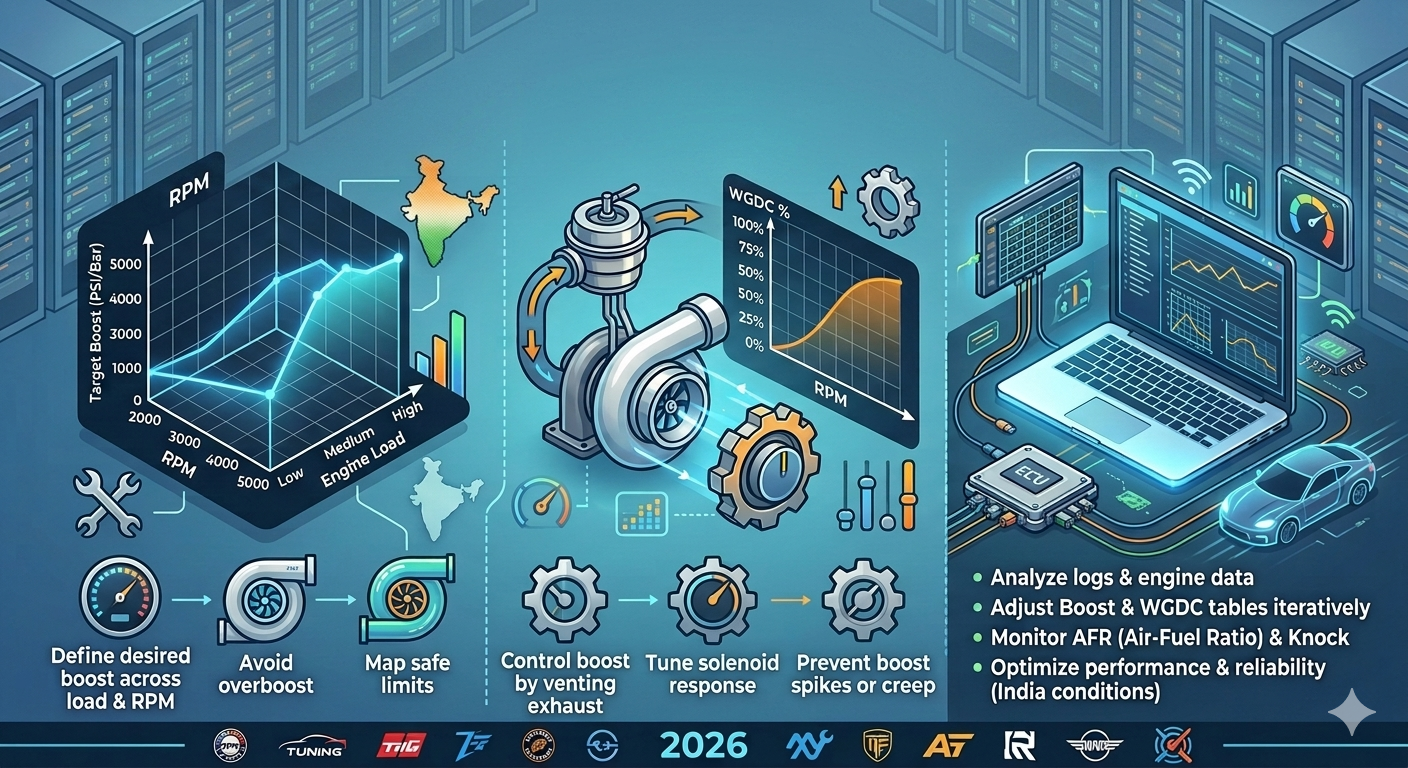
- Boost Control Strategies
Factory ECUs typically employ conservative boost control strategies that prioritize smoothness and reliability over responsiveness. Remapping can address this by:
- Reducing Boost Onset Threshold: Allowing boost buildup to begin at lower RPMs
- Increasing Initial Boost Request: Commanding higher boost pressure immediately upon throttle input
- Modifying Wastegate Duty Cycle: Keeping the wastegate closed longer during acceleration events
- PID Controller Adjustments: Changing how aggressively the ECU reacts to differences between requested and actual boost
- Ignition Timing Optimization
Ignition timing has a profound impact on exhaust gas temperature and velocity, which directly affects turbocharger spooling:
- Timing Retardation Under Load: Strategically retarding timing during acceleration to increase exhaust gas temperature and velocity
- Timing Advance at Steady State: Optimizing efficiency once boost is established
- Cylinder-Specific Timing: Adjusting timing for individual cylinders to optimize exhaust pulses
- Fuel Delivery Modifications
The air-fuel ratio significantly affects exhaust gas properties:
- Enrichment During Spool-up: Temporarily richening the mixture to increase exhaust gas volume and temperature
- Leaning Out at Boost: Optimizing the mixture once target boost is achieved
- Injection Timing Adjustments: Altering when fuel is introduced to maximize exhaust energy
- Throttle Mapping
How the ECU interprets throttle position sensor input affects turbocharger response:
- Increased Throttle Sensitivity: Making the electronic throttle more responsive to initial pedal input
- Progressive Mapping: Creating a more linear relationship between pedal position and throttle opening
- Accelerator Pump Effect: Mimicking carbureted engines’ accelerator pump through momentary enrichment
- Torque Management Adjustments
Modern ECUs limit torque for various reasons, including transmission protection and traction control:
- Reducing Torque Limitations: Removing artificial constraints that hinder boost buildup
- Modifying Traction Control Intervention: Allowing more wheel slip before power reduction
- Transmission Torque Management: Adjusting how the ECU limits torque during shifts
The Remapping Process for Turbo Lag Reduction
Professional ECU remapping to reduce turbo lag typically follows these steps:
- Baseline Assessment
Before any modifications, the tuner will:
- Perform data logging during various driving conditions
- Measure stock boost onset and buildup rates
- Identify specific areas of lag in the power delivery
- Assess the vehicle’s current mechanical condition
- Map Extraction and Analysis
Next, the current ECU calibration is extracted and analyzed:
- Existing boost control strategies are identified
- Target boost levels across the RPM range are noted
- Safety parameters and limitations are documented
- Integration between systems (traction control, transmission control) is mapped
- Parameter Modification
The tuner then makes targeted changes to relevant parameters:
- Boost control maps are adjusted for quicker response
- Ignition timing strategies are optimized for exhaust energy
- Fuel delivery parameters are fine-tuned for optimal spooling
- Throttle response curves are tailored to driver preference
- Testing and Validation
After remapping, thorough testing is essential:
- Data logging during identical scenarios as the baseline
- Measuring improvements in boost response time
- Ensuring all safety parameters remain functional
- Verifying that no new issues have been introduced
- Refinement
Based on testing results, final adjustments are made:
- Fine-tuning areas that show room for improvement
- Addressing any drivability issues that may have emerged
- Balancing responsiveness with reliability
- Optimizing for the specific driving style and conditions
Real-World Results: What to Expect
When properly executed, ECU remapping can produce significant improvements in turbocharger response:
Measurable Benefits
- Reduced Spool Time: Typically a 15-40% reduction in time-to-boost
- Lower Boost Threshold: Full boost often available 300-500 RPM sooner
- Improved Transient Response: More immediate power delivery during gear changes
- Better Part-Throttle Response: Enhanced drivability in everyday situations
- More Linear Power Delivery: Smoother transition into boost
Subjective Improvements
- Enhanced Driver Confidence: More predictable power delivery
- Reduced Need for Downshifting: Better response in the current gear
- Improved Overtaking Capability: Less planning required for passing maneuvers
- More Engaging Driving Experience: The car feels more responsive to driver inputs
Case Studies: Before and After
Small Displacement Turbocharged Engines
Four-cylinder turbocharged engines often benefit most dramatically from lag-focused remapping:
Example: 2.0L Turbocharged Sport Compact
- Before: Noticeable lag until 2800 RPM, full boost at 3200 RPM
- After: Initial boost at 1900 RPM, full boost by 2700 RPM
- Result: 35% quicker 0-60 mph time, significantly improved city driving dynamics
Performance Diesel Applications
Modern turbodiesel engines with variable geometry turbochargers show remarkable improvements:
Example: 3.0L V6 Turbodiesel SUV
- Before: Sluggish response below 1800 RPM, full torque at 2200 RPM
- After: Progressive torque development from 1400 RPM, full torque by 1900 RPM
- Result: Vastly improved towing capability and off-the-line performance
High-Performance Applications
Even factory-tuned performance cars have room for improvement:
Example: Factory Performance Sedan with Twin-Turbo V6
- Before: Slight hesitation during sudden throttle inputs, full boost by 3000 RPM
- After: Near-instantaneous response, full boost by 2600 RPM
- Result: More immediate power delivery, reduced need for downshifting on track
Potential Drawbacks and Considerations
While the benefits are compelling, there are important considerations before pursuing anti-lag focused remapping:
Reliability Implications
- Increased Thermal Load: Strategies that increase exhaust temperature can accelerate wear
- Higher Mechanical Stress: Quicker boost buildup means more stress on engine internals
- Turbocharger Longevity: More aggressive boost control may reduce turbocharger lifespan
- Supporting Modifications: May require improved cooling or stronger components for long-term reliability
Practical Limitations
- Factory Hardware Constraints: ECU remapping can’t overcome fundamental limitations of turbocharger size and design
- Emissions Compliance: Aggressive anti-lag strategies may affect emissions performance
- Fuel Quality Requirements: Some remapping approaches require higher octane fuel
- Warranty Considerations: Most manufacturer warranties won’t cover issues related to aftermarket ECU modifications
Complementary Modifications
To maximize the effectiveness of anti-lag ECU remapping, consider these supporting modifications:
Air Flow Improvements
- High-Flow Intake Systems: Reducing intake restriction helps turbos spool faster
- Upgraded Intercoolers: More efficient charge cooling allows for more aggressive boost targets
- Low-Restriction Exhaust Systems: Reducing backpressure improves turbine efficiency
Mechanical Enhancements
- Lighter Flywheel: Reduces rotational inertia and improves engine responsiveness
- Performance Clutch/Torque Converter: Better power transfer during boost buildup
- Blow-Off Valve or Bypass Valve Upgrades: Faster pressure relief between shifts
Choosing the Right Tuning Approach
Several approaches exist for ECU remapping, each with distinct advantages:
OTS (Off-The-Shelf) Maps
- Pros: Affordable, easily installed, widely tested
- Cons: Generic approach, not tailored to your specific vehicle
- Best For: Stock or lightly modified vehicles seeking moderate improvements
Custom Tuning
- Pros: Optimized for your specific vehicle and modifications, maximal results
- Cons: More expensive, requires expert tuner, may need dyno time
- Best For: Modified vehicles or those seeking the absolute best response
Flash Tuning Devices
- Pros: User-adjustable, multiple maps available, easy to return to stock
- Cons: Limited adjustment range, not as comprehensive as custom tuning
- Best For: Enthusiasts who want flexibility and different modes
The Future of Turbo Lag Reduction
The battle against turbo lag continues to evolve with emerging technologies:
- E-Turbo Technology: Electrically assisted turbochargers that eliminate traditional lag
- 48V Mild Hybrid Systems: Electric boost assistance during turbo spool-up
- Predictive Boost Control: AI and machine learning to anticipate driver needs
- Advanced Materials: Lower inertia turbocharger components that spool faster
- Smart ECU Algorithms: Continuously learning and adapting to driving style
Conclusion
ECU remapping represents one of the most effective, accessible ways to combat turbocharger lag without extensive mechanical modifications. By strategically adjusting boost control strategies, ignition timing, fuel delivery, and throttle mapping, professional tuners can transform the driving experience of turbocharged vehicles.
While not a complete elimination of the physical limitations inherent to turbocharging, well-executed remapping can dramatically reduce the perception of lag and deliver a more immediate, linear power delivery. For enthusiasts frustrated by the hesitation in their turbocharged vehicles, this approach offers a compelling balance of performance improvement, cost-effectiveness, and reversibility.
As with any performance modification, the key lies in finding the right balance between responsiveness and reliability. Working with experienced professionals who understand the complex interactions between ECU parameters and using quality tools for both programming and validation will ensure the best results in your quest to conquer turbo lag.
📺 Watch a real battery testing demo here: Reynlab YouTube Channel
🌐 Explore our automotive training programs: www.reynlab.com/our-courses