ECU Tuning for Optimal Ignition Timing and Better Engine Performance
Introduction to Ignition Timing
Ignition timing is one of the most critical parts of engine tuning. It determines exactly when the spark plug fires relative to the position of the piston in the cylinder. Getting it right can be the difference between a strong, efficient engine and one that is sluggish, thirsty or even at risk of damage.
When tuned correctly, optimal ignition timing gives more horsepower and torque, better fuel efficiency, smoother running, lower emissions, sharper throttle response and longer engine life.
In modern vehicles the Engine Control Unit (ECU) manages ignition timing through complex algorithms that consider inputs such as engine load, RPM, temperature and air intake. By modifying these parameters through ECU tuning, you can optimise the vehicle's performance for your needs.
Understanding Your Engine Control Unit (ECU)
What is an ECU?
The ECU is the brain of the engine management system. This computer controls many aspects of engine operation, and ignition timing is one of its primary functions. It processes data from numerous sensors around the engine to decide, in real time, when to trigger the spark plugs.
How ECUs control ignition timing
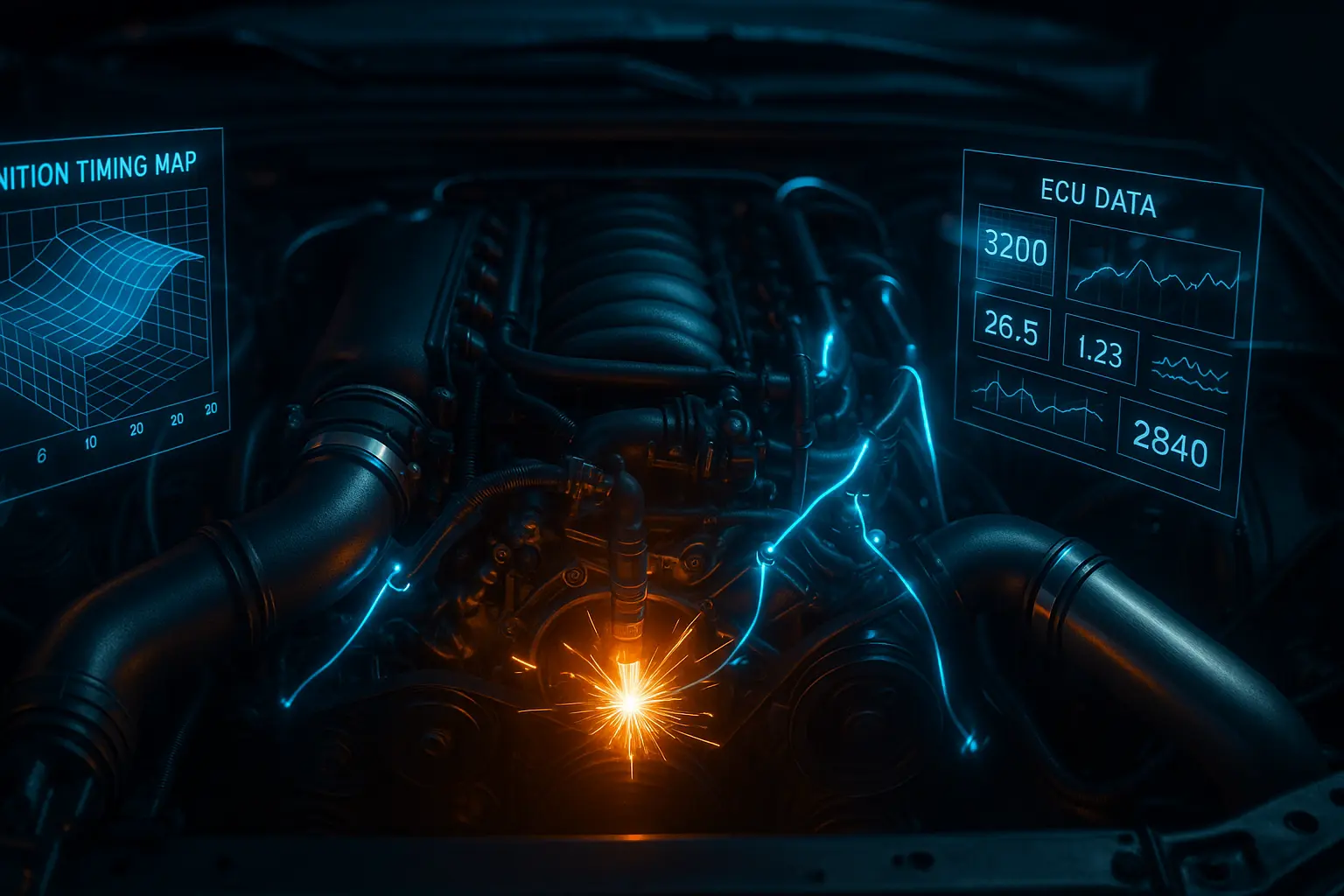
Modern ECUs use ignition timing maps, which are 3D tables that give timing values based on engine RPM and load. These maps tell the ECU exactly when to fire the spark plugs under different operating conditions.
The sensors that influence these decisions include:
- Crankshaft position sensor
- Camshaft position sensor
- Knock sensors
- Mass airflow sensor
- Intake air temperature sensor
- Engine coolant temperature sensor
- Throttle position sensor
- Oxygen sensors
Each manufacturer programs conservative ignition timing maps to allow for varying fuel quality and environmental conditions, and to ensure reliability across a wide range of driving situations. This conservatism often leaves room for performance improvements through careful tuning.
The Science Behind Optimal Ignition Timing
Combustion dynamics
For maximum power, the air-fuel mixture in the cylinder should reach peak pressure at roughly 15-20 degrees after Top Dead Center (ATDC). Combustion takes time to develop after the spark, so the spark must occur before the piston reaches Top Dead Center (TDC). This is called timing advance.
Factors affecting optimal timing
Several factors influence the ideal ignition timing for an engine:
- Engine speed (RPM): as speed rises there is less time for combustion, so timing must be advanced further.
- Engine load: under high load, higher cylinder pressures and temperatures make combustion quicker, so less advance is needed.
- Air-fuel ratio: leaner mixtures burn slower and need more advance, while richer mixtures burn faster and need less.
- Fuel octane rating: higher octane fuels can tolerate more advance without detonation.
- Compression ratio: higher compression engines generate more heat and pressure and often need less advance.
- Combustion chamber design: the shape and efficiency of the chamber affect flame propagation and timing requirements.
- Intake air temperature: cooler air is denser and may need different timing from hot air.
The concept of detonation
Detonation, also called knock or pinging, happens when the air-fuel mixture ignites spontaneously from compression before the flame front from the spark plug reaches it. The result is several flame fronts that collide and cause damaging pressure spikes in the cylinder.
Excessive ignition advance is the primary cause of detonation, which can lead to broken piston rings, damaged pistons, blown head gaskets, broken connecting rods and catastrophic engine failure. Modern ECUs use knock sensors to detect detonation and retard the timing to prevent damage, but understanding the phenomenon is vital for safe tuning.
Prerequisites for ECU Tuning
Before you adjust ignition timing through the ECU, make sure you have the following in place.
Knowledge requirements
You need a basic understanding of how engines work, familiarity with the specific ECU in your vehicle, knowledge of safe tuning practices, and the ability to interpret engine data.
Vehicle preparation
- Baseline condition: the engine should be in good mechanical condition with no existing issues.
- Fuel quality: use the right octane rating for your tuning goals, since higher octane fuels allow more aggressive timing.
- Spark plugs: install fresh, properly gapped plugs of the appropriate heat range.
- Ignition system: make sure coils, wires and other ignition components are in excellent condition.
- Air/fuel mixture: verify proper air/fuel ratios before adjusting timing.
Equipment needs
- ECU communication interface: an OBD-II port adapter or a dedicated hardware interface.
- Tuning software: compatible with your vehicle's ECU, for example HP Tuners, EcuFlash or Cobb AccessPort.
- Datalogging capability: to monitor engine parameters during tuning.
- Wide-band oxygen sensor: for accurate air/fuel ratio monitoring.
- Knock detection equipment: to identify detonation limits safely.
Step-by-Step ECU Tuning Process
- Establish a baseline. Before making changes, record stock timing values across the entire RPM and load range, run baseline performance tests (dyno or timed acceleration runs), log key engine parameters under various operating conditions, and document fuel consumption for later comparison.
- Research factory specifications. Find the factory timing specifications, the maximum safe timing advance for your engine, and any known tuning limitations for your engine platform.
- Set up the software. Install the tuning software, establish communication with your ECU, and back up the original ECU program (never skip this step). Then familiarise yourself with the timing maps in the software.
- Create a tuning strategy. Decide your goal: maximum power, better fuel economy, better drivability or a balanced approach. The goal dictates how aggressively you adjust the timing maps.
- Adjust the base timing map. Start with small, incremental changes of 1-2 degrees in a specific RPM/load cell. Work through the map systematically, one area at a time, and test each change before moving on. Pay special attention to the RPM and load ranges used most in daily driving.
- Test and validate. After each adjustment, monitor for detonation using the knock sensors or by listening carefully. Check for improvements in power, throttle response or efficiency, verify that engine temperatures stay in the normal range, and confirm that drivability has not suffered.
- Refine. Fine-tune the areas that gave good results and reduce timing where you saw knock or negative results. Test under various conditions such as cold start, hot weather and high load, and use smaller adjustments of 0.5-1 degree for the final optimisation.
- Final validation. Perform full-power runs to verify the improvements, test fuel consumption in normal driving, make sure cold-start and warm-up behaviour is appropriate, and check emissions if possible.
Advanced Timing Strategies
Variable timing maps
Most modern ECUs allow several timing maps for different conditions:
- Temperature-based adjustments: different maps for cold and fully warmed-up engines.
- Octane-specific maps: alternative maps for different fuel grades.
- Boost-dependent timing: on turbocharged or supercharged engines, timing is reduced as boost increases.
Dynamic timing adjustments
Advanced tuning can program the ECU to adjust timing in real time:
- Intake air temperature compensation: reducing timing as intake temperatures rise.
- Adaptive learning: letting the ECU make minor timing adjustments based on knock sensor feedback.
- Altitude compensation: adjusting timing as barometric pressure changes.
Cylinder-specific timing
Some high-end ECUs allow timing control for individual cylinders. This compensates for differences in cooling or intake path, addresses cylinder-specific knock tendencies and balances the power contribution of all cylinders.
Common Ignition Timing Issues and Solutions
Detonation or knock
Symptoms are a pinging or rattling sound under acceleration, the knock sensor triggering timing retard, and loss of power. To solve it, reduce timing advance in the affected RPM/load ranges, use higher octane fuel, lower the engine operating temperature and address hot spots in the combustion chamber.
Too little timing (retarded)
Symptoms are poor fuel economy, reduced power, excessive exhaust temperatures and sluggish throttle response. To solve it, gradually increase timing in the affected ranges, make sure the knock detection system works correctly, and check for restrictive exhaust or intake components.
Inconsistent running
Symptoms are a surging idle, erratic power delivery and hesitation during acceleration. To solve it, smooth the transitions between adjacent cells in the timing maps, address rapid timing fluctuations in transient conditions, and check for sensor problems that might cause timing instability.
Safety Considerations
Preventing engine damage
Never make large timing changes at once, and always err on the side of caution. Monitor for detonation continuously, with special attention to high-load, low-RPM conditions where knock is most likely.
Tuning environment
Do the initial tuning in controlled conditions, use consistent fuel for testing and consider the effect of ambient temperature on results. Validate the tune under various operating conditions before calling it complete.
Legal and emissions compliance
Aggressive timing changes may affect emissions, and some jurisdictions legally restrict ECU modifications. Consider keeping a compliant tune for emissions testing.
Tools and Software Recommendations
Professional-grade options
- HP Tuners: comprehensive support for many domestic vehicles. Pros: detailed control and excellent datalogging. Cons: a steep learning curve and a relatively high price.
- Cobb AccessPort: popular for Japanese and European sports cars. Pros: user-friendly, with pre-built maps available. Cons: limited customisation compared to other options.
- EcuFlash: an open-source option for many vehicles. Pros: free software and community support. Cons: needs additional hardware and is less user-friendly.
Monitoring equipment
- Wide-band air/fuel ratio gauge: AEM UEGO or Innovate Motorsports LM-2.
- Knock detection: knock ears, microphone setups or professional knock detection systems.
- Datalogging equipment: OBD-II scanners with real-time parameter display.
Frequently asked questions
Is ECU tuning the same as "chipping"?
No. "Chipping" is the outdated practice of replacing physical chips in older ECUs, while modern ECU tuning reprograms the existing ECU through its diagnostic port or with specialised hardware.
Will tuning my ECU void my warranty?
In many cases, yes. Manufacturers can deny warranty claims if they can prove your modifications caused a failure. Some tuning solutions let you return to stock programming before dealer visits.
How much performance gain can I expect from ignition timing optimisation?
It varies widely with how conservative the factory tune is. Typically you might see 5-10% more power from timing optimisation alone, and more when it is combined with other modifications.
Do I need a dyno to tune my ignition timing?
A dyno gives the most controlled environment, but it is not strictly necessary. Street tuning is possible with proper monitoring equipment and a cautious approach, though it is generally less precise.
Can I tune my ECU myself, or should I hire a professional?
It depends on your experience and willingness to learn. Beginners are strongly advised to work with a professional tuner, because improper ignition timing can cause catastrophic engine damage.
How often should I update my ECU tune?
Revisit the tune after any significant engine modification or fuel quality change, or if you notice performance issues. Otherwise a well-developed tune should stay effective until engine components wear significantly.
Summary
Optimising ignition timing through ECU tuning is one of the most effective ways to improve a vehicle's performance, efficiency and drivability. If you understand the principles and follow a methodical approach, you can get the engine's full potential while keeping it reliable.
Successful tuning takes patience, attention to detail and a commitment to safety. When in doubt, consult an experienced tuner who can advise on your vehicle and goals.
Watch our workshop videos on the Reynlab YouTube Channel, or explore our automotive training programs at www.reynlab.com/our-courses.
For blog on Ecu tuning & remap
For course on Ecu tuning & remap
Ultimate Guide to ECU Tuning for Better Fuel Injector Performance
ECU Remapping for Better Launch Control
Ultimate Guide to ECU Tuning for Altitude and Climate Conditions