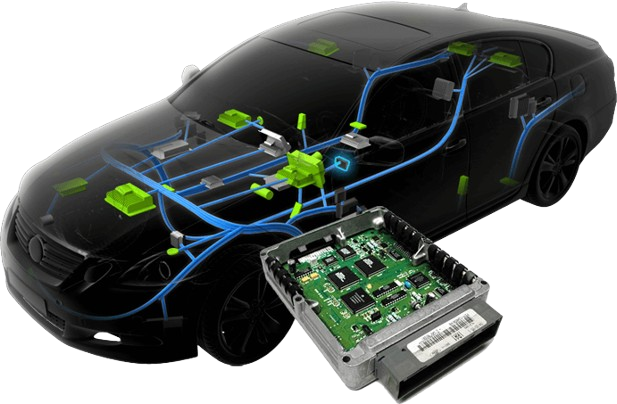
You already know that the Engine Control Module (ECM) is the brain of the car.
But here’s the real question:
👉 How does it actually work inside the car?
Understanding this is what separates:
- A basic mechanic ❌
- A skilled diagnostic technician ✅
In this guide, we’ll break down ECM working into simple steps, real-life examples, and workshop insights.
The Core Idea: ECM is a Decision-Making Computer
At its core, the ECM works like a mini computer.
👉 It follows a simple cycle:
- Input (Sensors)
- Processing (Logic + Software)
- Output (Actuators)
👉 This cycle happens hundreds of times per second
The ECM Working Cycle (3-Step System)
Step 1: Input – Data from Sensors
The ECM constantly receives signals from sensors across the engine.
Common Sensors:
- Oxygen Sensor (O2) → Measures exhaust gases
- Throttle Position Sensor (TPS) → Tracks accelerator input
- Mass Air Flow (MAF) Sensor → Measures intake air
- Engine Coolant Temperature Sensor → Monitors engine heat
- Crankshaft Position Sensor → Tracks engine rotation
👉 These sensors act as the eyes and ears of the ECM
Example
You press the accelerator → TPS sends signal → ECM receives data
Step 2: Processing – ECM Brain at Work
Once data is received, the ECM processes it using:
- Pre-Programmed Maps
- Fuel delivery
- Ignition timing
- Emission control
- Algorithms
- Calculates fuel quantity
- Determines spark timing
- Memory
- Stores past data
- Saves error codes
- Learns driving patterns
What Happens Internally?
- Microcontroller processes signals
- Software compares values
- Decisions are made instantly
👉 All within milliseconds
Step 3: Output – Controlling the Engine
After processing, ECM sends commands to actuators.
Actuators Include:
- Fuel injectors
- Ignition coils
- Idle air control valve
- Throttle body
Example
If more power is needed:
- ECM increases fuel injection
- Adjusts ignition timing
👉 Result: Smooth acceleration
Real-Life Working Example
Situation: You Press the Accelerator
- TPS sends signal to ECM
- ECM checks air intake (MAF sensor)
- ECM calculates required fuel
- ECM commands injectors
- ECM adjusts ignition timing
👉 Engine responds instantly
How ECM Makes Smart Decisions
The ECM doesn’t just react—it optimizes performance.
It balances:
- Power
- Fuel efficiency
- Emissions
Example: Cold Start
- More fuel injected
- Higher idle speed
👉 Helps engine warm up
Example: High Speed
- Adjusts ignition timing
- Reduces fuel waste
👉 Improves efficiency
ECM and Sensors: A Deep Relationship
👉 Without sensors, ECM is blind
👉 Without ECM, sensors are useless
Open Loop vs Closed Loop
Open Loop
- No feedback from O2 sensor
- Used during cold start
Closed Loop
- Uses sensor feedback
- Optimizes performance
What Happens When ECM Fails?
Common Symptoms:
- Engine not starting
- Poor mileage
- Misfiring
- Check engine light
Diagnostic Insight (Workshop Level)
Many technicians make this mistake:
👉 Replacing parts without checking ECM logic
Correct Approach:
- Scan error codes
- Check sensor data
- Verify ECM outputs
Tools to Understand ECM Working
Basic Tools:
- OBD scanner
- Multimeter
Advanced Tools:
- Oscilloscope
- ECM programming tools
Important Concept: ECM Maps
ECM uses maps such as:
- Fuel map
- Ignition map
👉 These are pre-defined tables guiding engine behavior
Does ECM Learn Over Time?
Yes. Modern ECMs use adaptive learning.
They adjust based on:
- Driving style
- Fuel quality
- Engine condition
Indian Driving Conditions Impact
In India:
- Heavy traffic
- Variable fuel quality
- Extreme climate
👉 ECM continuously adapts to these conditions
Why This Knowledge is Important
If you understand ECM working:
- Faster diagnosis
- Fewer mistakes
- Higher earning potential
Common Mistakes Beginners Make
❌ Blaming ECM for every issue
👉 Often sensors are the real cause
❌ Ignoring wiring problems
👉 Wiring faults mimic ECM issues
❌ Not understanding data flow
👉 Leads to wrong diagnosis
Frequently Asked Questions (FAQs)
Q1: How does ECM control the engine?
By receiving sensor data, processing it, and sending commands to actuators.
Q2: Does ECM work automatically?
Yes, continuously without driver input.
Q3: Can ECM adapt to driving style?
Yes, modern ECMs learn and adjust.
Q4: What happens if ECM fails?
Engine may not start or run properly.
Q5: Is ECM software important?
Yes, software controls all ECM decisions.
Conclusion
The Engine Control Module (ECM) is a highly intelligent system that continuously monitors, processes, and controls the engine.
In Simple Terms:
- Sensors provide input
- ECM processes data
- Actuators execute commands
Final Takeaway
Mastering this concept helps you move from:
👉 Guesswork mechanic → Skilled diagnostic technician
📺 Watch a real battery testing demo here: Reynlab YouTube Channel
🌐 Explore our automotive training programs: www.reynlab.com/our-courses