Introduction
Cold start issues plague many drivers, especially those living in regions with extreme temperature variations. That stubborn engine hesitation, rough idling, and excessive emissions during the first few minutes of operation aren’t just annoying—they’re indicators of suboptimal performance and can lead to long-term engine wear. While vehicle manufacturers program ECUs (Engine Control Units) with settings that balance performance, emissions, and reliability across a wide range of conditions, these factory settings often prioritize emissions compliance over optimal performance during cold starts.
This is where ECU tuning comes in. By strategically modifying how your engine’s computer manages fuel delivery, ignition timing, and other crucial parameters during cold starts, properly executed ECU tuning can dramatically improve your vehicle’s cold weather performance. In this article, we’ll explore how ECU tuning specifically addresses cold start challenges and the tangible benefits it can provide for your vehicle.
Understanding Cold Start Challenges
Before diving into ECU tuning solutions, it’s important to understand what exactly happens during a cold start and why engines struggle under these conditions.
The Science Behind Cold Starts
When an engine is cold, several factors combine to create performance challenges:
- Oil Viscosity: Engine oil thickens at lower temperatures, increasing resistance and reducing its ability to properly lubricate moving parts.
- Fuel Atomization: Cold intake manifolds and cylinder walls cause fuel to condense rather than properly atomize, leading to incomplete combustion.
- Sensor Readings: Temperature sensors detect the cold conditions and signal the ECU to adjust for these conditions—often with overly conservative parameters.
- Battery Performance: Cold temperatures reduce battery efficiency, resulting in slower cranking speeds during startup.
- Emissions Equipment: Modern vehicles with catalytic converters temporarily run rich (excess fuel) during cold starts to quickly heat the catalyst to operating temperature.
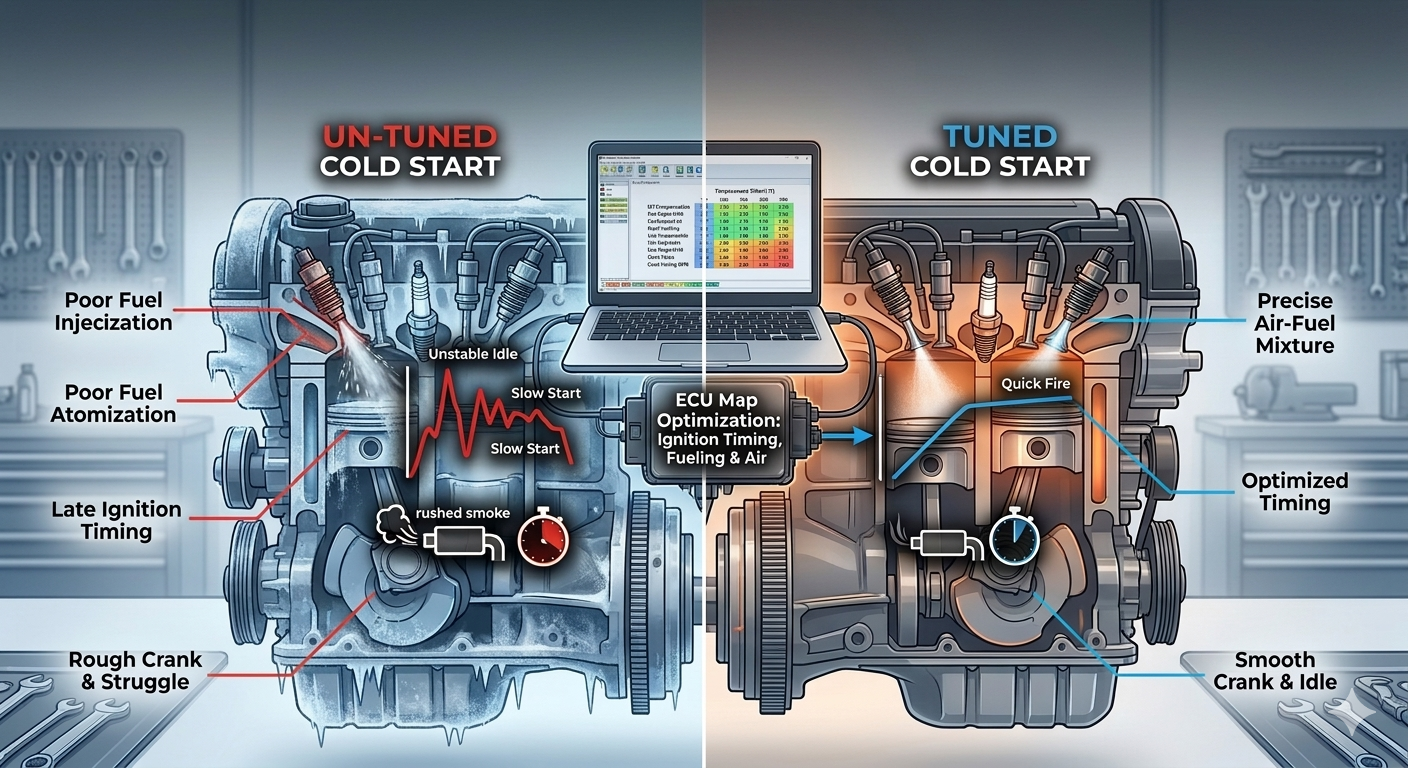
The factory ECU has pre-programmed cold start strategies that typically include:
- Increased idle speed
- Enriched fuel mixture (lower air-fuel ratio)
- Retarded ignition timing
- Altered valve timing (in vehicles with variable valve timing)
While these adjustments help the engine start and run when cold, they frequently result in poor fuel economy, excessive smoke, rough idle, hesitation during acceleration, and sometimes stalling.
How ECU Tuning Improves Cold Start Performance
Optimized Fuel Delivery
One of the primary ways ECU tuning improves cold starts is through precision adjustments to the fuel delivery strategy:
- Fine-tuned Cold Start Enrichment: Factory tunes often provide excessive fuel enrichment during cold starts as a failsafe. Through data-driven calibration, a skilled tuner can determine the minimum fuel enrichment needed for reliable starting while reducing waste.
- Progressive Fuel Tapering: Rather than abruptly switching from cold to warm operation, tuned ECUs can implement a smoother transition with a progressive reduction in fuel enrichment as the engine warms.
- Injector Pulse Optimization: By adjusting injector pulse width and timing specifically for cold operation, tuners can improve fuel atomization even in cold conditions.
These fuel delivery optimizations result in quicker starts, reduced emissions during warm-up, and improved fuel economy in the critical first minutes of operation.
Ignition Timing Adjustments
Factory ignition timing maps during cold starts are typically conservative to protect against potential detonation. ECU tuning can safely optimize this important parameter:
- Advanced Cold Timing: Carefully advancing ignition timing during cold operation (where safe) can improve combustion efficiency and accelerate engine warm-up.
- Temperature-Specific Timing Maps: Performance-oriented ECU tunes can include multiple timing maps for different temperature ranges, providing optimal ignition characteristics at each stage of warm-up.
- Cylinder-Specific Timing: Some advanced tuning platforms allow for cylinder-specific timing adjustments, compensating for the uneven heating that often occurs during cold starts.
Idle Control Refinement
Cold idle instability is a common complaint that ECU tuning can effectively address:
- Stabilized Idle Speed Control: Refined idle control algorithms maintain more consistent RPM during warm-up, eliminating the surging often experienced with factory tunes.
- Improved Throttle Response: Modifying throttle sensitivity during the warm-up phase can eliminate the hesitation drivers often experience when accelerating from a cold idle.
- IAC/ISC Valve Optimization: Adjusting the Idle Air Control or Idle Speed Control valve parameters provides more precise airflow management during cold idle conditions.
Enhanced Variable Valve Timing Control
For vehicles equipped with variable valve timing (VVT) systems, ECU tuning offers significant cold-start improvements:
- Cold-Specific VVT Maps: Creating dedicated valve timing maps for cold operation improves combustion efficiency and accelerates catalyst warm-up.
- Earlier VVT Engagement: Many factory tunes delay full VVT functionality until the engine reaches normal operating temperature. Custom tunes can engage limited VVT function earlier in the warm-up process.
Real-World Benefits of Cold Start Tuning
When properly executed by a skilled professional, cold start-focused ECU tuning delivers several measurable benefits:
Faster Warm-Up Times
By optimizing combustion efficiency during cold operation, tuned ECUs can reduce the time required for engines to reach optimal operating temperature by 15-30% in many cases. This not only improves the driving experience but reduces engine wear and emissions that occur during extended warm-up periods.
Reduced Emissions
While it might seem counterintuitive, properly optimized cold start tuning can actually reduce harmful emissions. By eliminating excessive fuel enrichment and improving combustion efficiency, less unburned fuel enters the exhaust stream, reducing hydrocarbon emissions during the critical warm-up phase.
Improved Drivability
Drivers immediately notice enhanced cold-weather drivability through:
- Elimination of cold stalling
- Reduced startup hesitation
- Smoother idle characteristics
- More consistent throttle response
- Elimination of the “cold bog” when accelerating
Fuel Economy Improvements
Cold operation is notoriously inefficient. By refining the warm-up strategy, ECU tuning can improve fuel economy during the first few minutes of operation—often by 5-15% compared to factory settings. For drivers making numerous short trips, these savings can be substantial over time.
Implementation Considerations
Professional vs. DIY Tuning
While DIY tuning options exist, cold start tuning requires specialized knowledge and equipment to perform safely:
- Data Acquisition: Proper cold start tuning requires data logging during actual cold starts across various ambient temperatures.
- Incremental Testing: Changes must be implemented gradually and tested across multiple cold starts to ensure reliability.
- Safety Parameters: Critical failsafes must remain intact to protect the engine if extreme conditions are encountered.
For these reasons, cold start optimization is typically best left to experienced professional tuners with specific expertise in this area.
Vehicle-Specific Considerations
Cold start tuning approaches vary considerably between vehicle types:
- Naturally Aspirated vs. Forced Induction: Turbocharged and supercharged engines have unique cold start requirements due to their more complex air delivery systems.
- Direct Injection Systems: Modern direct injection engines benefit from specific cold start strategies that account for their unique injection characteristics.
- Diesel Applications: Diesel engines have entirely different cold start challenges, often involving glow plug timing and multiple injection events.
Emissions Compliance
It’s important to note that while cold start tuning can reduce some emissions, modifications must remain compliant with local regulations:
- Catalyst Light-Off: Any modifications must still ensure rapid heating of the catalytic converter.
- OBD-II Readiness: Tune modifications should not interfere with emissions system monitoring.
- Legal Considerations: In many regions, modifications affecting emissions control systems may not be legal for street use.
Conclusion
ECU tuning offers substantial benefits for improving cold start performance, addressing one of the most common complaints among vehicle owners. Through precision adjustments to fuel delivery, ignition timing, idle control, and variable valve timing parameters, a properly executed cold start tune can transform a vehicle’s cold weather operation.
The benefits—faster warm-ups, reduced emissions, improved drivability, and better fuel economy—make cold start tuning one of the most immediately noticeable and practical ECU modifications available. Whether you’re dealing with bitter winter temperatures or simply want more consistent morning startups, addressing cold start behavior through professional ECU tuning can significantly enhance your driving experience while potentially extending engine life through reduced cold-operation wear.
As with any performance modification, the key lies in working with experienced professionals using data-driven approaches rather than generic solutions. With proper implementation, cold start tuning represents one of the most practical and beneficial ECU modifications available for daily driven vehicles
📺 Watch a real battery testing demo here: Reynlab YouTube Channel
🌐 Explore our automotive training programs: www.reynlab.com/our-courses
🌐 Explore our automotive training programs: www.reynlab.com/our-courses