Powerful Ways to Refine Engine Output Using ECU Remapping
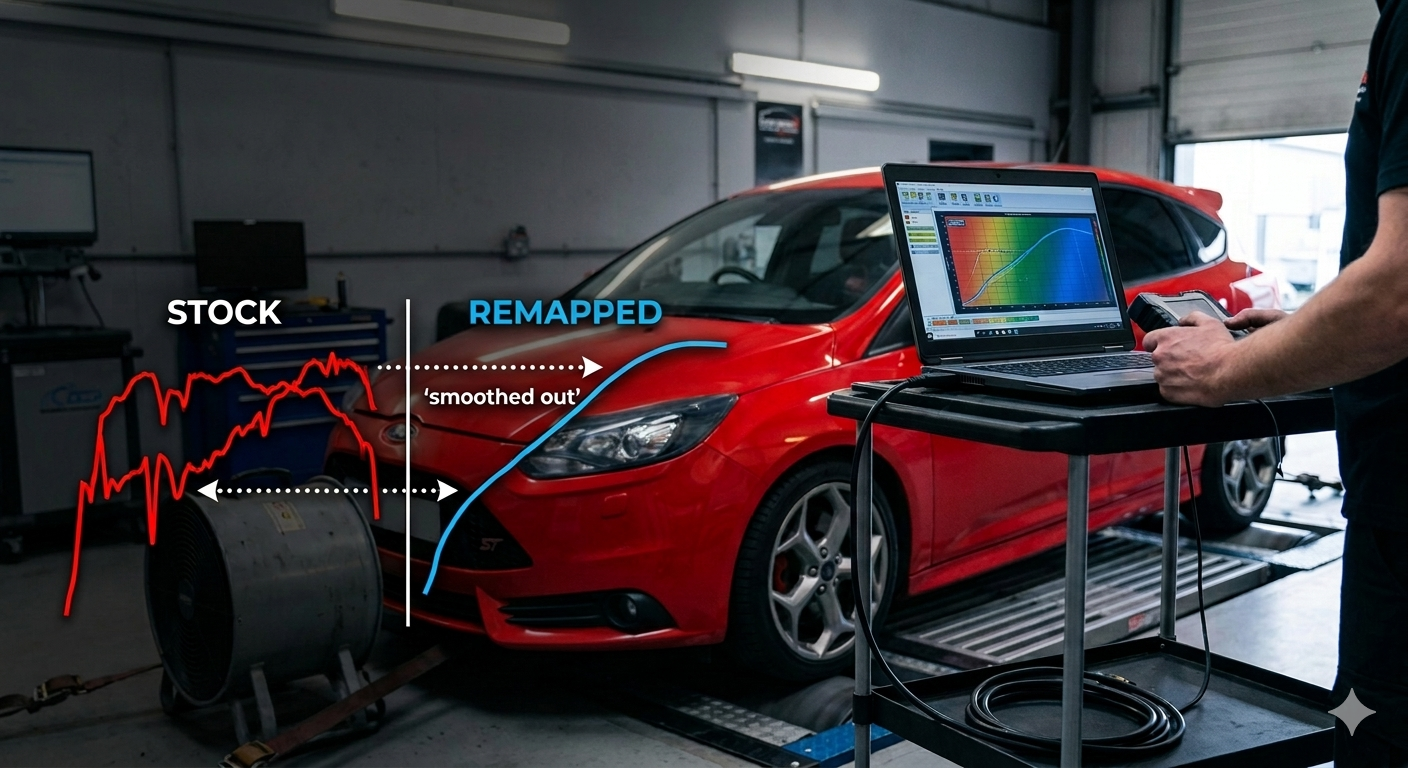
ECU remapping for smoother power delivery
One of the most useful yet understated benefits of ECU remapping is smoother, more linear power delivery. Peak horsepower and torque figures dominate marketing material, but the character of power delivery has arguably a bigger effect on the driving experience. That means how power is spread across the rev range and how predictably it responds to throttle inputs. This guide explains how ECU remapping can refine power delivery to make a car more enjoyable, controlled and predictable.
Understanding power delivery characteristics
Before looking at remapping strategies, it helps to understand what makes up "smooth power delivery" and why factory calibrations sometimes fall short.
Defining smooth power delivery
Smooth power delivery combines several qualities:
- Linearity: the proportional relationship between throttle input and power output, giving predictable response across the pedal's range of motion.
- Progressive torque curve: a torque curve that builds consistently and gradually, without abrupt spikes or dips.
- Throttle resolution: the precision with which small throttle adjustments translate into the right power changes.
- Transient response: how the engine handles momentary changes in load, such as quick throttle adjustments or gear changes.
- Consistency: reliable power characteristics regardless of temperature, altitude or fuel quality.
Why factory calibrations often compromise smoothness
Several factors lead manufacturers to use calibrations that compromise power delivery:
- Emissions compliance: meeting stringent emissions standards often requires compromises in fuelling and timing that create dips or flat spots in the power curve.
- Conservative safety margins: manufacturers build in large buffers to allow for varying fuel quality, maintenance practices and operating conditions.
- Diverse market requirements: global platforms must work acceptably in markets with very different fuel qualities and environmental conditions.
- Production tolerances: factory tunes must allow for manufacturing variations between individual engines.
- Cost considerations: economic pressure to use standardised components that may not suit a specific engine variant.
These constraints often leave power delivery that feels artificially restrained, inconsistent across the rev range, or unnecessarily peaky rather than progressive and linear.
Analysing power delivery before remapping
A methodical approach to improving power delivery starts with thorough analysis.
Diagnostic data collection
Before making any changes, collect data to establish a baseline.
- Dynamometer testing: full power runs to map the stock torque curve, step tests at fixed rpm points to assess throttle response, and partial throttle sweeps to evaluate part-load behaviour.
- Real-world data logging: acceleration runs through each gear, roll-on tests from various speeds, transient response during quick throttle changes, and part-throttle cruising in different conditions.
- Subjective assessment: driver feedback on throttle predictability, identification of specific problem areas (flat spots, hesitation), evaluation of drivability in various scenarios and comparison against similar vehicles.
Common power delivery issues
Several issues typically show up during baseline testing:
- Torque dips: noticeable depressions in the torque curve, often around emissions-critical operating points.
- Throttle mapping nonlinearity: a disproportionate relationship between pedal position and actual throttle opening.
- Boost delivery issues: in turbocharged applications, uneven boost build-up or sharp pressure spikes.
- Overrun hesitation: a momentary hesitation when moving from closed to open throttle.
- Inconsistent part-throttle response: unpredictable power delivery during light or moderate acceleration.
- Torque management intervention: excessive power reduction during gear changes or throttle transitions.
ECU parameters affecting power delivery
Several ECU parameters directly shape the character of power delivery.
Throttle mapping
The relationship between pedal position and actual throttle opening fundamentally shapes how power feels to the driver. Standard mapping approaches are:
- Linear maps, which create a 1:1 relationship between pedal and throttle position
- Progressive maps, which accelerate throttle opening in the middle of pedal travel
- Regressive maps, which delay throttle opening until later in pedal travel
- Multi-segment maps, which create varying rates of change through the pedal movement
Advanced strategies include rpm-dependent maps that vary with engine speed, gear-specific throttle maps tailored to each transmission ratio, mode-selective maps that change with driver-selected programs, and accelerator rate-sensitive maps that respond differently to quick and gradual inputs.
Ignition timing control
How spark timing is managed across the rev range significantly affects torque characteristics. Static timing maps work in three layers: base timing tables set the fundamental advance values, load-based adjustments modify advance under varying demands, and temperature compensation keeps timing consistent across operating conditions.
Dynamic timing strategies include transient timing adjustments during throttle changes, anti-lag timing strategies that maintain boost pressure, cylinder-specific timing optimisation for balanced combustion, and adaptive timing that learns from knock sensor feedback.
Fuelling parameters
Fuel delivery precision directly affects power smoothness. Air-fuel ratio targets are typically:
- Stoichiometric (14.7:1) for emissions and economy
- Slightly rich (12.5-13.5:1) for maximum power
- Leaner mixtures (15-16:1) for cruise efficiency
- Transitional enrichment during acceleration
Injector control can be refined with latency compensation at varying voltages, multiple injection events for better atomisation, injector flow matching for cylinder-to-cylinder consistency, and acceleration enrichment optimised for transient response.
Boost control (forced induction)
For turbocharged and supercharged engines, boost management is critical. Boost target strategies include graduated boost curves that build progressively with rpm, load-dependent boost limiting for drivability, gear-specific boost targets for balanced acceleration and temperature-dependent boost mapping for consistency.
Wastegate and bypass control covers PID controller tuning for boost stability, preemptive wastegate positioning for faster response, anti-overshoot algorithms to prevent boost spikes and integrated control with throttle position for a cohesive response.
Torque management integration
Modern ECUs actively manage torque output to protect the transmission and keep the vehicle stable. Traditional torque limiting uses maximum torque ceilings based on gear position, timing retard to reduce torque during shifts, fuel reduction for transient torque control and throttle closure during critical events.
More sophisticated strategies include predictive torque reduction before shift events, progressive torque restoration after an intervention, situational torque management based on vehicle dynamics and driver-preference adaptation for a sporting or comfort bias.
Remapping strategies for smoother power
With the baseline analysis done and the key parameters identified, several remapping strategies can greatly improve power delivery.
Linearising throttle response
The aim is a more intuitive connection between foot and engine.
- Initial throttle take-up: remove artificial "dead zones" in the first 5-10% of pedal travel, create precise control for small throttle openings and add a subtle progressive curve for easier manoeuvring.
- Mid-range proportionality: establish a consistent relationship between pedal position and power, remove artificial steps or plateaus in the throttle map and create a natural feel that builds driver confidence.
- Full-throttle transition: smooth the transition to wide-open throttle, eliminate abrupt power delivery at the end of pedal travel and make the full-power response predictable.
Smoothing torque curves
Removing irregularities in the torque curve makes acceleration more consistent.
- Identifying torque dips: locate the rpm ranges with torque depressions, analyse fuelling and timing at those points and decide whether emissions constraints are causing the limitation.
- Remediation: adjust ignition timing to fill torque depressions, optimise fuelling at the problem rpm ranges, modify cam timing (if variable) to improve mid-range torque and revise boost targets to remove turbo lag or boost holes.
- Transition smoothing: focus on the areas between power bands in multi-cam or variable valve engines, create smooth transitions between operating modes and eliminate perceptible steps in power delivery.
Enhancing transient response
This means improving engine behaviour during throttle transitions.
- Accelerator pump effect: implement an electronic equivalent of the carburettor accelerator pump, with momentary enrichment proportional to the rate of throttle movement and an enrichment duration tailored to prevent flat spots.
- Ignition timing strategies: advance timing momentarily as the throttle opens, create timing maps specific to acceleration events and make the timing algorithms sensitive to rate of change.
- Anti-lag implementation: use mild anti-lag strategies for street applications, maintain turbocharger speed during brief throttle closure and restore boost smoothly after gear changes.
Refining part-throttle operation
This improves the driving experience in normal, everyday use.
- Cruise optimisation: create specific mapping for common highway speeds, optimise for smoothness rather than maximum economy and eliminate hunting or surging at steady throttle.
- Light acceleration mapping: develop precise control for 25-50% throttle operation, create a natural, progressive power build-up and remove the "on-off" sensation common in drive-by-wire systems.
- Load transition improvement: smooth the transition between vacuum and boost, eliminate hesitation when accelerating from cruise and make the response to small throttle adjustments predictable.
Implementing vehicle-specific strategies
Approaches should be tailored to the engine and vehicle type.
- Naturally aspirated engines: focus on ignition timing optimisation across the rev range, improve volumetric efficiency through mapping, implement precise throttle control and revise VTEC/VVT/VANOS transition points for smoothness.
- Turbocharged applications: develop progressive boost build-up curves, create smooth transitions between off-boost and on-boost operation, implement subtle anti-lag for better drivability and focus on boost stability under varying conditions.
- Diesel engines: optimise injection timing for smoother torque delivery, refine pilot injection quantity and timing, create smoother EGR integration and use torque-smoothing strategies during DPF regeneration.
Real-world tuning process
A methodical approach to remapping for smoother power delivery goes through several phases:
- Comprehensive baseline analysis. Before making changes, conduct full power runs on a load-bearing dynamometer, create detailed log files of stock operation across various scenarios, identify the areas that need improvement and set objective metrics for measuring success.
- Targeted parameter modification. Begin with the most impactful parameters. Start with throttle mapping for an immediate drivability improvement, address any obvious torque dips or flat spots, add basic transient enrichment improvements and make preliminary boost control revisions if applicable.
- Incremental testing and validation. After the initial changes, evaluate subjective feedback from test drives, analyse data logs for improved metrics, identify any unintended consequences and refine the most successful modifications.
- Comprehensive integration. With the primary issues addressed, integrate the throttle, timing and fuelling maps, develop synchronised strategies for transient conditions, add conditional mapping for different operating scenarios and fine-tune for consistency across varying conditions.
- Final validation and documentation. Before delivery, test extensively across various driving conditions, create comparative data to demonstrate the improvements, document all changes for future reference and give maintenance recommendations for sustained performance.
Summary
ECU remapping for smoother power delivery goes well beyond chasing peak performance figures. It is about refining how power feels, responds and fits into the driving experience. By focusing on throttle linearity, torque curve consistency, transient response and part-throttle behaviour, tuners can change a vehicle's character into something more intuitive, controlled and enjoyable.
Whether the goal is daily drivability, confident handling or better responsiveness, a thoughtful, data-driven remap can give a level of refinement that factory calibrations often leave untapped. In the hands of a skilled tuner, smoother power delivery is one of the most rewarding upgrades a driver can get.
Watch our workshop videos on the Reynlab YouTube Channel. You can also explore our automotive training programs at www.reynlab.com/our-courses.