ECU Tuning vs Chip Tuning vs Remapping: Complete Beginner’s Guide 2025
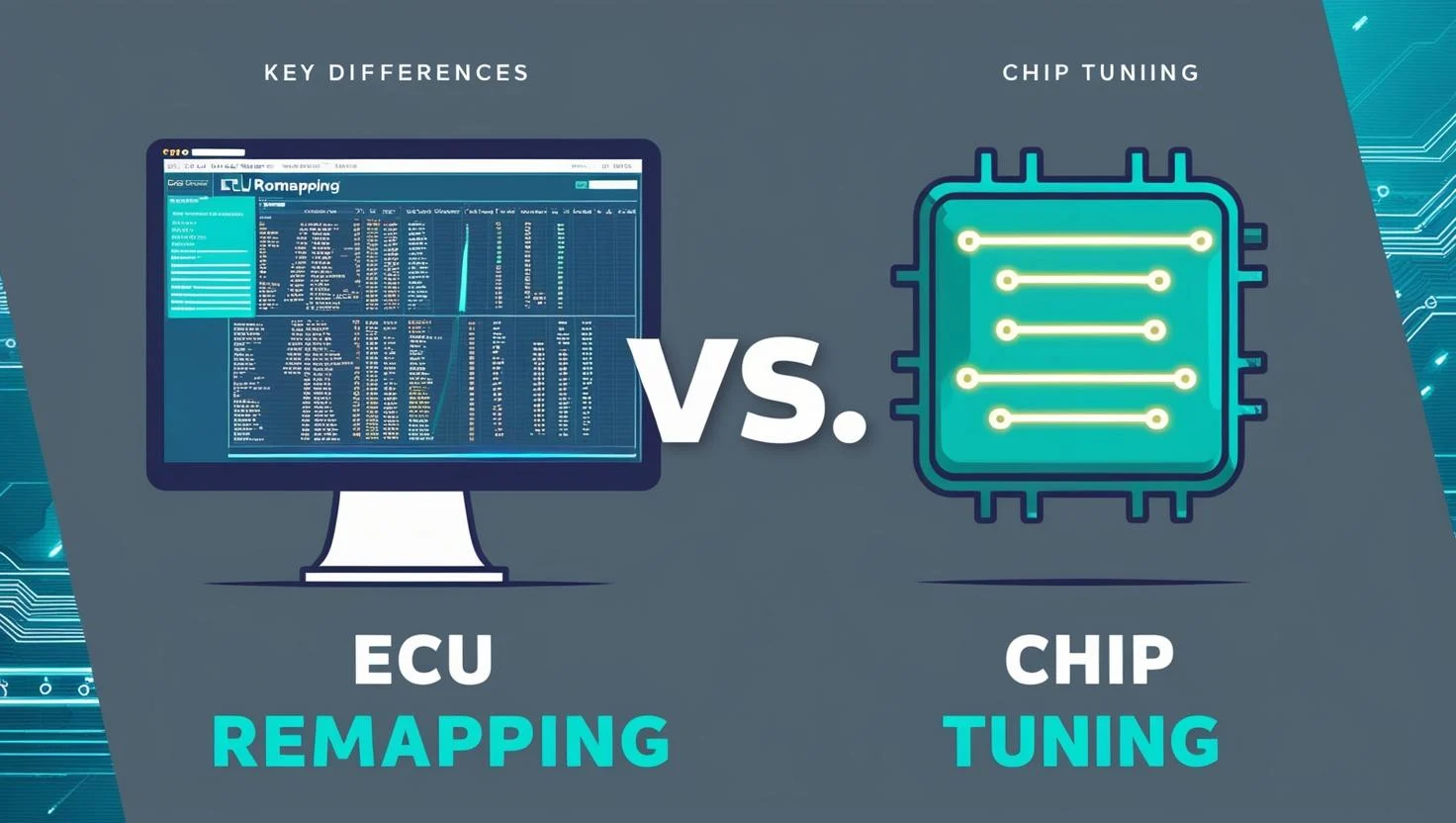
If you’re new to the world of automotive performance enhancement, the terms ECU tuning, chip tuning, and remapping can seem confusing and interchangeable. However, understanding the differences between these three approaches is crucial for anyone looking to improve their vehicle’s performance, fuel efficiency, or drivability.
This comprehensive beginner’s guide will clarify the distinctions between ECU tuning, chip tuning, and remapping, helping you make informed decisions about which approach best suits your needs and budget.
Understanding the Basics: What Controls Your Engine?
Before diving into the differences, it’s essential to understand how modern engines are controlled.
The Electronic Control Unit (ECU)
The ECU is your engine’s brain, constantly monitoring and adjusting various parameters to optimize performance, emissions, and fuel efficiency. It processes information from dozens of sensors and controls actuators throughout the engine system.
Key ECU Functions:
Fuel injection timing and quantity
Ignition timing optimization
Boost pressure control (turbocharged engines)
Emissions system management
Idle speed control
Temperature management
ECU Tuning: The Modern Approach
ECU tuning, also known as engine tuning or performance tuning, involves modifying the software parameters within the ECU to optimize engine performance. This is the most comprehensive and flexible approach to engine modification.
How ECU Tuning Works
ECU tuning involves connecting to the vehicle’s ECU through the OBD-II port or by direct connection to the ECU. Tuners use specialized software to read the existing calibration, modify specific parameters, and write the updated calibration back to the ECU.
Key Characteristics:
Method: Software-based modification
Access: OBD-II port or direct ECU connection
Reversibility: Fully reversible
Customization: Highly customizable
Time Required: 2-6 hours depending on complexity
ECU Tuning Process
- Vehicle Diagnostics: Check for existing issues
- ECU Reading: Extract current calibration file
- Analysis: Understand current parameters
- Modification: Adjust maps and parameters
- Writing: Upload modified calibration
- Testing: Road test and fine-tuning
Advantages of ECU Tuning
Comprehensive Control: Access to all engine parameters
Customization: Tailored to specific requirements
Reversibility: Easy to return to stock settings
Updates: Can be modified and updated easily
No Hardware Changes: Purely software-based
Disadvantages of ECU Tuning
Cost: Requires expensive software and equipment
Complexity: Needs technical expertise
Time: Can be time-intensive
Risk: Potential for engine damage if done incorrectly
Best For:
Performance enthusiasts seeking maximum customization
Professional tuners and workshops
Vehicles requiring specific optimization Users wanting reversible modifications
Chip Tuning: The Traditional Hardware Approach
Chip tuning is the original method of engine modification, involving the physical replacement or modification of the ECU’s memory chip containing the engine calibration.
How Chip Tuning Works
Traditional chip tuning requires physically accessing the ECU, removing the original EPROM (Erasable Programmable Read-Only Memory) chip, and replacing it with a modified version containing new calibration data.
Key Characteristics:
Method: Hardware-based modification
Access: Physical ECU opening required
Reversibility: Possible but requires keeping original chip
Customization: Limited to pre-programmed options Time Required: 1-3 hours
Types of Chip Tuning
- EPROM Replacement
Process: Remove and replace original chip
Applications: Older vehicles (1990s-early 2000s)
Advantages: Permanent modification
Disadvantages: Requires ECU opening, limited flexibility
- Piggyback Chips
Process: Install additional chip alongside original
Applications: Various vehicle types
Advantages: Non-invasive, easily removable
Disadvantages: Limited modification scope
- Flash Chip Modification
Process: Reprogram existing flash memory
Applications: Modern vehicles with flash memory
Advantages: No physical chip replacement needed
Disadvantages: Requires specialized equipment
Advantages of Chip Tuning
Permanence: Modifications remain after battery disconnection
Simplicity: Often plug-and-play solutions
Cost: Can be less expensive than full ECU tuning
Reliability: Proven technology with long track record
Disadvantages of Chip Tuning
Limited Flexibility: Pre-programmed options only
Hardware Risk: Potential ECU damage during installation
Warranty: May void manufacturer warranty
Updates: Difficult to modify after installation
Best For:
Older vehicles without OBD-II ports
Users seeking simple, permanent solutions
Budget-conscious modifications
Vehicles with limited ECU tuning support
Remapping: The Bridge Between Old and New
Remapping is essentially a modern term for ECU tuning, but it specifically refers to the process of rewriting the ECU’s memory maps. The term originated from the practice of modifying “maps” – the data tables that control engine parameters.
How Remapping Works
Remapping involves connecting to the ECU and rewriting specific data maps that control various engine functions. This process is similar to ECU tuning but focuses specifically on modifying the lookup tables (maps) that the ECU uses to make decisions.
Key Characteristics:
Method: Software-based map modification
Access: OBD-II port or direct connection
Reversibility: Fully reversible
Customization: Moderate to high
Time Required: 1-4 hours
Types of Engine Maps
- Fuel Maps
Function: Control fuel injection quantity and timing
Parameters: Injector pulse width, fuel pressure, lambda targets
Impact: Affects power, efficiency, and emissions
- Ignition Maps
Function: Control spark timing across RPM and load ranges
Parameters: Ignition advance, knock control, idle timing
Impact: Affects power delivery and engine smoothness
- Boost Maps (Turbocharged Engines)
Function: Control turbocharger boost pressure
Parameters: Wastegate control, overboost protection
Impact: Affects power output and turbo response
- Limiters and Safety Maps
Function: Protect engine from damage
Parameters: Rev limiter, speed limiter, temperature limits
Impact: Affects maximum performance and safety
Remapping Process
- ECU Connection: Connect to vehicle’s ECU
- Map Reading: Extract current calibration maps
- Analysis: Analyze existing parameters
- Map Modification: Adjust specific data tables
- Validation: Check for errors and consistency
- Writing: Upload modified maps
- Testing: Verify performance and safety
Advantages of Remapping
Focused Approach: Targets specific performance areas
Proven Results: Established modification techniques
Professional Services: Widely available
Reversibility: Easy to return to stock
Disadvantages of Remapping
Limited Scope: May not address all tuning possibilities
Standardization: Often uses generic maps
Cost: Professional services can be expensive
Dependency: Requires ongoing professional support
Best For:
Users seeking proven performance improvements
Those preferring professional services
Vehicles with established remapping support
Users wanting moderate customization
Detailed Comparison: ECU Tuning vs Chip Tuning vs Remapping
Technical Complexity
Aspect | ECU Tuning | Chip Tuning | Remapping |
Skill Level Required | High | Medium | Medium |
Equipment Needed | Expensive | Moderate | Moderate |
Time Investment | High | Low | Medium |
Learning Curve | Steep | Moderate | Moderate |
ustomization Capability Feature | ECU Tuning | Chip Tuning | Remapping |
Parameter Control | Complete | Limited | Good |
Custom Calibration | Full | Preset | Moderate |
Vehicle-Specific | Yes | Limited | Yes |
Update Flexibility | High | Low | Medium |
C
Cost Analysis
ECU Tuning Costs
Software: ₹50,000-₹150,000
Hardware: ₹30,000-₹100,000
Training: ₹25,000-₹75,000
Service Price: ₹15,000-₹40,000
Chip Tuning Costs
Equipment: ₹20,000-₹60,000
Chips: ₹2,000-₹10,000 each
Installation: ₹5,000-₹15,000
Service Price: ₹8,000-₹25,000
Remapping Costs
Professional Service: ₹10,000-₹30,000
Equipment (DIY): ₹25,000-₹75,000
Map Files: ₹3,000-₹10,000
Training: ₹15,000-₹50,000
Performance Gains Comparison
Power Improvements
ECU Tuning: 15-30% increase possible
Chip Tuning: 10-20% increase typical
Remapping: 12-25% increase common
Fuel Efficiency
ECU Tuning: 5-15% improvement potential
Chip Tuning: 3-10% improvement typical
Remapping: 5-12% improvement common
Torque Enhancement
ECU Tuning: 20-35% increase possible
Chip Tuning: 15-25% increase typical
Remapping: 18-30% increase common
Risk Assessment
ECU Tuning Risks
Engine Damage: High if done incorrectly
ECU Corruption: Moderate risk
Warranty Void: High likelihood
Detectability: Moderate to high
Chip Tuning Risks
ECU Damage: High during installation
Component Failure: Moderate risk
Warranty Void: High likelihood
Detectability: Low to moderate
Remapping Risks
Engine Damage: Moderate if done incorrectly
ECU Issues: Low to moderate
Warranty Void: High likelihood
Detectability: Moderate
Vehicle Compatibility Guide
Modern Vehicles (2015-Present)
Best Choice: ECU Tuning or Remapping
Why: Advanced ECU systems with OBD-II access
Considerations: Security protocols may limit access
Mid-Range Vehicles (2005-2015)
Best Choice: ECU Tuning or Remapping
Why: Good balance of features and accessibility
Considerations: Some models may require BDM access
Older Vehicles (1995-2005)
Best Choice: Chip Tuning or ECU Tuning
Why: Simple ECU systems, easier access
Considerations: Limited OBD-II functionality
Classic Vehicles (Pre-1995)
Best Choice: Chip Tuning
Why: Simple or no ECU systems
Considerations: May require carburetor tuning instead
Indian Market Considerations
Popular Vehicle Applications
Maruti Suzuki
Recommended: ECU Tuning/Remapping
Tools: Galletto 1260, KESS V2
Typical Gains: 10-20% power, 8-15% efficiency
Hyundai
Recommended: ECU Tuning/Remapping
Tools: KESS V2, ECM Titanium
Typical Gains: 12-22% power, 6-12% efficiency
Tata Motors
Recommended: ECU Tuning
Tools: Professional equipment required
Typical Gains: 15-25% power, 10-18% efficiency
Mahindra
Recommended: ECU Tuning/Remapping
Tools: Specialized software needed
Typical Gains: 18-30% power, 12-20% efficiency
Legal and Regulatory Considerations
BS6 Compliance
Requirement: Must maintain emissions standards
Impact: Limits aggressive tuning options
Solution: Conservative tuning approaches
Insurance Implications
Risk: Policy may be voided
Solution: Inform insurance provider
Alternative: Reversible modifications
RTO Regulations
Requirement: Vehicle must pass fitness tests
Impact: Avoid visible modifications
Solution: Software-only changes
Choosing the Right Approach
For Beginners
Recommendation: Professional Remapping Service
Why: Lowest risk, proven results
Cost: ₹10,000-₹25,000
Time: 2-4 hours
Reversibility: Usually included
For Enthusiasts
Recommendation: ECU Tuning with Training
Why: Maximum control and learning
Cost: ₹75,000-₹150,000 (including equipment)
Time: 3-6 months learning curve
Benefits: Long-term skill development
For Professionals
Recommendation: Comprehensive ECU Tuning Setup
Why: Business opportunity and expertise
Cost: ₹200,000-₹500,000 (complete setup)
Time: 6-12 months to establish
Returns: ₹50,000-₹200,000 monthly potential
For Budget-Conscious Users
Recommendation: Chip Tuning or Basic Remapping
Why: Lower cost, acceptable results
Cost: ₹8,000-₹20,000
Time: 1-2 hours
Limitations: Limited customization
Future Trends and Developments
Hybrid and Electric Vehicles
Challenge: New tuning requirements
Opportunity: Battery and motor optimization
Skills: Electrical system knowledge needed
Advanced Driver Assistance Systems (ADAS)
Impact: Complex sensor integration
Requirement: Comprehensive system understanding
Solution: Specialized training and equipment
Over-the-Air Updates
Trend: Remote ECU updates
Impact: Traditional tuning methods affected
Adaptation: New approaches needed
Artificial Intelligence Integration
Development: AI-powered tuning optimization
Benefit: Automated parameter adjustment
Timeline: 2-5 years for mainstream adoption
Common Mistakes to Avoid
Beginner Mistakes
- Skipping Diagnostics: Always check for existing issues
- Ignoring Backups: Create backups before modification
- Aggressive Tuning: Start with conservative changes
- Inadequate Testing: Proper road testing essential
Professional Mistakes
- Generic Maps: Always customize for specific vehicles
- Ignoring Safety: Maintain safety margins
- Poor Documentation: Keep detailed records
- Inadequate Tools: Invest in quality equipment
Business Mistakes
- Underpricing Services: Maintain profitable margins
- Inadequate Insurance: Protect against liability
- Poor Customer Communication: Explain processes clearly
- Ignoring Regulations: Stay compliant with laws
Conclusion
Understanding the differences between ECU tuning, chip tuning, and remapping is crucial for making informed decisions about engine modification. Each approach has its place in the automotive tuning world, and the best choice depends on your specific needs, budget, and technical expertise.
Key Takeaways:
ECU Tuning: Maximum flexibility and control, highest complexity
Chip Tuning: Traditional approach, good for older vehicles
Remapping: Modern standard, balance of features and accessibility
For beginners, starting with professional remapping services provides the best introduction to engine tuning while minimizing risks. As experience grows, advancing to ECU tuning offers maximum control and customization possibilities.
The Indian automotive market offers excellent opportunities for skilled tuning professionals, with growing demand for performance optimization and fuel efficiency improvements. Whether pursuing this as a hobby or career, understanding these fundamental approaches provides the foundation for success in automotive tuning.
Remember that all forms of engine modification carry risks and should be approached with proper knowledge, equipment, and safety precautions. When in doubt, consult with experienced professionals and always prioritize safety over maximum performance.
Ready to start your engine tuning journey? Explore our comprehensive training programs covering ECU tuning, chip tuning, and remapping techniques specifically designed for Indian market vehicles and regulations.
📺 Watch a real battery testing demo here: Reynlab YouTube Channel
🌐 Explore our automotive training programs: www.reynlab.com/our-courses