Introduction
In the quest for automotive performance, enthusiasts often focus on visible components like turbochargers, exhausts, or intake systems. However, one of the most critical yet frequently overlooked aspects of engine performance lies in the precise delivery of fuel through injectors and the electronic calibration that controls them. Fuel injectors—these relatively small components—play an outsized role in determining an engine’s power potential, efficiency, and reliability.
Electronic Control Unit (ECU) tuning specifically targeted at optimizing fuel injector performance represents one of the most sophisticated approaches to extracting maximum performance from modern engines. By precisely calibrating how the ECU controls fuel injectors across all operating conditions, skilled tuners can unlock significant improvements in power delivery, throttle response, fuel economy, and emissions control.
This blog post explores the complex relationship between ECU programming and fuel injector performance, providing insights into how professional tuning can optimize these critical components for various performance goals. Whether you’re looking to accommodate larger aftermarket injectors, resolve drivability issues, or simply maximize the potential of your stock fuel system, understanding these principles is essential for any serious automotive enthusiast.
Understanding Fuel Injector Basics
Before diving into ECU tuning strategies, it’s important to understand how modern fuel injectors function and what parameters can be adjusted through tuning.
How Fuel Injectors Work
Modern fuel injectors are electromagnetic solenoid valves that precisely meter fuel delivery to the engine. When energized by the ECU, the injector’s solenoid opens, allowing pressurized fuel to spray through a precisely engineered nozzle. The amount of fuel delivered depends on:
- Injector pulse width: The duration the injector remains open (measured in milliseconds)
- Fuel pressure: The pressure differential across the injector
- Injector flow rate: The physical flow capacity of the injector (typically rated in cc/min or lb/hr)
- Spray pattern: The physical distribution pattern of the fuel spray
The ECU primarily controls the pulse width (often called injection duration), while the other factors are largely determined by physical components. However, advanced tuning can adjust for variations in these physical parameters to optimize overall performance.
Key Injector Characteristics That Affect Tuning
Several injector characteristics significantly impact tuning strategies:
Flow Rate
The injector’s flow rate determines how much fuel it can deliver in a given time period. Flow rates are typically specified at a reference pressure (usually 43.5 PSI/3 bar for port injection or 58 PSI/4 bar for direct injection).
Higher-performance engines generally require higher flow rates, but simply installing larger injectors without proper ECU calibration will result in poor drivability, excessive fuel consumption, and potentially engine damage.
Latency (Dead Time)
Injectors don’t open and close instantaneously. There’s a delay between when the ECU sends the signal and when the injector physically opens (opening time) and another delay when closing (closing time). These delays, collectively called “latency” or “dead time,” vary based on:
- Injector design and quality
- Battery voltage
- Fuel pressure
- Injector temperature
- Wear and deposits
Proper ECU tuning must compensate for these latencies to ensure accurate fuel delivery, especially at short pulse widths (idle and cruise conditions).
Linearity
Ideally, doubling the pulse width would double the fuel delivered. However, real injectors aren’t perfectly linear in their response, particularly at very short pulse widths. This non-linearity must be mapped and compensated for in the ECU calibration.
Minimum Pulse Width
Every injector has a minimum pulse width below which it cannot reliably operate. Attempting to run below this threshold results in inconsistent fuel delivery and unstable operation. Proper tuning ensures the ECU never commands pulse widths below this minimum threshold.
ECU Parameters That Control Injector Performance
Modern engine management systems offer numerous parameters that affect how fuel injectors operate. Understanding these adjustable variables is crucial for effective tuning:
- Injector Flow Rate Scaling
This fundamental parameter tells the ECU the flow capacity of the installed injectors. When upgrading to larger or smaller injectors, this value must be accurately adjusted to maintain proper air-fuel ratios.
Incorrect scaling leads to:
- Too high: Engine runs lean (insufficient fuel)
- Too low: Engine runs rich (excessive fuel)
Professional tuners determine the precise flow rate through empirical testing rather than relying solely on manufacturer specifications, which can vary from the actual performance in a specific application.
- Injector Dead Time Compensation
Also called “injector offset,” this parameter compensates for the mechanical and electrical delays discussed earlier. The ECU adds this time to every injection event to ensure the actual fuel delivered matches what was commanded.
Dead time compensation typically varies with battery voltage and is represented as a table or curve in the ECU calibration. Proper tuning of this parameter is especially critical for stable idle quality and smooth low-speed operation.
- Injector Battery Voltage Correction
As battery voltage fluctuates (during cranking, accessory loading, or alternator charging), injector performance changes. Lower voltage means slower solenoid response, requiring longer commanded pulse widths to deliver the same amount of fuel.
Modern ECUs include voltage compensation tables that adjust pulse widths based on the current electrical system voltage. Proper calibration of these tables ensures consistent fueling regardless of electrical system conditions.
- Injector Phase and Timing
Injection timing—when the pulse begins relative to the engine cycle—significantly impacts performance, emissions, and efficiency. Direct injection systems particularly benefit from optimized injection timing strategies that may vary based on:
- Engine speed and load
- Cylinder wall and piston temperature
- Desired combustion characteristics
- Emissions requirements
Advanced tuning can include multiple injection events per cycle (pre-injection, main injection, post-injection) for enhanced combustion control.
- Transient Fueling Compensation
During rapid throttle changes, the ECU must adjust fueling to compensate for momentary changes in manifold dynamics, fuel film behavior, and air mass calculation inaccuracies. These “acceleration enrichment” and “deceleration fuel cut” parameters significantly impact drivability and responsiveness.
Proper transient fueling calibration produces crisp throttle response without hesitation or stumbling during acceleration and smooth deceleration without lurching or backfiring.
Tuning Strategies for Enhanced Injector Performance
With a solid understanding of the parameters involved, let’s explore specific tuning strategies to optimize fuel injector performance for different goals:
Upgrading to Larger Injectors
When modifying engines for increased power, larger fuel injectors are often necessary to support the additional air and fuel requirements. The tuning process for upgraded injectors typically involves:
- Accurate Flow Rate Calculation: Determining the engine’s maximum fuel requirements based on targeted horsepower, brake-specific fuel consumption (BSFC), and desired safety margin.
- Injector Duty Cycle Analysis: Ensuring the selected injectors won’t exceed 80-85% duty cycle (percentage of time open) at maximum power to maintain adequate headroom for transient conditions.
- Low-Pulse Width Calibration: Carefully mapping the injector’s behavior at low pulse widths to maintain drivability during idle and cruise conditions.
- Dead Time Recalibration: Testing and adjusting the dead time compensation values specific to the new injectors across the voltage range.
- Idle Stability Optimization: Fine-tuning idle control parameters to accommodate the different flow characteristics of the new injectors.
This comprehensive approach ensures that the upgraded injectors provide the necessary fuel flow for maximum performance while maintaining excellent drivability in all conditions.
Improving Part-Throttle Drivability
Many enthusiasts focus exclusively on maximum power but neglect the part-throttle performance that affects daily driving. Tuning strategies to enhance everyday drivability include:
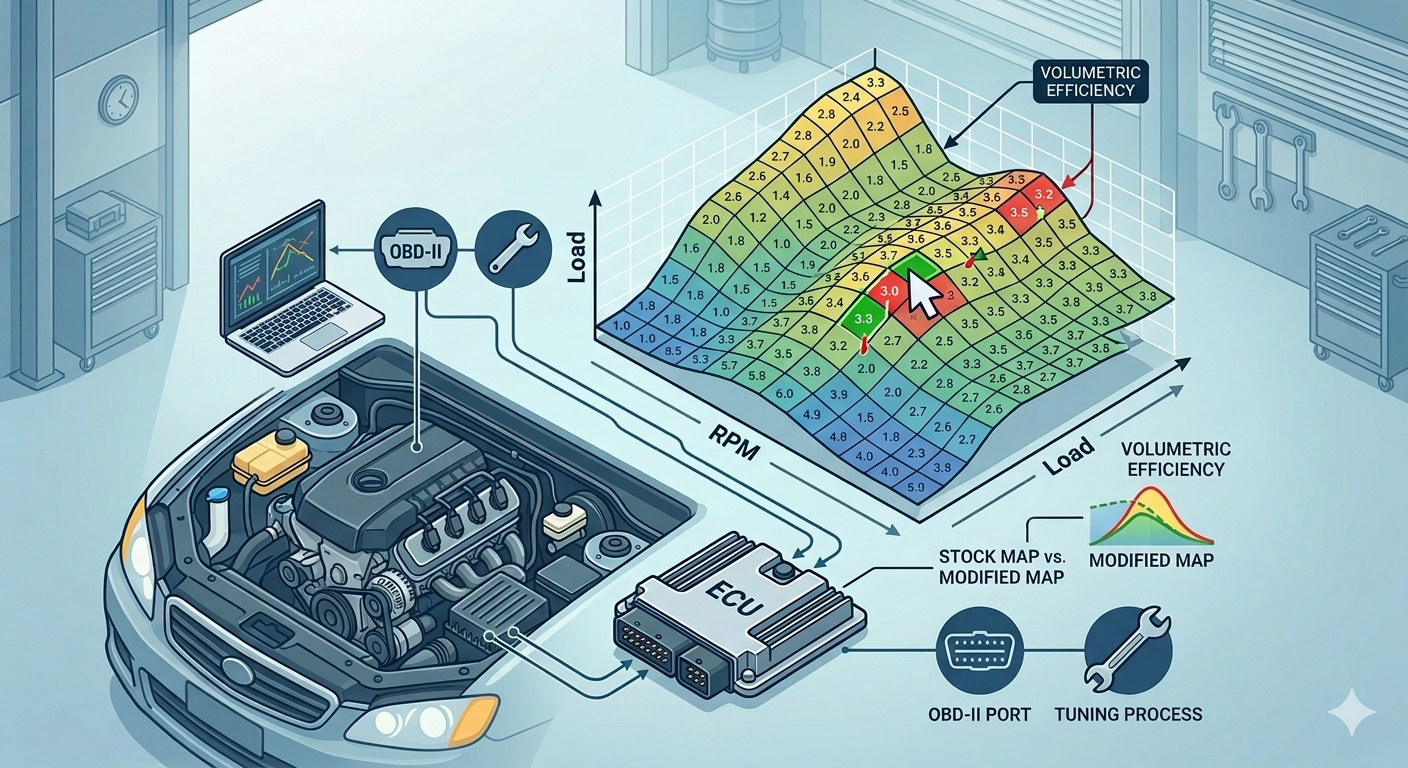
- Volumetric Efficiency Refinement: Precisely mapping the engine’s breathing efficiency across the RPM range to ensure accurate air mass calculation and appropriate fuel delivery.
- Transient Fueling Optimization: Fine-tuning acceleration enrichment and deceleration fuel cut parameters for seamless throttle response.
- Injector Minimum Pulse Width Mapping: Identifying and programming the minimum stable pulse width to prevent unstable operation at light loads.
- Closed Loop Operation Expansion: Extending closed-loop fueling control (using oxygen sensor feedback) to more operating conditions for improved consistency.
These adjustments result in smoother power delivery, more predictable throttle response, and elimination of hesitation or surging during normal driving.
Maximizing Fuel Economy
For those prioritizing efficiency, injector-focused tuning can yield significant improvements in fuel economy without sacrificing reliability:
- Lean Cruise Calibration: Carefully adjusting air-fuel ratios in cruise conditions to operate on the lean side of stoichiometric while maintaining stability.
- Injector Precision Mapping: Detailed calibration of injector response across the entire operating range, with particular attention to the cruise range where most driving occurs.
- Deceleration Fuel Cut Optimization: Extending fuel cut-off during deceleration while maintaining smooth operation when throttle is reapplied.
- Cylinder-to-Cylinder Balancing: Using individual cylinder fuel trim to ensure each cylinder operates at the optimal air-fuel ratio, compensating for differences in air flow distribution or injector variations.
These strategies can improve fuel economy by 5-15% depending on the vehicle and previous calibration, while maintaining excellent drivability.
Direct Injection Specific Strategies
Direct injection systems present unique tuning opportunities and challenges:
- Injection Strategy Optimization: Calibrating multiple injection events per cycle (pre, main, post) to optimize combustion, reduce emissions, and minimize carbon buildup.
- Stratified Charge Operation: Expanding the operating range of stratified charge combustion (where applicable) for improved efficiency.
- Injector Deposit Compensation: Implementing periodic high-pressure injection events to clean injector deposits that commonly affect direct injection systems.
- Integration with Dual-Fuel Systems: For applications with both port and direct injection, optimizing the balance between the two systems for best performance and efficiency.
Direct injection tuning requires specialized knowledge and equipment but offers significant performance and efficiency benefits when properly executed.
Tools and Techniques for Professional Injector Tuning
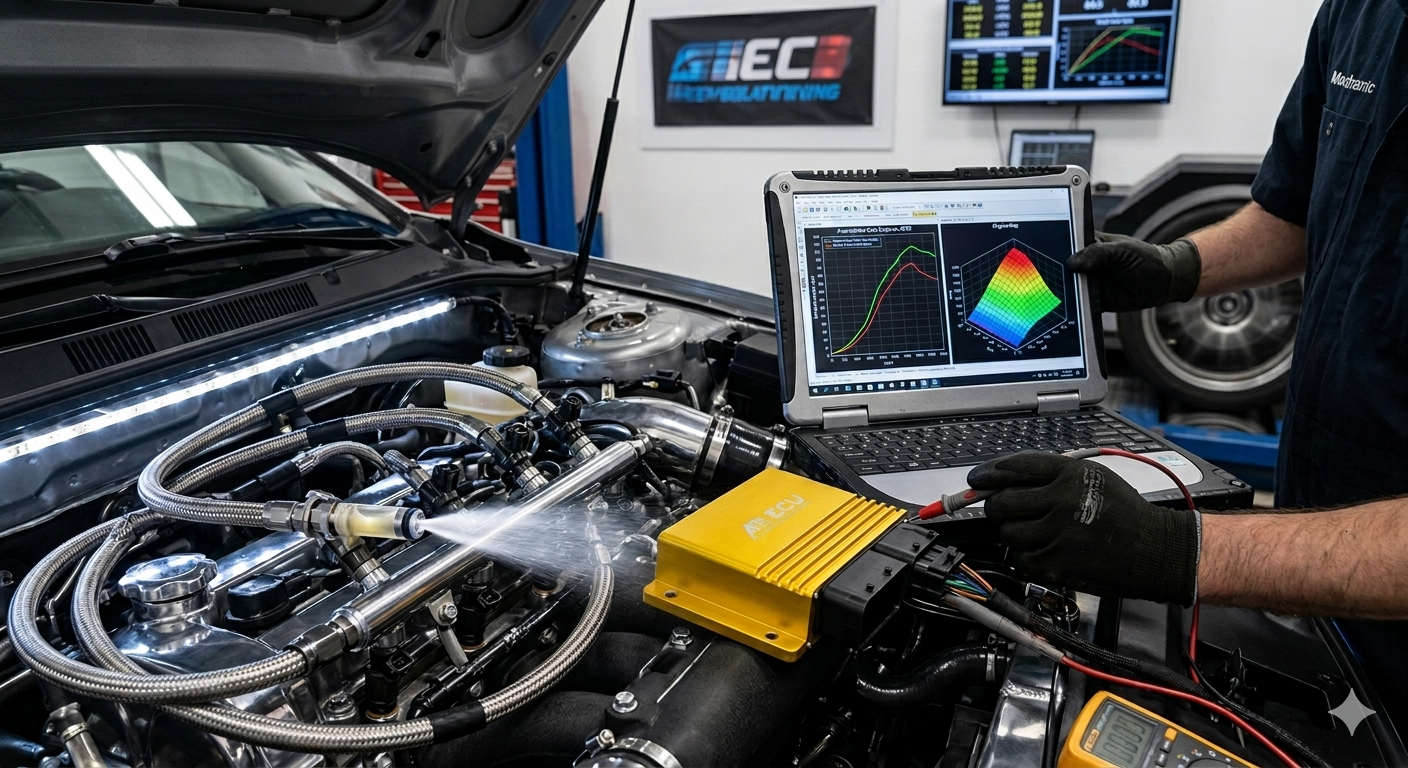
Professional-grade injector tuning requires sophisticated tools and methodologies:
Data Acquisition
Capturing real-time data is essential for effective injector tuning:
- Wide-band Oxygen Sensors: Providing accurate air-fuel ratio feedback across the operating range
- High-Speed Data Logging: Capturing transient conditions that affect injector performance
- Cylinder Pressure Sensors: In advanced applications, directly measuring combustion quality
- Injector Current Probes: Directly measuring actual injector electrical characteristics
Flow Testing and Characterization
Professional tuners often use specialized equipment to measure actual injector performance:
- Injector Flow Benches: Precisely measuring flow rates at various pulse widths and pressures
- Ultrasonic Cleaning Equipment: Restoring injectors to optimal performance before tuning
- Spray Pattern Analysis: Evaluating the quality and distribution of the fuel spray
Dyno Testing
Dynamometer testing allows controlled, repeatable evaluation of performance changes:
- Steady-State Testing: Measuring performance at fixed RPM and load points
- Transient Testing: Evaluating response during acceleration and deceleration
- Environmental Simulation: Testing performance under various temperature conditions
Common Issues and Solutions
Even with proper tuning, certain injector-related issues may arise. Here are common problems and their solutions:
Injector Deposits
Symptoms: Rough idle, hesitation, reduced power Solutions:
- Program periodic cleaning strategies into the ECU (high-pressure injection events)
- Adjust fuel trim compensation to account for flow restrictions
- Recommend quality fuel and proper fuel system maintenance
Inadequate Fuel Supply
Symptoms: Lean conditions under high load, power loss Solutions:
- Verify and tune fuel pressure regulation
- Program fuel pressure safety limits and fallback strategies
- Adjust injector duty cycle limits to prevent overtaxing the fuel system
Injector Failures
Symptoms: Misfires, severe rough running, check engine light Solutions:
- Implement cylinder-specific fuel trim monitoring
- Program misfire detection and protection strategies
- Create safe mode calibrations that protect the engine if injector failure is detected
Conclusion
ECU tuning for enhanced fuel injector performance represents one of the most technical yet rewarding aspects of modern engine management. By understanding the complex relationship between electronic control strategies and physical injector characteristics, skilled tuners can extract remarkable improvements in power, efficiency, and drivability from virtually any fuel-injected engine.
Whether accommodating aftermarket injectors in a high-performance build, resolving drivability issues with stock components, or pursuing maximum efficiency for everyday driving, proper injector-focused tuning is essential. The precision with which modern ECUs can control fuel delivery—down to fractions of a millisecond—provides unprecedented opportunities to optimize combustion across all operating conditions.
For the serious enthusiast, investing in professional injector characterization and ECU calibration delivers benefits that extend far beyond maximum power figures. The improvements in throttle response, cold-start behavior, fuel economy, and overall driving experience often prove more valuable in daily use than headline-grabbing horsepower numbers.
As automotive technology continues to advance, with direct injection becoming ubiquitous and more sophisticated multi-pulse injection strategies emerging, the importance of expert ECU tuning for injector performance will only increase. Those who master these techniques—whether professional tuners or dedicated enthusiasts—will continue to push the boundaries of what’s possible from modern engines while maintaining the reliability and drivability that make performance truly usable.
📺 Watch a real battery testing demo here: Reynlab YouTube Channel
🌐 Explore our automotive training programs: www.reynlab.com/our-courses