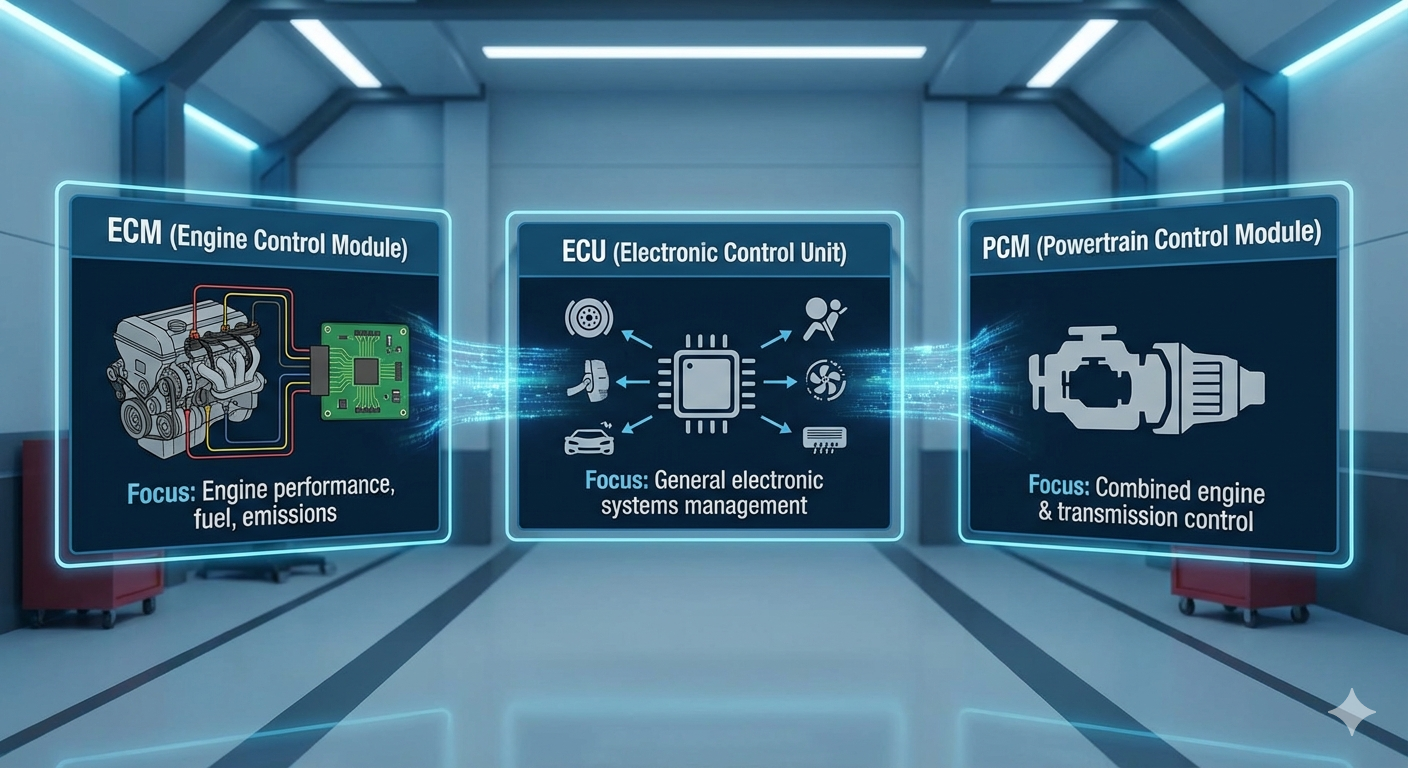
If you’ve ever visited a garage or searched about car electronics, you’ve likely come across three confusing terms:
👉 ECM
👉 ECU
👉 PCM
Many people—including mechanics—use them interchangeably.
👉 But here’s the truth:
They are related, but not the same
Understanding this difference is important if you:
- Want to learn ECM repair
- Own a garage
- Are entering automotive electronics
⚙️ WHAT IS AN ECU? (ELECTRONIC CONTROL UNIT)
Definition:
👉 ECU is a general term for any electronic module that controls a specific function in a car
Types of ECUs in a car:
- Engine Control Module (ECM)
- Transmission Control Module (TCM)
- ABS Control Module
- Airbag Control Module
- Body Control Module (BCM)
👉 Modern vehicles may have 20–100 ECUs
👉 ECU is not one unit—it’s a category
💡 SIMPLE ANALOGY
Think of a car like a company:
- ECU = Employees (many)
- ECM = Engine manager
- PCM = Manager handling engine + transmission
🔧 WHAT IS ECM? (ENGINE CONTROL MODULE)
Definition:
👉 ECM is a type of ECU that controls only the engine
What ECM controls:
- Fuel injection
- Ignition timing
- Air-fuel ratio
- Emission systems
👉 It is the most important ECU in most vehicles
🇮🇳 ECM IN INDIAN CARS
Common in:
- Maruti Suzuki
- Hyundai
- Tata Motors
- Mahindra & Mahindra
👉 Mostly used in entry-level and mid-range vehicles
⚡ WHAT IS PCM? (POWERTRAIN CONTROL MODULE)
Definition:
👉 PCM controls both engine and transmission in a single unit
What PCM controls:
- Engine functions (like ECM)
- Transmission functions (like TCM)
Where it is used:
- Premium cars
- Automatic transmission vehicles
- International models
Examples:
- Ford
- Chevrolet
👉 More common in high-end vehicles
📊 KEY DIFFERENCES: ECM vs ECU vs PCM
- ECU → General category of all control units
- ECM → Controls engine only
- PCM → Controls engine + transmission
Quick understanding:
👉 ECU = Category
👉 ECM = Engine
👉 PCM = Engine + Transmission
🔍 WHY THIS DIFFERENCE MATTERS
Understanding this helps in accurate diagnosis
- ECM failure → Engine issues
- PCM failure → Engine + gear shifting issues
- Other ECU failure → System-specific problems
🛠️ REAL WORKSHOP EXAMPLE
Problem:
- Engine misfire
- Gear shifting issue
👉 If vehicle has PCM:
One module may be responsible
👉 If ECM + TCM are separate:
Both must be diagnosed
⚠️ COMMON CONFUSION IN INDIA
Many workshops say:
👉 “ECU problem”
But actually mean:
- ECM issue
- Sensor issue
- Wiring issue
💡 IMPORTANT TIP FOR BEGINNERS
Never assume ECU = ECM
👉 Always:
- Scan the vehicle
- Identify the module
- Check wiring and sensors
🔗 COMMUNICATION BETWEEN MODULES
Modern cars use CAN Bus (Controller Area Network)
👉 Allows communication between:
- ECM
- PCM
- Other ECUs
Example:
- Accelerator pressed → ECM processes demand
- PCM adjusts gear shifting
- ABS maintains stability
👉 All modules work together
🚨 SYMPTOMS BASED ON MODULE TYPE
ECM Issues:
- Engine not starting
- Poor mileage
- Misfire
PCM Issues:
- Gear shifting problems
- Combined engine + transmission issues
Other ECU Issues:
- ABS warning
- Airbag light
💰 REPAIR VS REPLACEMENT (INDIA CONTEXT)
ECM:
- Replacement: ₹20,000 – ₹80,000
- Repair: ₹3,000 – ₹15,000
PCM:
- Replacement: ₹40,000 – ₹1,50,000
- Repair: ₹8,000 – ₹25,000
👉 PCM is more expensive due to higher complexity
📈 WHY STUDENTS MUST UNDERSTAND THIS
Benefits:
- Better diagnostics
- Higher earning potential
- Ability to handle modern cars
- Strong ECM repair foundation
🚀 FUTURE TRENDS
With:
- BS6 norms
- Hybrid vehicles
- Electric vehicles
👉 Control systems are becoming more integrated
Future direction:
- Centralized modules
- AI-driven diagnostics
❌ COMMON MYTHS
- ❌ ECU and ECM are the same → False
- ❌ PCM is used in all cars → False
- ❌ Modules must always be replaced → False
👉 Many modules can be repaired
❓ FREQUENTLY ASKED QUESTIONS (FAQs)
Q1: Is ECM the same as ECU?
→ No, ECM is a type of ECU
Q2: What is PCM?
→ Controls engine and transmission
Q3: Which is better: ECM or PCM?
→ Depends on vehicle design
Q4: Do all cars have PCM?
→ No, most Indian cars use ECM
Q5: Can PCM be repaired?
→ Yes, but requires advanced skills
🏁 CONCLUSION
Understanding the difference between ECM, ECU, and PCM is fundamental in automotive electronics
👉 Remember:
- ECU = General term
- ECM = Engine control
- PCM = Engine + Transmission
🚀 FINAL TAKEAWAY
This knowledge helps you:
👉 Diagnose problems accurately
👉 Avoid unnecessary replacements
👉 Build strong expertise in ECM repair
📺 Watch a real battery testing demo here: Reynlab YouTube Channel
🌐 Explore our automotive training programs: www.reynlab.com/our-courses