Engine Tuning Before ECUs
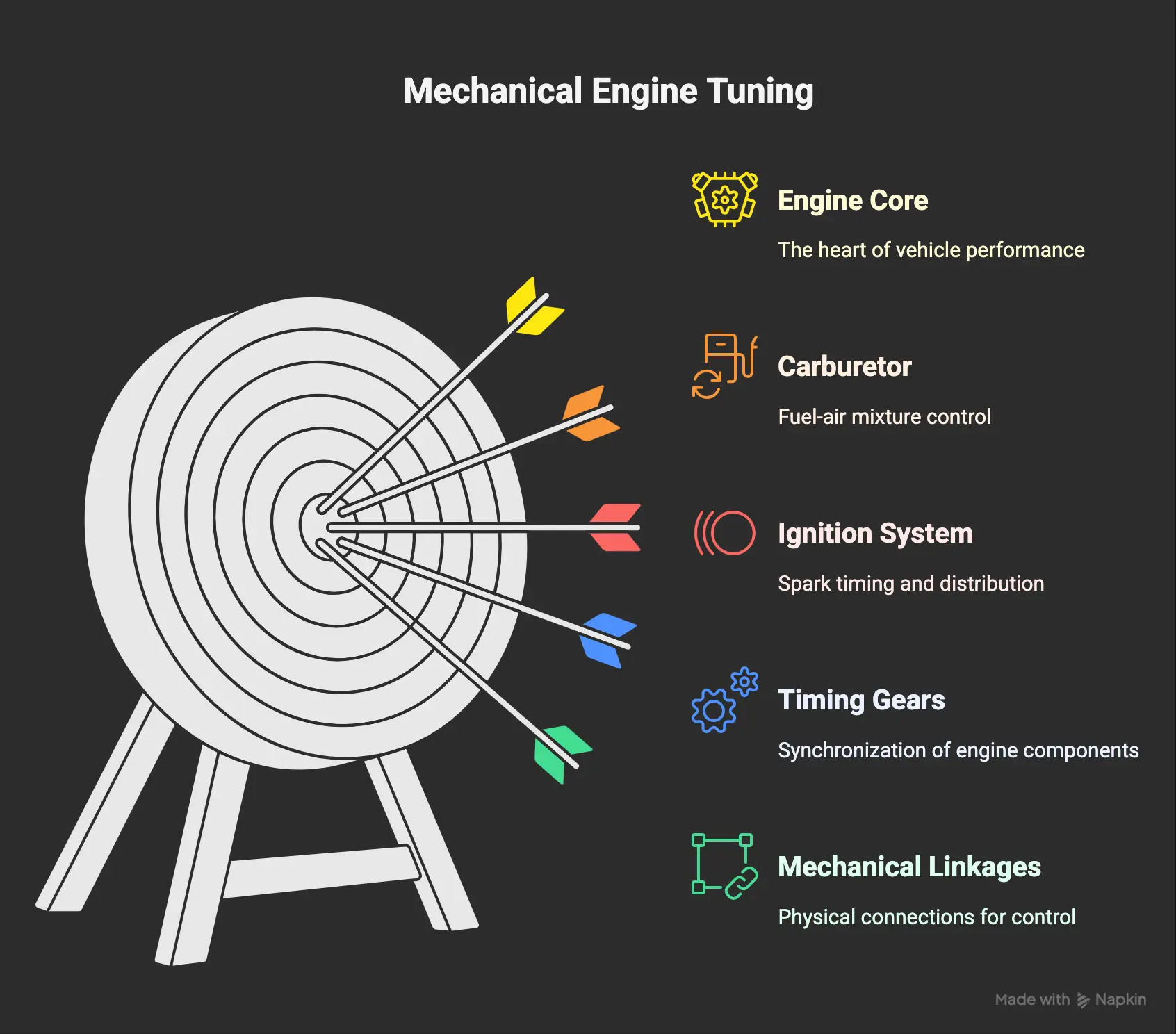
Engine tuning before ECUs
With computerised engine management everywhere, it is easy to forget that vehicles were once tuned by purely mechanical means. Before Electronic Control Units (ECUs) changed the industry, tuning a car or motorcycle engine took patience, skill and mechanical know-how. That heritage still influences tuning culture in India, where young enthusiasts appreciate both vintage and contemporary vehicles.
What is engine tuning?
Engine tuning is the process of modifying an engine's operating parameters to get the best performance, fuel efficiency, reliability, or a balance of these. Today it usually means adjusting software parameters in the ECU. Historically it meant making physical adjustments to engine components.
The carburettor era
The carburettor was the centrepiece of engine tuning before electronic fuel injection became standard. This mechanical device mixed air and fuel in the correct proportions before delivering them to the combustion chambers.
How carburettors work
A carburettor works on the Bernoulli principle: air flowing through a venturi creates a pressure drop that draws fuel into the airstream. The main parts a tuner adjusted were:
- Main jets: control the amount of fuel delivered in mid to high-range operation.
- Pilot jets: deliver fuel at idle and low speeds.
- Needle and jet: control fuel delivery during the transition from low to high speeds.
- Float height: sets the fuel level in the float bowl, which affects overall richness.
- Air screws: fine-tune the air-fuel mixture at idle.
The tuning process
Tuning a carburettor was meticulous work with four stages:
- Baseline setup: establish initial settings from the manufacturer's recommendations.
- Jet selection: choose jet sizes to suit the engine and the environmental conditions.
- Synchronisation: on multi-carburettor setups, make sure all the carburettors work in harmony.
- Mixture adjustment: fine-tune the air-fuel ratio for different operating conditions.
Many older enthusiasts in India fondly remember weekends spent tuning the carburettors on Royal Enfield motorcycles or Ambassador cars. They often developed an intuitive sense of engine performance from sound, smell and feel.
Ignition timing
Ignition timing is when the spark plugs fire in relation to piston position. Before electronic ignition, timing was adjusted mechanically, and it was crucial for engine performance.
Mechanical distributors
The distributor was the heart of the ignition system. It contained contact points (breaker points), which were mechanical switches that opened and closed to create the spark. It also had two mechanical advance mechanisms:
- Centrifugal advance: weights that adjusted timing with engine rpm.
- Vacuum advance: a diaphragm that adjusted timing with engine load.
Adjusting the timing
- Use a timing light. This stroboscopic lamp flashes in sync with the spark, so you can see the timing marks.
- Rotate the distributor. Loosen it and turn it to advance or retard the timing.
- Set the points gap. The gap between the contact points controls dwell time.
- Replace and gap the spark plugs. This makes sure the plugs work properly.
For many Indian mechanics trained in the 1970s and 1980s, setting the timing by ear was a mark of expertise, especially in rural areas where timing lights were not always available.
Valve adjustment
Valve adjustment was another critical part of tuning, and it demanded mechanical skill and precision.
Mechanical valve trains
Before hydraulic lifters became common, engines used:
- Solid lifters: these needed regular adjustment as they wore.
- Rocker arms: they pivoted on shafts or studs to transfer camshaft motion to the valves.
- Pushrods: they connected the camshaft to the rocker arms in overhead valve engines.
The adjustment process
- Measure clearances with feeler gauges, checking the gap between valve components.
- Adjust clearances by turning adjustment screws or replacing shims to set them precisely.
- Set valve lash, so there is proper clearance for thermal expansion in operation.
The engine had to be rotated to specific positions for each cylinder, and every valve was worked through methodically. In India this skill was often passed from master mechanics to apprentices, particularly in the thriving two-wheeler service industry that maintains everything from humble Hero motorcycles to premium imports.
Compression ratio
Compression ratio fundamentally affects engine performance, and it was changed during rebuilds or performance modifications. The methods were:
- Cylinder head milling: removing material from the head to decrease chamber volume.
- Different thickness head gaskets: changing the gasket thickness to alter chamber volume.
- Piston selection: using pistons with different dome or dish configurations.
- Cylinder block decking: machining the block deck surface.
Many mechanically inclined enthusiasts in India changed their motorcycles' compression ratios to cope with varying fuel quality across regions, particularly in remote areas where premium fuel might not be available.
Jetting for altitude and climate
India's geography, from coastal plains to the Himalayan highlands, posed unique challenges for carburetion. Mechanics and riders had to know how to adjust their vehicles for changing conditions:
- Altitude: higher altitudes needed leaner jetting because of reduced air density.
- Temperature: cold weather needed richer mixtures and hot weather leaner ones.
- Humidity: high humidity reduced the oxygen content of the air, so slightly leaner mixtures were needed.
Riders travelling from Delhi to Ladakh, for instance, would often carry different jets and change them as they climbed through dramatic elevation changes.
The tools of the trade
Skilled mechanics accumulated these tools over years:
- Vacuum gauges: measured intake manifold vacuum to assess engine efficiency.
- Dwell meters: measured how long the contact points stayed closed.
- Timing lights: stroboscopic tools for setting ignition timing.
- Compression testers: assessed cylinder compression and engine health.
- Mixture analysers: basic devices that analysed exhaust gas for tuning carburettors.
- Tachometers: measured engine rpm for synchronising multiple carburettors.
- Feeler gauges: used for setting valve clearances and point gaps.
Many of these tools are still found in vintage motorcycle and car workshops across India, particularly in cities with active classic vehicle communities such as Chennai, Pune and Delhi.
Performance modifications
Try this free
India's only virtual dynoEngine Dyno
See what a calibration change does to torque on India’s only virtual dyno.
Try freeBeyond basic tuning, enthusiasts modified their engines for more performance by mechanical means:
- Port and polish: hand-finishing the intake and exhaust ports for better flow.
- Camshaft selection: fitting different profile camshafts to alter valve timing.
- Exhaust system design: building custom exhaust systems with optimised back pressure.
- Intake manifold modifications: polishing or replacing manifolds for better airflow.
- Carburettor sizing: fitting larger or multiple carburettors for more fuel delivery.
This work needed extensive knowledge of engine breathing and how components interact. In India it led to specialised tuning shops in major cities, many of which now offer both mechanical and electronic tuning.
Power versus reliability
One of the greatest challenges was balancing performance gains against reliability and drivability. Mechanical tuners had to consider:
- Heat management: higher performance often meant more heat.
- Fuel quality limitations: modifications had to allow for the fuel actually available.
- Drivability trade-offs: racing-oriented tunes often sacrificed low-end torque and smooth idling.
- Maintenance intervals: higher performance typically meant more frequent maintenance.
This created different tuning philosophies. Some Indian mechanics focused on bulletproof reliability for rural use, while others pursued maximum performance for competitive events.
The sensory side of tuning
Pre-ECU tuning relied on the tuner's senses as much as on data. Experienced tuners used:
- Sound: listening for the distinctive sounds of proper combustion.
- Smell: detecting rich or lean conditions from the exhaust odour.
- Feel: sensing engine vibration and throttle response.
- Sight: reading spark plug condition and exhaust colour.
- Touch: feeling component temperatures and noticing abnormal operation.
This created a deep connection between tuner and machine that many enthusiasts feel has faded in the digital age. Many young Indian enthusiasts still seek out older mechanics to learn these skills, particularly those interested in vintage motorcycles like Yezdis, Jawas and classic Royal Enfields.
The move to electronic systems
The late 1980s and early 1990s saw a gradual shift from purely mechanical tuning to electronic systems. Before full ECUs became standard, transitional technologies included:
- Electronic ignition modules: these replaced points with electronic triggers.
- Transistorised coil ignition: this improved spark energy and reliability.
- Rudimentary fuel injection: early mechanical and simple electronic injection systems.
These systems began appearing in premium vehicles in India in the 1990s and filtered down to mass-market vehicles over the following decades.
Why mechanical tuning still matters in India
Mechanical tuning knowledge is still relevant for several reasons:
- Vintage vehicle maintenance: the thriving classic vehicle scene needs these skills.
- Rural mechanics: in remote areas, mechanical skills remain essential for keeping older vehicles running.
- Understanding fundamentals: mechanical principles help you understand modern electronic systems.
- Self-reliance: being able to tune without electronic diagnostic equipment is still valuable.
Many automotive and mechanical engineering students in India still learn these fundamentals alongside modern electronic systems, which produces a generation that bridges both worlds.
Summary
ECUs have transformed tuning with their precision and adaptability, but mechanical tuning is an important chapter that still influences modern practice. The skills, patience and mechanical sympathy of the pre-ECU era laid the foundation for today's tuning culture.
For young Indian enthusiasts and engineering students, these principles give real insight into how engines work. That holds whether you maintain a classic Royal Enfield, restore a vintage Hindustan Ambassador or tune a modern motorcycle.
The next time you connect a laptop to your vehicle's OBD port, spare a thought for the tuners who got remarkable results with basic tools, keen senses and mechanical ingenuity. Their legacy lives on in the sound of a well-tuned carburettor and the satisfaction of mechanical perfection achieved through skill rather than software.