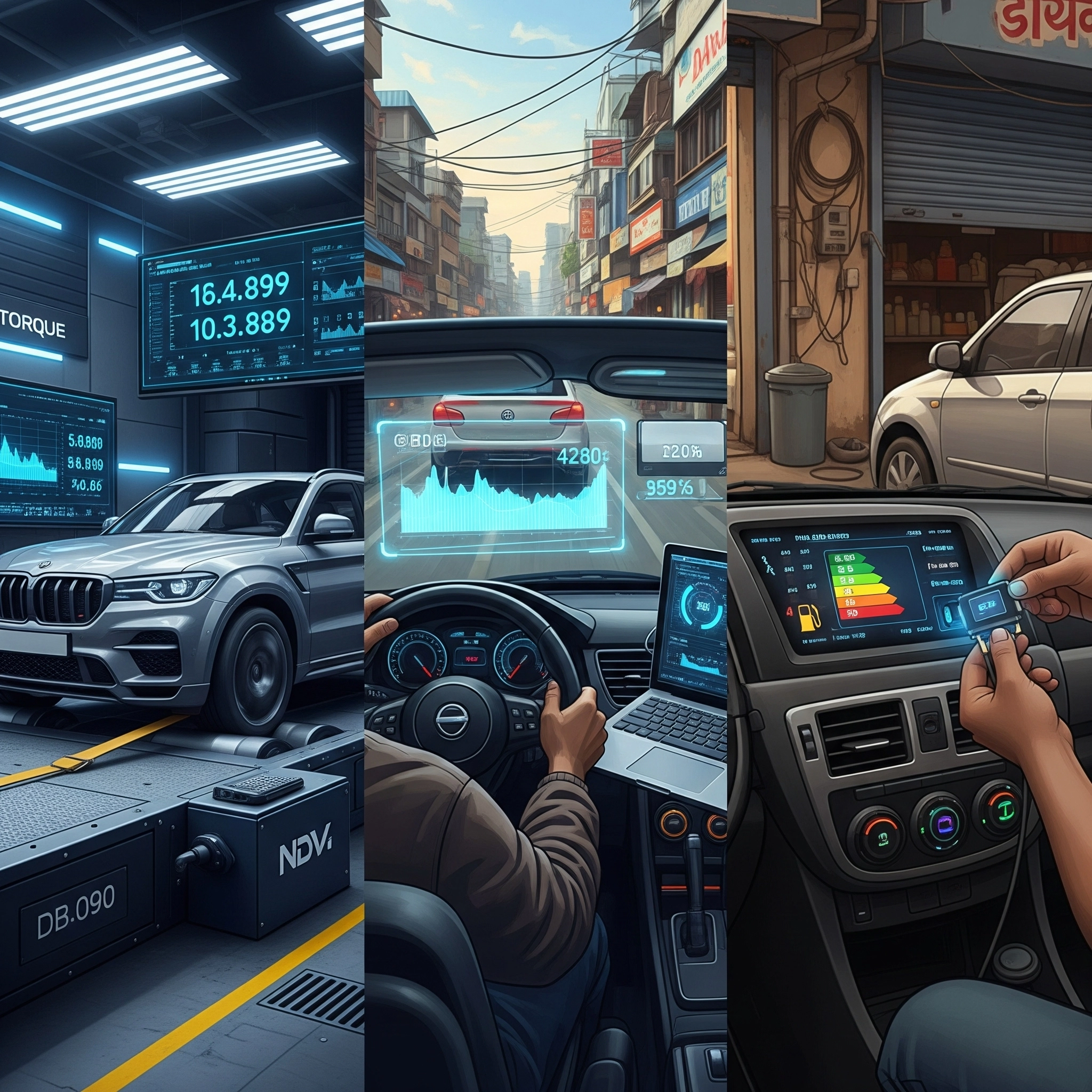
When it comes to ECU tuning, one of the most fundamental decisions tuners face is choosing between OBD-II (On-Board Diagnostics) access and direct ECU access methods like BDM (Background Debug Mode) and JTAG (Joint Test Action Group). Understanding the differences between these approaches is crucial for Indian car tuners, especially students and professionals just starting their journey in automotive performance optimization.
This comprehensive guide explores nine key differences between OBD-II and direct ECU access methods, helping you make informed decisions about which approach suits your specific tuning needs, budget, and skill level.
Understanding the Basics
What is OBD-II Access?
OBD-II is a standardized system implemented in vehicles manufactured after 1996 (in most markets) and 2001 onwards in India. It provides a diagnostic interface that allows external devices to communicate with the vehicle’s ECU through a 16-pin connector typically located under the dashboard.
Key Characteristics:
Access Point: Standardized 16-pin connector
Method: Software-based communication protocols
Invasiveness: Non-invasive, plug-and-play
Reversibility: Completely reversible
Skill Level: Beginner to intermediate
What is Direct ECU Access?
Direct ECU access involves physically opening the ECU housing and connecting directly to the ECU’s internal components using specialized interfaces and protocols. The most common methods include BDM (Background Debug Mode), JTAG (Joint Test Action Group), and Boot Mode.
Key Characteristics:
Access Point: Internal ECU connections
Method: Hardware-based direct communication
Invasiveness: Invasive, requires ECU opening
Reversibility: Reversible but complex Skill Level: Advanced to professional
The 9 Key Differences
- Accessibility and Convenience
OBD-II Access
Advantages:
Quick Connection: Simply plug into the OBD-II port
No Disassembly: No need to remove or open the ECU
On-Vehicle Tuning: Can tune without removing components
Time Efficient: 30-60 minutes for reading/writing Mobile Service Friendly: Ideal for on-site tuning
Process:
- Locate OBD-II port (usually under steering column)
- Connect tuning device via cable
- Turn ignition on (engine off)
- Launch tuning software
- Read/write ECU data
Indian Market Application: Perfect for mobile tuning services in urban areas like Mumbai, Delhi, and Bangalore where customers prefer on-site service. Particularly effective for popular Indian vehicles like Maruti Swift, Hyundai i20, and Honda City.
Limitations:
Only works if ECU manufacturer allows OBD access
Some modern ECUs have locked OBD protocols
Limited access to certain ECU areas
May not work on heavily secured ECUs
Direct ECU Access
Challenges:
ECU Removal Required: Must physically remove ECU from vehicle
Disassembly Needed: ECU housing must be opened
Specialized Tools: Requires BDM frames, JTAG interfaces
Time Intensive: 2-4 hours for complete process
Workshop Required: Not suitable for mobile operations
Process:
- Locate and remove ECU from vehicle
- Open ECU housing carefully
- Identify connection points on PCB
- Connect BDM/JTAG adapter
- Read/write using specialized software
- Reassemble and reinstall
Indian Market Application: Essential for workshop-based operations handling European vehicles (Volkswagen, Skoda, Audi) and newer Maruti models with advanced security. Common in professional tuning centers in Pune, Chennai, and Hyderabad.
Advantages:
Works on virtually any ECU
Bypasses security protocols
Access to all ECU memory areas
Can recover “bricked” ECUs
Typical Scenarios for Indian Tuners:
Scenario | OBD-II | Direct Access |
Maruti Swift (2015) | ✓ Primary method | Used if OBD fails |
VW Polo (2020) | May work | ✓ Often required |
Hyundai Verna (2018) | ✓ Works well | Rarely needed |
Tata Nexon (2021) | ✓ Recommended | Backup option |
Mahindra XUV (2019) | ✓ Usually works | For advanced mods |
- Equipment and Investment Requirements
OBD-II Tuning Equipment
Essential Tools:
Entry Level: ₹15,000-₹30,000
Galletto 1260: ₹10,000
OBD cables: ₹3,000
Basic software: ₹2,000
Professional Level: ₹50,000-₹1,20,000
KESS V2: ₹55,000 (original) / ₹20,000 (clone)
Alientech K-TAG: ₹1,20,000
Professional cables: ₹15,000
ECM Titanium: ₹35,000
Laptop Requirements:
Minimum: Core i5, 8GB RAM, 256GB SSD
Cost: ₹40,000-₹80,000
Operating System: Windows 10/11
Total Investment (Basic): ₹55,000-₹1,10,000 Total Investment (Professional): ₹1,50,000₹3,00,000
Direct ECU Access Equipment
Essential Tools:
Entry Level: ₹40,000-₹80,000 BDM Frame: ₹8,000
JTAG Interface: ₹15,000
Adapter Set: ₹12,000
Reading tool (FG Tech): ₹25,000 Software: ₹20,000
Professional Level: ₹1,50,000-₹4,00,000
Professional BDM/JTAG Station: ₹80,000
Alientech K-TAG Master: ₹1,50,000
Complete Adapter Library: ₹50,000
WinOLS Professional: ₹90,000
Backup systems: ₹30,000
Additional Requirements:
Soldering station: ₹5,000-₹15,000
Microscope or magnifier: ₹8,000-₹25,000
ESD protection equipment: ₹3,000-₹10,000
ECU opening tools: ₹5,000-₹12,000
Total Investment (Basic): ₹95,000-₹1,80,000 Total Investment (Professional): ₹3,00,000₹6,00,000
ROI Comparison for Indian Market:
Investment Level | OBD-II Setup | Direct Access Setup |
Initial Cost | ₹1,00,000 | ₹2,00,000 |
Service Price | ₹10,000 avg | ₹15,000 avg |
Monthly Volume | 30 vehicles | 20 vehicles |
Monthly Revenue | ₹3,00,000 | ₹3,00,000 |
ROI Timeline | 1-2 months | 2-3 months |
- Technical Complexity and Skill Requirements
OBD-II Tuning Complexity
Skill Level: Beginner to Intermediate Learning Timeline: 2-4 months for proficiency
Required Knowledge:
Basic automotive electronics
ECU communication protocols
Software operation
Map identification
Checksum correction
Training Investment:
Online courses: ₹5,000-₹25,000
Professional training: ₹30,000-₹75,000
Self-learning resources: Free-₹10,000
Common Challenges:
Protocol compatibility issues
Communication errors
Security handshake failures
Software configuration
Error Recovery:
Usually simple software reset
Minimal risk of permanent damage
Can retry connection easily
Direct ECU Access Complexity
Skill Level: Advanced to Professional Learning Timeline: 6-12 months for proficiency
Required Knowledge:
Advanced electronics and PCB reading
Soldering and micro-soldering
ECU architecture understanding
Memory mapping knowledge
Hardware troubleshooting
Risk assessment and prevention
Training Investment:
Specialized courses: ₹50,000-₹1,50,000
Hands-on workshops: ₹75,000-₹2,00,000 Apprenticeship: 6-12 months
Common Challenges:
Identifying correct connection points
Avoiding component damage
Dealing with security measures
Recovering from failed attempts
PCB variations between ECU versions
Error Recovery:
Complex and risky
Potential for permanent ECU damage
May require professional ECU repair Expensive if mistakes occur
Skill Development Roadmap:
Months 1-3 (OBD-II Foundation):
Understanding OBD-II protocols
Basic diagnostics
Simple remapping Tool operation
Months 4-6 (Advanced OBD-II):
Complex tuning projects Custom map creation
Problem-solving
Multiple vehicle types
Months 7-9 (Introduction to Direct Access):
ECU architecture
Basic BDM connections
Supervised direct access Risk management
Months 10-12 (Professional Direct Access):
Independent BDM/JTAG work Complex ECU types
Recovery procedures
Advanced troubleshooting
- Vehicle Compatibility and Coverage
OBD-II Compatible Vehicles
High Compatibility (90%+ Success Rate):
Maruti Suzuki (2010-2020)
Hyundai (2012-2020)
Honda (2010-2019)
Ford (2011-2020)
Renault (2012-2019)
Medium Compatibility (60-80% Success Rate):
Volkswagen (varies by model)
Skoda (varies by model)
Tata Motors (newer models)
Mahindra (selective models)
Nissan (2015+)
Low Compatibility (30-50% Success Rate):
Premium European brands (BMW, Mercedes, Audi post-2018)
Latest BS6 models with advanced security
Hybrid and electric vehicles
Commercial vehicles with specialized ECUs
Indian Market Specifics:
CNG Variants: Good OBD-II compatibility
Diesel Models: Generally OBD-II accessible
Turbo Petrol: Mixed compatibility
Automatic Transmissions: Often require direct access for TCU
Direct Access: Universal Solution
Compatibility: 99% of all ECUs can be accessed Application: When OBD-II fails or is unavailable
Common Applications in India:
Volkswagen Group (VAG):
Polo, Vento (2016+)
Skoda Rapid, Octavia
Audi A4, A6 (newer models) Reason: Advanced security protocols blocking OBD
Premium Segments:
Mercedes-Benz C-Class, E-Class
BMW 3-Series, 5-Series
Audi A4, A6, Q5 Reason: Manufacturer security measures
Latest Models:
BS6 compliant vehicles (2020+) Vehicles with encrypted ECUs Advanced safety system integration Reason: Enhanced security features
Recovery Situations:
Failed OBD tuning attempts
Corrupted ECU files
Lost communication
Security lockouts
- Speed and Efficiency
OBD-II Performance
Reading Speed:
Small ECU (256KB): 1-3 minutes
Medium ECU (512KB-1MB): 3-8 minutes
Large ECU (2MB+): 8-15 minutes
Writing Speed:
Small ECU: 2-5 minutes
Medium ECU: 5-12 minutes Large ECU: 12-20 minutes
Total Service Time:
Preparation: 10-15 minutes
Diagnostic Scan: 5-10 minutes
Reading: 3-15 minutes
Map Modification: 30-60 minutes (off-vehicle)
Writing: 5-20 minutes
Verification: 10-15 minutes
Road Testing: 20-30 minutes
Average Total: 90-150 minutes (1.5-2.5 hours)
Vehicles Per Day Potential: 4-6 vehicles
Direct ECU Access Performance
Reading Speed:
Depends on method and ECU size
BDM: 5-15 minutes
JTAG: 10-25 minutes
Boot Mode: 3-8 minutes
Writing Speed:
Similar to reading times
Verification adds 5-10 minutes
Total Service Time:
ECU Removal: 20-45 minutes
ECU Opening: 15-30 minutes
Connection Setup: 10-20 minutes Reading: 5-25 minutes
Map Modification: 30-60 minutes
Writing: 5-25 minutes
ECU Reassembly: 15-30 minutes
ECU Reinstallation: 20-45 minutes
Verification and Testing: 20-30 minutes
Average Total: 180-300 minutes (3-5 hours)
Vehicles Per Day Potential: 2-3 vehicles
Efficiency Comparison:
Metric | OBD-II | Direct Access |
Setup Time | 10-15 min | 60-90 min |
Read/Write | 10-35 min | 20-50 min |
Total Time | 90-150 min | 180-300 min |
Daily Capacity | 4-6 vehicles | 2-3 vehicles |
Service Price | ₹10,000 | ₹15,000 |
Daily Revenue | ₹40,000-60,000 | ₹30,000-45,000 |
- Risk Factors and Safety
OBD-II Risks
Risk Level: Low to Medium
Potential Issues:
Communication Errors: 5-10% occurrence
Impact: Failed tuning attempt
Recovery: Retry connection Cost: Time only
Incomplete Writing: 2-5% occurrence Impact: ECU may not start
Recovery: Rewrite original file
Cost: Additional service time
Checksum Errors: 3-7% occurrence Impact: ECU warning lights
Recovery: Correct and rewrite Cost: Minimal
Security Lockouts: 1-3% occurrence
Impact: Lost OBD access
Recovery: Requires direct access
Cost: ₹5,000-15,000
Overall ECU Damage Risk: <1%
Safety Measures:
Always create backup before writing
Verify battery voltage (>12.5V) Ensure stable power supply Use quality cables and tools
Follow proper protocols
Direct Access Risks
Risk Level: Medium to High
Potential Issues:
Component Damage: 5-15% for beginners
Impact: Permanent ECU damage
Recovery: ECU repair/replacement Cost: ₹15,000-80,000
Incorrect Connection: 10-20% for beginners
Impact: Failed reading or ECU damage
Recovery: Varies by severity Cost: ₹0-50,000
Static Discharge: 2-5% occurrence Impact: Component failure
Recovery: Often irreversible Cost: ₹20,000-80,000
Soldering Damage: 3-8% for beginners
Impact: Lifted pads, broken traces
Recovery: Professional PCB repair
Cost: ₹10,000-40,000
Overall ECU Damage Risk: 5-20% for beginners, <2% for professionals
Safety Measures:
ESD protection mandatory
Proper lighting and magnification
Quality soldering equipment
Practice on junk ECUs
Insurance coverage recommended
Comprehensive training essential
Risk Mitigation Strategies:
For OBD-II:
Use reliable tools from reputable brands
Keep software updated
Maintain backup files
Test in safe environment first
For Direct Access:
Extensive training before attempting
Start with low-value ECUs
Use proper ESD protection
Have ECU repair contacts
Maintain professional liability insurance
Document all procedures
- Versatility and Capability
OBD-II Capabilities
What You Can Do:
Read and write ECU calibration files
Clear diagnostic trouble codes
Monitor real-time data
Perform basic diagnostics
Flash performance maps Reset adaptations
Limitations:
Cannot access locked ECUs
Limited to manufacturer-allowed areas
Cannot recover “bricked” ECUs
May not access all memory regions
Security-dependent functionality
Typical Modifications:
Fuel maps optimization
Ignition timing adjustment
Boost pressure control (turbo)
Rev limiter modification
Speed limiter removal
Lambda target adjustments
Cannot Typically Access:
Immobilizer data
VIN information (locked) Secure boot areas
Encrypted regions
Some TCU functions
Direct Access Capabilities
What You Can Do:
Access any ECU memory region Bypass security protocols
Recover corrupted ECUs
Clone ECUs
Modify immobilizer data
Read encrypted data
Access boot loaders
Perform micro-level modifications
No Limitations:
Works regardless of security
Full ECU memory access
Can fix “bricked” units
Access to all calibration areas
Advanced Modifications:
Complete ECU cloning
VIN modification (where legal)
Immobilizer programming
Advanced safety system modification
Custom firmware installation
Hybrid system optimization
Recovery Capabilities:
Restore failed OBD tuning
Fix communication errors
Recover from power loss during writing
Repair corrupted firmware
Professional Applications:
ECU repair services
Advanced custom tuning
Race car calibration
Commercial fleet optimization
Research and development
- Legal and Warranty Implications
OBD-II Legal Status
In India:
Legal for Diagnostics: Fully legal
Performance Tuning: Gray area
Emissions Impact: Must maintain BS6 compliance Insurance: May affect claims
Warranty Impact:
Detection: Moderate difficulty
Manufacturer Response: Varies by brand
Evidence: Flash counters may show modification Reversal: Easy to return to stock
Best Practices:
Keep original files backed up
Ensure emissions compliance
Inform customers about warranty
Document all work
Detectability:
Flash counters: Often visible
Software version: May show mismatch
Diagnostic history: Can be traced
Emission tests: Modified parameters detectable
Direct ECU Access Legal Status
In India:
ECU Opening: Not specifically illegal Modification: Same as OBD-II tuning Immobilizer Work: Restricted
Cloning: Legal issues if unauthorized
Warranty Impact:
Detection: Physical evidence (opened ECU)
Manufacturer Response: Likely warranty void
Evidence: Tamper seals broken, visible opening Reversal: Cannot hide physical access
Additional Concerns:
Breaking tamper seals
Physical evidence of access PCB modifications visible
Potential for misuse
Risk Management:
Clear customer disclosure
Comprehensive liability insurance
Proper documentation
Legal consultation recommended
- Cost Analysis and ROI
OBD-II Service Economics
Per Vehicle Costs:
Software/Maps: ₹500-2,000
Time (2 hours): Labor cost
Consumables: Minimal
Overhead: ₹200-500
Pricing Structure:
Budget Market: ₹6,000-10,000
Mid-Range: ₹10,000-18,000 Premium: ₹18,000-30,000 Profit Margins:
Gross Margin: 85-92%
Net Margin: 70-85% (after expenses)
Monthly Revenue Potential:
Part-Time (30 vehicles): ₹3,00,000
Full-Time (80 vehicles): ₹8,00,000
Established (120 vehicles): ₹12,00,000
Direct Access Service Economics Per Vehicle Costs:
Software/Maps: ₹1,000-3,000
Time (4 hours): Labor cost
Consumables: ₹200-800
Risk Premium: ₹500-1,500
Pricing Structure:
Standard Service: ₹12,000-18,000
Complex ECUs: ₹18,000-30,000
Recovery Service: ₹20,000-40,000 Premium/Race: ₹30,000-60,000
Profit Margins:
Gross Margin: 75-88%
Net Margin: 60-75% (after expenses and risk)
Monthly Revenue Potential:
Part-Time (20 vehicles): ₹3,00,000
Full-Time (45 vehicles): ₹6,75,000
Established (60 vehicles): ₹9,00,000
Combined Approach ROI:
Month | OBD-II Services | Direct Access | Total Revenue |
Month 1-3 | 40 @ ₹12,000 | 10 @ ₹18,000 | ₹6,60,000 |
Month 4-6 | 60 @ ₹12,000 | 15 @ ₹20,000 | ₹10,20,000 |
Month 7-12 | 80 @ ₹12,000 | 20 @ ₹22,000 | ₹14,00,000 |
Choosing the Right Approach: Decision Matrix
When to Use OBD-II
Ideal Scenarios:
Vehicle supports OBD tuning
Mobile tuning service
Time-sensitive projects
Beginner to intermediate skill level
Budget-conscious operation
High-volume tuning business
Reversible modifications required
Best for These Vehicles:
Maruti Suzuki (2008-2020)
Hyundai/Kia (2010-2020)
Honda (2010-2019)
Ford (2011-2020)
Renault/Nissan (2012-2019)
Tata Motors (selective models)
When to Use Direct Access
Ideal Scenarios:
OBD access blocked or unavailable
Advanced security systems
ECU recovery needed
Premium vehicle tuning
Workshop-based operation
Professional/race applications
Complete ECU access required
Best for These Vehicles:
Volkswagen/Skoda/Audi (2016+)
Premium brands (BMW, Mercedes, Audi)
Latest BS6 models with security
Failed OBD tuning attempts
Specialized commercial vehicles
Custom/race applications
Hybrid Approach (Recommended for Professionals)
Equipment Investment: ₹2,50,000-4,50,000 Capability: 95% of market coverage Revenue Potential: ₹8,00,000-15,00,000 monthly Strategy:
- Start with OBD-II for 70-80% of work
- Use direct access for remaining 20-30%
- Premium pricing for direct access services
- Build reputation with reliable OBD work
- Expand to complex cases gradually
Practical Recommendations for Indian Students
Learning Path
Stage 1: Foundation (Months 1-4)
Focus: OBD-II tuning exclusively
Investment: ₹50,000-₹1,00,000
Practice vehicles: 20-30
Revenue target: ₹1,00,000-2,00,000
Stage 2: Proficiency (Months 5-8)
Focus: Advanced OBD-II, intro to direct access
Investment: ₹50,000-₹1,00,000 additional
Practice vehicles: 40-50
Revenue target: ₹3,00,000-5,00,000
Stage 3: Professional (Months 9-12)
Focus: Combined approach mastery
Investment: ₹1,00,000-₹2,00,000 additional
Practice vehicles: 60-80
Revenue target: ₹5,00,000-8,00,000
Equipment Priorities
Year 1:
Quality OBD-II tool: ₹50,000-₹80,000
Professional laptop: ₹60,000
Basic software: ₹20,000-₹40,000
Training: ₹30,000-₹50,000
Year 2:
Direct access equipment: ₹1,00,000-₹2,00,000
Advanced software: ₹40,000-₹80,000
Specialized training: ₹50,000-₹1,00,000
Conclusion
Both OBD-II and direct ECU access methods have their place in modern automotive tuning. For Indian car tuners, especially students and new professionals, understanding these nine key differences is essential for making informed decisions about equipment investment, skill development, and service offerings.
Key Takeaways:
- Start with OBD-II for lower investment and faster learning curve
- Progress to direct access as skills and business grow
- Combine both methods for maximum market coverage
- Prioritize safety and proper training at every stage
- Understand legal implications and maintain compliance
- Focus on quality service over volume initially
- Invest in continuous learning and skill development
- Build strong customer relationships through reliable work
- Plan for long-term growth with staged equipment investment
The Indian automotive tuning market offers excellent opportunities for skilled professionals who master both OBD-II and direct access techniques. By starting with OBD-II tuning and gradually expanding to direct access methods, Indian students can build successful careers in this growing industry while managing risk and investment effectively.
Remember that success in ECU tuning comes not just from technical skills but from combining technical expertise with business acumen, customer service excellence, and commitment to safety and legal compliance.
Ready to master both OBD-II and direct ECU access methods? Join our comprehensive training program that covers both approaches with hands-on practice, real-world projects, and ongoing mentorship to ensure your success in the automotive tuning industry.
📺 Watch a real battery testing demo here: Reynlab YouTube Channel
🌐 Explore our automotive training programs: www.reynlab.com/our-courses