Introduction
In today’s automotive landscape, electronic control units (ECUs) serve as the digital brains behind modern vehicles. For performance enthusiasts in India, ECU tuning represents an enticing pathway to unlock hidden potential in their cars without extensive mechanical modifications. However, this practice isn’t without risks, particularly regarding how it affects critical vehicle stability systems.
This comprehensive guide explores the complex relationship between ECU tuning and vehicle stability systems, providing essential knowledge for Indian automotive engineering students and car enthusiasts alike. We’ll examine how modifications to your vehicle’s electronic brain can impact safety features that might one day save your life on India’s diverse and challenging roadways.
Understanding ECU Fundamentals
What Exactly is an ECU?
The Electronic Control Unit (ECU) functions as your vehicle’s central computer, processing data from numerous sensors throughout the car and making real-time adjustments to various systems. Modern vehicles typically contain multiple specialized ECUs working in harmony to control everything from engine performance to stability systems.
In Indian market vehicles, from affordable hatchbacks like the Tata Tiago to premium sedans like the Honda City, ECUs manage crucial parameters including:
- Fuel injection timing and quantity
- Ignition timing
- Turbocharger boost pressure (in turbocharged vehicles)
- Throttle response
- Shift points (in automatic transmissions)
- Anti-lock braking system (ABS) operation
- Traction control engagement
- Electronic stability control interventions
The Rise of ECU Tuning in India
ECU tuning has gained significant popularity among India’s younger car enthusiasts, primarily due to the considerable performance gains possible without expensive hardware upgrades. This is especially appealing in the Indian market, where import duties and taxes make aftermarket parts costly.
For many Indian engineering students and young professionals, ECU tuning represents an accessible entry point into vehicle modification. Cities like Delhi, Mumbai, Bangalore, and Chennai now host numerous tuning shops catering to this growing demand.
ECU Tuning Explained
What is ECU Tuning/Remapping?
ECU tuning (also called remapping or flashing) involves modifying the software parameters that govern how your vehicle’s computer makes decisions. Factory ECU settings are typically conservative, prioritizing reliability, emissions compliance, and fuel economy over maximum performance.
Tuning adjusts these parameters to extract additional performance, typically focusing on:
- Power and Torque Increases: By optimizing fuel and ignition maps
- Throttle Response: Creating more immediate engine response to pedal inputs
- Removing Limitations: Such as top speed governors or rev limiters
- Turbo Boost Adjustment: Increasing boost pressure in turbocharged engines
For Indian market vehicles like the Hyundai i20 N Line, Skoda Octavia RS, or Mahindra XUV700, quality tuning can yield power increases of 10-25% depending on the engine design and original state of tune.
Common ECU Tuning Methods
- Chip Tuning
Traditional chip tuning involves physically replacing or modifying the ECU’s microchip. While this method was common in older vehicles, it’s increasingly rare in modern cars with sophisticated, integrated ECUs.
- OBD Flashing
This method uses the vehicle’s on-board diagnostics (OBD) port to rewrite the ECU software. It’s the most common approach in India today, offering convenience and reversibility. Popular devices like the EvoTech PowerControl or Racechip connect through the OBD-II port for relatively straightforward installation.
- Bench Flashing
This more invasive approach requires removing the ECU from the vehicle and reprogramming it on a specialized “bench.” While more time-consuming, it allows for deeper modifications and is often necessary for heavily modified vehicles.
- Piggyback Systems
These systems intercept and modify sensor signals before they reach the ECU, effectively “tricking” it into adjusting performance parameters. Popular in India due to their non-invasive nature, devices like the Unichip offer modular tuning without permanent ECU modifications.
Vehicle Stability Systems Overview
Critical Safety Systems in Modern Vehicles
Modern vehicles incorporate several electronic stability systems that work together to maintain vehicle control during challenging driving conditions:
- Anti-lock Braking System (ABS)
ABS prevents wheel lockup during heavy braking, maintaining steering control and reducing stopping distances on slippery surfaces. This is particularly valuable during India’s monsoon season when roads become treacherously slick.
- Electronic Stability Control (ESC/ESP)
ESP detects and reduces loss of traction, helping prevent skids and maintaining the vehicle’s intended direction. It’s especially important on India’s varied road conditions, from smooth highways to unpredictable rural roads.
- Traction Control System (TCS)
TCS prevents wheel spin during acceleration by reducing engine power or applying brake pressure to specific wheels. This improves vehicle stability on low-friction surfaces like wet roads common during Indian monsoons.
- Electronic Brake-force Distribution (EBD)
EBD optimizes brake pressure between front and rear wheels based on load conditions, enhancing stability during emergency stopping.
- Brake Assist System (BAS)
BAS detects emergency braking situations and automatically increases braking pressure to reduce stopping distances. This can be crucial on India’s congested urban roads where sudden stops are common.
How These Systems Communicate with the ECU
These stability systems don’t operate in isolation—they constantly communicate with the engine ECU and each other through the vehicle’s Controller Area Network (CAN). This communication ensures coordinated responses to changing driving conditions.
For example, when ESP detects potential understeer, it may request the engine ECU to reduce power while simultaneously applying brake pressure to specific wheels. This complex dance of electronic systems happens within milliseconds, often without the driver’s awareness.
How ECU Tuning Affects Vehicle Stability Systems
The Interconnected Relationship
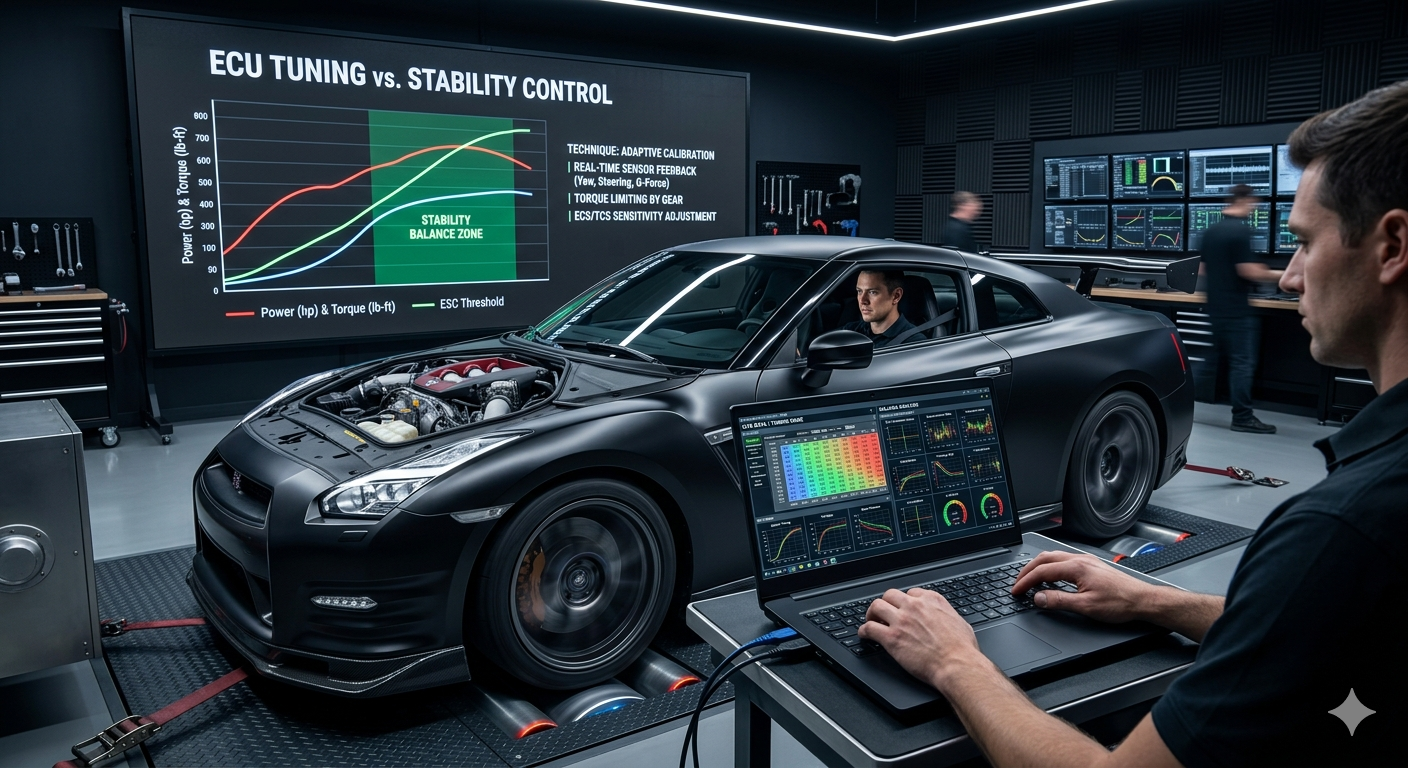
When an ECU is tuned for increased performance, several changes can affect how stability systems function:
- Increased Torque and Power
Tuning typically increases engine torque, especially in the mid-range. While this improves acceleration, it also means stability systems must work harder to manage the additional power, particularly in front-wheel-drive vehicles common in India like the Honda City or Hyundai Verna.
- Modified Throttle Maps
More aggressive throttle mapping (the relationship between pedal position and throttle opening) can create more sudden power delivery, potentially challenging traction control systems on wet or uneven road surfaces.
- Altered Sensor Parameters
Some tunes modify how the ECU interprets sensor data, which can affect how quickly stability systems detect and respond to traction loss.
Specific Impacts on Key Safety Systems
Impact on ABS
ECU tuning typically has minimal direct impact on ABS function, as these systems operate relatively independently. However, increased vehicle performance can mean higher speeds and more demanding braking scenarios, potentially pushing the ABS system closer to its operational limits.
Impact on Traction Control
Traction control systems are significantly affected by ECU tuning, particularly in high-torque scenarios. When engine power increases substantially, the stock traction control may become either:
- Overly Intrusive: Constantly engaging and reducing driver enjoyment
- Insufficient: Unable to properly manage the increased power in low-traction situations
Impact on Electronic Stability Control
ESC systems face similar challenges when vehicle performance increases. The stock calibration may not be optimized for the new power delivery characteristics, potentially reducing effectiveness or creating overly aggressive interventions.
Case Studies: Real-World Examples from Indian Roads
Case Study 1: Turbocharged Hatchbacks
Popular turbocharged hatchbacks in India like the Volkswagen Polo GT TSI respond dramatically to ECU tuning. A standard remap can increase output from approximately 110 PS to 130-140 PS. In dry conditions, this typically presents few issues for stability systems.
However, during monsoon season, when roads are slick with water, the increased torque can overwhelm the front wheels during cornering or when driving over standing water. In these scenarios, owners report more frequent and sometimes unpredictable traction control interventions.
Case Study 2: Premium Sedans with Performance Tunes
Models like the Skoda Octavia and Honda Civic with aggressive ECU tunes often require complementary modifications to traction and stability systems. Without these adjustments, drivers report situations where:
- Traction control cuts power too aggressively during spirited driving
- ESP interventions feel unnatural or occur at inappropriate times
- The vehicle’s handling characteristics become less predictable in limit situations
Case Study 3: SUVs with Increased Torque
Popular Indian market SUVs like the Mahindra Thar and Tata Harrier see substantial torque increases from ECU tuning. While beneficial for off-road performance, this additional torque can affect on-road stability, particularly during cornering where weight transfer is already significant.
Professional tuning shops in Bangalore and Delhi now specifically offer stability system recalibration alongside ECU tuning for these vehicles to maintain safety margins.
Best Practices for Safe ECU Tuning
Maintaining Stability System Functionality
For students and enthusiasts considering ECU tuning, following these guidelines can help maintain safe vehicle operation:
- Choose Reputable Tuners
Select established tuning services with specific experience with your vehicle model. In India, look for shops with verifiable testimonials and a history of successful tunes on similar vehicles.
- Consider Comprehensive Tuning Packages
Quality tuners don’t just focus on maximizing power—they also recalibrate stability systems to work harmoniously with the new performance parameters. This might include:
- Adjusting traction control thresholds
- Recalibrating ESP intervention points
- Fine-tuning ABS operation for changed vehicle dynamics
- Stage Your Modifications
Rather than immediately pushing for maximum performance, consider a staged approach:
- Stage 1: Conservative ECU tune with minimal stability system impact
- Stage 2: Moderate performance increases with stability system adjustments
- Stage 3: Maximum performance requiring comprehensive stability system recalibration
- Test Under Various Conditions
After tuning, gradually test your vehicle in various conditions before pushing limits:
- Dry roads with good visibility
- Wet conditions with cautious driving
- Different loads (passengers, cargo)
- Various road surfaces common in India (smooth highways, rough rural roads)
Legal and Warranty Considerations in India
Indian vehicle owners should be aware of several important considerations before ECU tuning:
- Warranty Implications
Most manufacturer warranties in India become void with ECU modifications. Some premium brands like Mercedes-Benz and BMW actively scan for tuning during service visits.
- Insurance Concerns
Many Indian insurance policies require disclosure of performance modifications. Undisclosed modifications can lead to claim denials in accident situations.
- Emissions Compliance
India’s increasingly strict BS6 emissions standards mean that improper tuning could render your vehicle non-compliant. Quality tunes maintain emissions control functionality while improving performance.
- Regional Transport Office (RTO) Regulations
Some states have specific regulations regarding engine modifications. Always check local RTO guidelines before proceeding with significant performance alterations.
Advanced Tuning Considerations for Engineering Students
Understanding ECU Communication Protocols
For automotive engineering students, understanding the communication protocols between the ECU and stability systems provides valuable insights:
- CAN Bus Architecture: Modern vehicles use Controller Area Network (CAN) systems for inter-ECU communication
- OBD-II Protocols: Including ISO 9141-2, ISO 14230, SAE J1850, and ISO 15765 (CAN)
- FlexRay: Higher bandwidth protocol used in advanced stability systems
Diagnostic Tools for Analysis
Several diagnostic tools can help engineering students analyze ECU and stability system interactions:
- VCDS (VAG-COM Diagnostic System): Popular for Volkswagen Group vehicles in India
- Launch X431: Widely available diagnostic tool with good coverage of Indian market vehicles
- ELM327-based OBD scanners: Affordable entry-level options for basic monitoring
Future Trends in ECU Tuning and Stability Systems
AI-Driven Adaptive Tuning
The next frontier in ECU tuning involves artificial intelligence systems that can adapt vehicle performance and stability parameters in real time based on:
- Driver behavior patterns
- Road conditions
- Weather factors
- Traffic situations
Several Indian tech startups are currently developing these adaptive systems, particularly for the unique driving conditions found across the subcontinent.
Integration with Advanced Driver Assistance Systems (ADAS)
As ADAS features become more common in Indian market vehicles, ECU tuning will need to consider these additional systems:
- Lane keeping assistance
- Adaptive cruise control
- Emergency braking systems
- Semi-autonomous driving features
Future tuning solutions will likely offer comprehensive packages that optimize performance while maintaining or enhancing these safety systems.
Conclusion
ECU tuning offers exciting possibilities for enhancing vehicle performance, but it requires thoughtful consideration of how these modifications affect critical safety systems. For Indian automotive students and enthusiasts, understanding this complex relationship is essential for making informed decisions about vehicle modifications.
By choosing reputable tuners, taking a methodical approach to modifications, and maintaining awareness of how stability systems interact with performance enhancements, it’s possible to enjoy improved vehicle performance without compromising safety. As automotive technology continues to evolve, the relationship between performance tuning and vehicle safety systems will only become more sophisticated, offering new opportunities for those with the knowledge to navigate this complex terrain.
Whether you’re an engineering student looking to understand automotive systems more deeply or an enthusiast seeking responsible performance upgrades, maintaining this balance between performance and safety should always remain the priority.
FAQs About ECU Tuning and Vehicle Stability
- Will ECU tuning void my car warranty in India? Yes, most manufacturer warranties in India are voided by ECU modifications, though some aftermarket tuners offer their own limited warranties.
- Can I revert to the stock ECU tune if needed? Yes, reputable tuning services in India typically save your vehicle’s original programming, allowing restoration to factory settings.
- How much power increase can I expect from ECU tuning? For Indian market vehicles, typical gains range from 10-25% depending on the engine design, with turbocharged engines generally seeing the largest improvements.
- Is ECU tuning legal in India? ECU tuning itself isn’t explicitly illegal, but modifications that affect emissions or significantly alter vehicle characteristics may violate RTO regulations in some states.
- Should I inform my insurance company about ECU tuning? Yes, failing to disclose significant performance modifications could invalidate your insurance coverage in the event of an accident or claim.
📺 Watch a real battery testing demo here: Reynlab YouTube Channel
🌐 Explore our automotive training programs: www.reynlab.com/our-courses