OBD-II vs Direct ECU Access: What Indian Tuners Need to Know (2025 Guide)
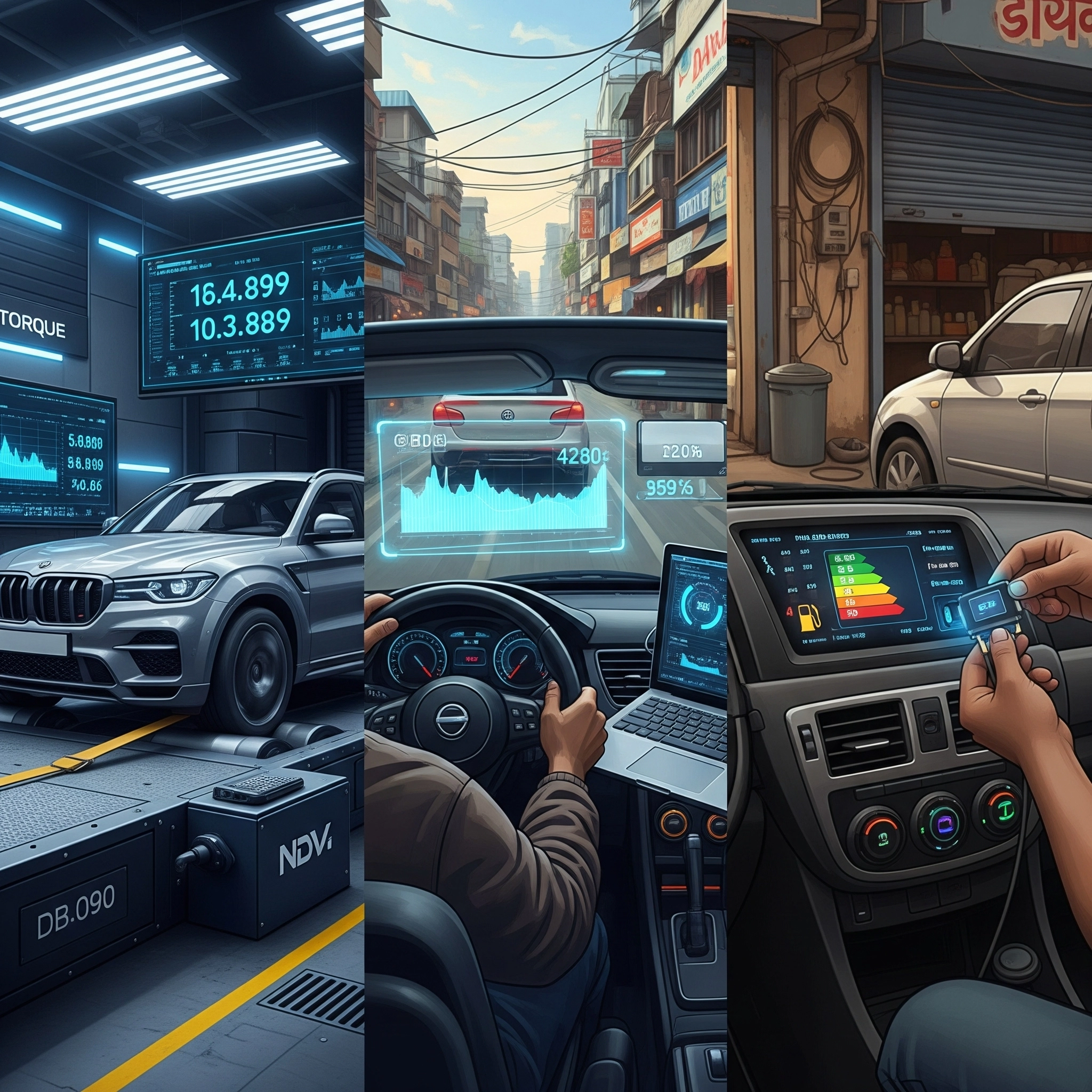
When it comes to ECU tuning, one of the most basic decisions a tuner faces is choosing between OBD-II (On-Board Diagnostics) access and direct ECU access methods such as BDM (Background Debug Mode) and JTAG (Joint Test Action Group). Understanding the difference matters for Indian car tuners, especially students and professionals just starting out in automotive performance work.
This guide covers nine key differences between OBD-II and direct ECU access, to help you decide which approach suits your tuning needs, budget and skill level.
Understanding the basics
What is OBD-II access?
OBD-II is a standardised system implemented in vehicles manufactured after 1996 in most markets, and from 2001 onwards in India. It provides a diagnostic interface that lets external devices communicate with the vehicle's ECU through a 16-pin connector, typically located under the dashboard. Its key characteristics are:
- Access point: standardised 16-pin connector.
- Method: software-based communication protocols.
- Invasiveness: non-invasive and plug-and-play.
- Reversibility: completely reversible.
- Skill level: beginner to intermediate.
What is direct ECU access?
Direct ECU access means physically opening the ECU housing and connecting directly to the ECU's internal components using specialised interfaces and protocols. The most common methods are BDM (Background Debug Mode), JTAG (Joint Test Action Group) and Boot Mode. Its key characteristics are:
- Access point: internal ECU connections.
- Method: hardware-based direct communication.
- Invasiveness: invasive, because the ECU has to be opened.
- Reversibility: reversible but complex.
- Skill level: advanced to professional.
The 9 key differences
1. Accessibility and convenience
OBD-II access
OBD-II access is quick. You simply plug into the OBD-II port, with no need to remove or open the ECU, and you can tune without removing any components. Reading and writing takes 30-60 minutes, and it is ideal for mobile, on-site tuning. The process is:
- Locate the OBD-II port (usually under the steering column).
- Connect the tuning device via cable.
- Turn the ignition on (engine off).
- Launch the tuning software.
- Read and write the ECU data.
In the Indian market this is perfect for mobile tuning services in urban areas like Mumbai, Delhi and Bangalore, where customers prefer on-site service. It is particularly effective for popular Indian vehicles like the Maruti Swift, Hyundai i20 and Honda City.
The limitations are that it only works if the ECU manufacturer allows OBD access, some modern ECUs have locked OBD protocols, access to certain ECU areas is limited, and it may not work on heavily secured ECUs.
Direct ECU access
Direct access is more demanding. The ECU must be physically removed from the vehicle and its housing opened, and you need specialised tools such as BDM frames and JTAG interfaces. The complete process takes 2-4 hours, and it needs a workshop, so it is not suitable for mobile operations. The process is:
- Locate and remove the ECU from the vehicle.
- Open the ECU housing carefully.
- Identify the connection points on the PCB.
- Connect the BDM/JTAG adapter.
- Read and write using specialised software.
- Reassemble and reinstall.
In India it is essential for workshop-based operations handling European vehicles (Volkswagen, Skoda, Audi) and newer Maruti models with advanced security, and it is common in professional tuning centres in Pune, Chennai and Hyderabad.
Its advantages are that it works on virtually any ECU, bypasses security protocols, gives access to all ECU memory areas and can recover "bricked" ECUs.
Typical scenarios for Indian tuners:
| Scenario | OBD-II | Direct Access |
|---|---|---|
| Maruti Swift (2015) | Primary method | Used if OBD fails |
| VW Polo (2020) | May work | Often required |
| Hyundai Verna (2018) | Works well | Rarely needed |
| Tata Nexon (2021) | Recommended | Backup option |
| Mahindra XUV (2019) | Usually works | For advanced mods |
2. Equipment and investment requirements
OBD-II tuning equipment
Entry level costs ₹15,000-₹30,000 and typically includes a Galletto 1260 at ₹10,000, OBD cables at ₹3,000 and basic software at ₹2,000. Professional level costs ₹50,000-₹1,20,000 and includes the KESS V2 at ₹55,000 (original) or ₹20,000 (clone), the Alientech K-TAG at ₹1,20,000, professional cables at ₹15,000 and ECM Titanium at ₹35,000.
You also need a laptop with a minimum of Core i5, 8GB RAM and a 256GB SSD, running Windows 10/11. It costs ₹40,000-₹80,000. The total investment is ₹55,000-₹1,10,000 for a basic setup and ₹1,50,000-₹3,00,000 for a professional one.
Direct ECU access equipment
Entry level costs ₹40,000-₹80,000 and includes a BDM frame at ₹8,000, a JTAG interface at ₹15,000, an adapter set at ₹12,000, a reading tool (FG Tech) at ₹25,000 and software at ₹20,000. Professional level costs ₹1,50,000-₹4,00,000 and includes a professional BDM/JTAG station at ₹80,000, the Alientech K-TAG Master at ₹1,50,000, a complete adapter library at ₹50,000, WinOLS Professional at ₹90,000 and backup systems at ₹30,000.
Additional requirements are:
- Soldering station: ₹5,000-₹15,000
- Microscope or magnifier: ₹8,000-₹25,000
- ESD protection equipment: ₹3,000-₹10,000
- ECU opening tools: ₹5,000-₹12,000
The total investment is ₹95,000-₹1,80,000 for a basic setup and ₹3,00,000-₹6,00,000 for a professional one.
ROI comparison for the Indian market
| Investment Level | OBD-II Setup | Direct Access Setup |
|---|---|---|
| Initial Cost | ₹1,00,000 | ₹2,00,000 |
| Service Price | ₹10,000 avg | ₹15,000 avg |
| Monthly Volume | 30 vehicles | 20 vehicles |
| Monthly Revenue | ₹3,00,000 | ₹3,00,000 |
| ROI Timeline | 1-2 months | 2-3 months |
3. Technical complexity and skill requirements
OBD-II tuning complexity
OBD-II tuning is for beginners to intermediate tuners, and proficiency takes 2-4 months. You need basic automotive electronics, ECU communication protocols, software operation, map identification and checksum correction. Training costs ₹5,000-₹25,000 for online courses, ₹30,000-₹75,000 for professional training, and anything from free to ₹10,000 for self-learning resources.
Common challenges are protocol compatibility issues, communication errors, security handshake failures and software configuration. Error recovery is usually a simple software reset, with minimal risk of permanent damage, and you can retry the connection easily.
Direct ECU access complexity
Direct access is for advanced to professional tuners, and proficiency takes 6-12 months. You need advanced electronics and PCB reading, soldering and micro-soldering, an understanding of ECU architecture, memory mapping knowledge, hardware troubleshooting, and risk assessment and prevention. Training costs ₹50,000-₹1,50,000 for specialised courses and ₹75,000-₹2,00,000 for hands-on workshops, plus an apprenticeship of 6-12 months.
Common challenges are identifying the correct connection points, avoiding component damage, dealing with security measures, recovering from failed attempts and PCB variations between ECU versions. Error recovery is complex and risky. There is potential for permanent ECU damage, it may require professional ECU repair, and it is expensive if mistakes occur.
Skill development roadmap
- Months 1-3 (OBD-II foundation): understanding OBD-II protocols, basic diagnostics, simple remapping and tool operation.
- Months 4-6 (advanced OBD-II): complex tuning projects, custom map creation, problem-solving and multiple vehicle types.
- Months 7-9 (introduction to direct access): ECU architecture, basic BDM connections, supervised direct access and risk management.
- Months 10-12 (professional direct access): independent BDM/JTAG work, complex ECU types, recovery procedures and advanced troubleshooting.
4. Vehicle compatibility and coverage
OBD-II compatible vehicles
- High compatibility (90%+ success rate): Maruti Suzuki (2010-2020), Hyundai (2012-2020), Honda (2010-2019), Ford (2011-2020) and Renault (2012-2019).
- Medium compatibility (60-80% success rate): Volkswagen (varies by model), Skoda (varies by model), Tata Motors (newer models), Mahindra (selective models) and Nissan (2015+).
- Low compatibility (30-50% success rate): premium European brands (BMW, Mercedes, Audi post-2018), the latest BS6 models with advanced security, hybrid and electric vehicles, and commercial vehicles with specialised ECUs.
Some Indian market specifics: CNG variants have good OBD-II compatibility, diesel models are generally OBD-II accessible, turbo petrol has mixed compatibility, and automatic transmissions often require direct access for the TCU.
Direct access: the universal solution
Direct access can reach 99% of all ECUs, and it is the answer when OBD-II fails or is unavailable. Common applications in India are:
- Volkswagen Group (VAG): Polo and Vento (2016+), Skoda Rapid and Octavia, and newer Audi A4 and A6. The reason is advanced security protocols that block OBD.
- Premium segments: Mercedes-Benz C-Class and E-Class, BMW 3-Series and 5-Series, and Audi A4, A6 and Q5. The reason is manufacturer security measures.
- Latest models: BS6 compliant vehicles (2020+), vehicles with encrypted ECUs and advanced safety system integration. The reason is enhanced security features.
- Recovery situations: failed OBD tuning attempts, corrupted ECU files, lost communication and security lockouts.
5. Speed and efficiency
OBD-II performance
Reading takes 1-3 minutes for a small ECU (256KB), 3-8 minutes for a medium ECU (512KB-1MB) and 8-15 minutes for a large ECU (2MB+). Writing takes 2-5 minutes for a small ECU, 5-12 minutes for a medium one and 12-20 minutes for a large one.
The total service time breaks down as:
- Preparation: 10-15 minutes
- Diagnostic scan: 5-10 minutes
- Reading: 3-15 minutes
- Map modification: 30-60 minutes (off-vehicle)
- Writing: 5-20 minutes
- Verification: 10-15 minutes
- Road testing: 20-30 minutes
The average total is 90-150 minutes (1.5-2.5 hours), which allows 4-6 vehicles per day.
Direct ECU access performance
Reading speed depends on the method and ECU size: BDM takes 5-15 minutes, JTAG 10-25 minutes and Boot Mode 3-8 minutes. Writing times are similar to reading, and verification adds 5-10 minutes.
The total service time breaks down as:
- ECU removal: 20-45 minutes
- ECU opening: 15-30 minutes
- Connection setup: 10-20 minutes
- Reading: 5-25 minutes
- Map modification: 30-60 minutes
- Writing: 5-25 minutes
- ECU reassembly: 15-30 minutes
- ECU reinstallation: 20-45 minutes
- Verification and testing: 20-30 minutes
The average total is 180-300 minutes (3-5 hours), which allows 2-3 vehicles per day.
Efficiency comparison
| Metric | OBD-II | Direct Access |
|---|---|---|
| Setup Time | 10-15 min | 60-90 min |
| Read/Write | 10-35 min | 20-50 min |
| Total Time | 90-150 min | 180-300 min |
| Daily Capacity | 4-6 vehicles | 2-3 vehicles |
| Service Price | ₹10,000 | ₹15,000 |
| Daily Revenue | ₹40,000-60,000 | ₹30,000-45,000 |
6. Risk factors and safety
OBD-II risks
The risk level is low to medium. The potential issues are:
- Communication errors (5-10% occurrence): the tuning attempt fails. Recovery is to retry the connection, and the cost is time only.
- Incomplete writing (2-5% occurrence): the ECU may not start. Recovery is to rewrite the original file, at the cost of additional service time.
- Checksum errors (3-7% occurrence): the ECU shows warning lights. Recovery is to correct and rewrite, at minimal cost.
- Security lockouts (1-3% occurrence): OBD access is lost. Recovery requires direct access and costs ₹5,000-15,000.
The overall ECU damage risk is under 1%. Safety measures are to always create a backup before writing, verify battery voltage (above 12.5V), ensure a stable power supply, use quality cables and tools, and follow proper protocols.
Direct access risks
The risk level is medium to high. The potential issues are:
- Component damage (5-15% for beginners): permanent ECU damage. Recovery is ECU repair or replacement, costing ₹15,000-80,000.
- Incorrect connection (10-20% for beginners): a failed reading or ECU damage. Recovery varies by severity, at a cost of ₹0-50,000.
- Static discharge (2-5% occurrence): component failure. Recovery is often irreversible and costs ₹20,000-80,000.
- Soldering damage (3-8% for beginners): lifted pads and broken traces. Recovery is professional PCB repair, costing ₹10,000-40,000.
The overall ECU damage risk is 5-20% for beginners and under 2% for professionals. Safety measures are mandatory ESD protection, proper lighting and magnification, quality soldering equipment, practice on junk ECUs, insurance coverage and comprehensive training.
Risk mitigation strategies
For OBD-II, use reliable tools from reputable brands, keep software updated, maintain backup files and test in a safe environment first.
For direct access, get extensive training before attempting it, start with low-value ECUs, use proper ESD protection, keep ECU repair contacts, maintain professional liability insurance and document all procedures.
7. Versatility and capability
OBD-II capabilities
With OBD-II you can read and write ECU calibration files, clear diagnostic trouble codes, monitor real-time data, perform basic diagnostics, flash performance maps and reset adaptations. Typical modifications are fuel map optimisation, ignition timing adjustment, boost pressure control (turbo), rev limiter modification, speed limiter removal and lambda target adjustments.
The limitations are that you cannot access locked ECUs, you are limited to manufacturer-allowed areas, you cannot recover "bricked" ECUs, you may not reach all memory regions, and functionality depends on security. You typically cannot access immobilizer data, VIN information (locked), secure boot areas, encrypted regions or some TCU functions.
Direct access capabilities
With direct access you can reach any ECU memory region, bypass security protocols, recover corrupted ECUs, clone ECUs, modify immobilizer data, read encrypted data, access boot loaders and make micro-level modifications. There are no limitations: it works regardless of security, gives full ECU memory access, can fix "bricked" units and reaches all calibration areas.
Advanced modifications include complete ECU cloning, VIN modification (where legal), immobilizer programming, advanced safety system modification, custom firmware installation and hybrid system optimisation. For recovery, it can restore failed OBD tuning, fix communication errors, recover from power loss during writing and repair corrupted firmware. Professional applications are ECU repair services, advanced custom tuning, race car calibration, commercial fleet optimisation and research and development.
8. Legal and warranty implications
OBD-II legal status
In India, OBD-II use is fully legal for diagnostics, while performance tuning is a grey area. You must maintain BS6 compliance, and insurance claims may be affected.
On warranty, detection is of moderate difficulty and the manufacturer response varies by brand. Flash counters may show the modification, but it is easy to return to stock. Best practices are to keep the original files backed up, ensure emissions compliance, inform customers about the warranty and document all work. Modification can be detected through flash counters (often visible), software version mismatches, diagnostic history that can be traced, and modified parameters showing up in emission tests.
Direct ECU access legal status
In India, opening an ECU is not specifically illegal, and modification is treated the same as OBD-II tuning. Immobilizer work is restricted, and cloning raises legal issues if unauthorised.
On warranty, the physical evidence of an opened ECU makes detection easy, and the manufacturer will likely void the warranty. Tamper seals are broken and the opening is visible, and you cannot hide the physical access. Additional concerns are broken tamper seals, visible PCB modifications and the potential for misuse. For risk management, give clear customer disclosure, carry comprehensive liability insurance, keep proper documentation and take legal consultation.
9. Cost analysis and ROI
OBD-II service economics
Per-vehicle costs are software/maps at ₹500-2,000, about 2 hours of labour, minimal consumables and overhead of ₹200-500. Pricing is ₹6,000-10,000 in the budget market, ₹10,000-18,000 mid-range and ₹18,000-30,000 premium. Gross margin is 85-92% and net margin is 70-85% after expenses.
Monthly revenue potential is ₹3,00,000 part-time (30 vehicles), ₹8,00,000 full-time (80 vehicles) and ₹12,00,000 for an established business (120 vehicles).
Direct access service economics
Per-vehicle costs are software/maps at ₹1,000-3,000, about 4 hours of labour, consumables of ₹200-800 and a risk premium of ₹500-1,500. Pricing is ₹12,000-18,000 for standard service, ₹18,000-30,000 for complex ECUs, ₹20,000-40,000 for recovery service and ₹30,000-60,000 for premium or race work. Gross margin is 75-88% and net margin is 60-75% after expenses and risk.
Monthly revenue potential is ₹3,00,000 part-time (20 vehicles), ₹6,75,000 full-time (45 vehicles) and ₹9,00,000 for an established business (60 vehicles).
Combined approach ROI
| Month | OBD-II Services | Direct Access | Total Revenue |
|---|---|---|---|
| Month 1-3 | 40 @ ₹12,000 | 10 @ ₹18,000 | ₹6,60,000 |
| Month 4-6 | 60 @ ₹12,000 | 15 @ ₹20,000 | ₹10,20,000 |
| Month 7-12 | 80 @ ₹12,000 | 20 @ ₹22,000 | ₹14,00,000 |
Choosing the right approach: decision matrix
When to use OBD-II
OBD-II is ideal when the vehicle supports OBD tuning, you run a mobile tuning service, projects are time-sensitive, you are a beginner to intermediate tuner, you are budget-conscious, you run a high-volume tuning business or reversible modifications are required. It is best for these vehicles:
- Maruti Suzuki (2008-2020)
- Hyundai/Kia (2010-2020)
- Honda (2010-2019)
- Ford (2011-2020)
- Renault/Nissan (2012-2019)
- Tata Motors (selective models)
When to use direct access
Direct access is ideal when OBD access is blocked or unavailable, advanced security systems are involved, ECU recovery is needed, you are tuning a premium vehicle, you run a workshop-based operation, the work is professional or race-level, or complete ECU access is required. It is best for these vehicles:
- Volkswagen/Skoda/Audi (2016+)
- Premium brands (BMW, Mercedes, Audi)
- Latest BS6 models with security
- Failed OBD tuning attempts
- Specialised commercial vehicles
- Custom/race applications
Hybrid approach (recommended for professionals)
The hybrid approach needs an equipment investment of ₹2,50,000-4,50,000, covers 95% of the market and has a revenue potential of ₹8,00,000-15,00,000 monthly. The strategy is:
- Start with OBD-II for 70-80% of work.
- Use direct access for the remaining 20-30%.
- Charge premium pricing for direct access services.
- Build your reputation with reliable OBD work.
- Expand to complex cases gradually.
Practical recommendations for Indian students
Learning path
- Stage 1, foundation (months 1-4): focus on OBD-II tuning exclusively. Investment is ₹50,000-₹1,00,000, with 20-30 practice vehicles and a revenue target of ₹1,00,000-2,00,000.
- Stage 2, proficiency (months 5-8): focus on advanced OBD-II and an introduction to direct access. Additional investment is ₹50,000-₹1,00,000, with 40-50 practice vehicles and a revenue target of ₹3,00,000-5,00,000.
- Stage 3, professional (months 9-12): focus on mastering the combined approach. Additional investment is ₹1,00,000-₹2,00,000, with 60-80 practice vehicles and a revenue target of ₹5,00,000-8,00,000.
Equipment priorities
In year 1, buy a quality OBD-II tool (₹50,000-₹80,000), a professional laptop (₹60,000), basic software (₹20,000-₹40,000) and training (₹30,000-₹50,000). In year 2, add direct access equipment (₹1,00,000-₹2,00,000), advanced software (₹40,000-₹80,000) and specialised training (₹50,000-₹1,00,000).
Summary
Both OBD-II and direct ECU access have their place in modern automotive tuning. For Indian car tuners, especially students and new professionals, understanding these nine differences is important for decisions about equipment investment, skill development and service offerings. The key takeaways are:
- Start with OBD-II for lower investment and a faster learning curve.
- Progress to direct access as your skills and business grow.
- Combine both methods for maximum market coverage.
- Prioritise safety and proper training at every stage.
- Understand the legal implications and maintain compliance.
- Focus on quality service over volume initially.
- Invest in continuous learning and skill development.
- Build strong customer relationships through reliable work.
- Plan for long-term growth with staged equipment investment.
The Indian automotive tuning market offers good opportunities for skilled professionals who master both OBD-II and direct access techniques. By starting with OBD-II tuning and gradually expanding to direct access, Indian students can build successful careers in this growing industry while managing risk and investment.
Success in ECU tuning comes not just from technical skills but from combining technical expertise with business sense, good customer service and a commitment to safety and legal compliance.
Want to learn both OBD-II and direct ECU access? Our training program covers both approaches with hands-on practice, real-world projects and ongoing mentorship.
Watch our workshop videos on the Reynlab YouTube Channel. You can also explore our automotive training programs at www.reynlab.com/our-courses.
For blog on Ecu tuning & remap
For course on Ecu tuning & remap
Powerful Ways to Refine Engine Output Using ECU Remapping
Expert Strategies for Better Engine Cooling with ECU Remapping