What Is Model Based Development? A Complete Introduction
In the world of embedded systems, automotive electronics, aerospace, and robotics, Model-Based Development (MBD) has become the gold standard for designing, simulating, testing, and deploying complex systems. But what exactly is MBD, and why is it gaining so much traction?
In this complete guide, we’ll explore the core concepts, tools, workflows, and real-world benefits of Model-Based Development, along with a real-world case study from Bosch’s Electric Power Steering (EPS) development.
What Is Model-Based Development?
Model-Based Development (MBD) is a software and system design approach that uses visual models as the central element in the development lifecycle. Instead of writing code first, developers create graphical representations of a system’s behavior, logic, and architecture.
These models are then used to:
- Simulate system behavior
- Validate and verify requirements
- Automatically generate code
- Conduct real-time testing
At its core, MBD emphasizes “design first, code later”. This reduces development time, minimizes errors, and ensures that the system behaves as intended before hardware is even built.
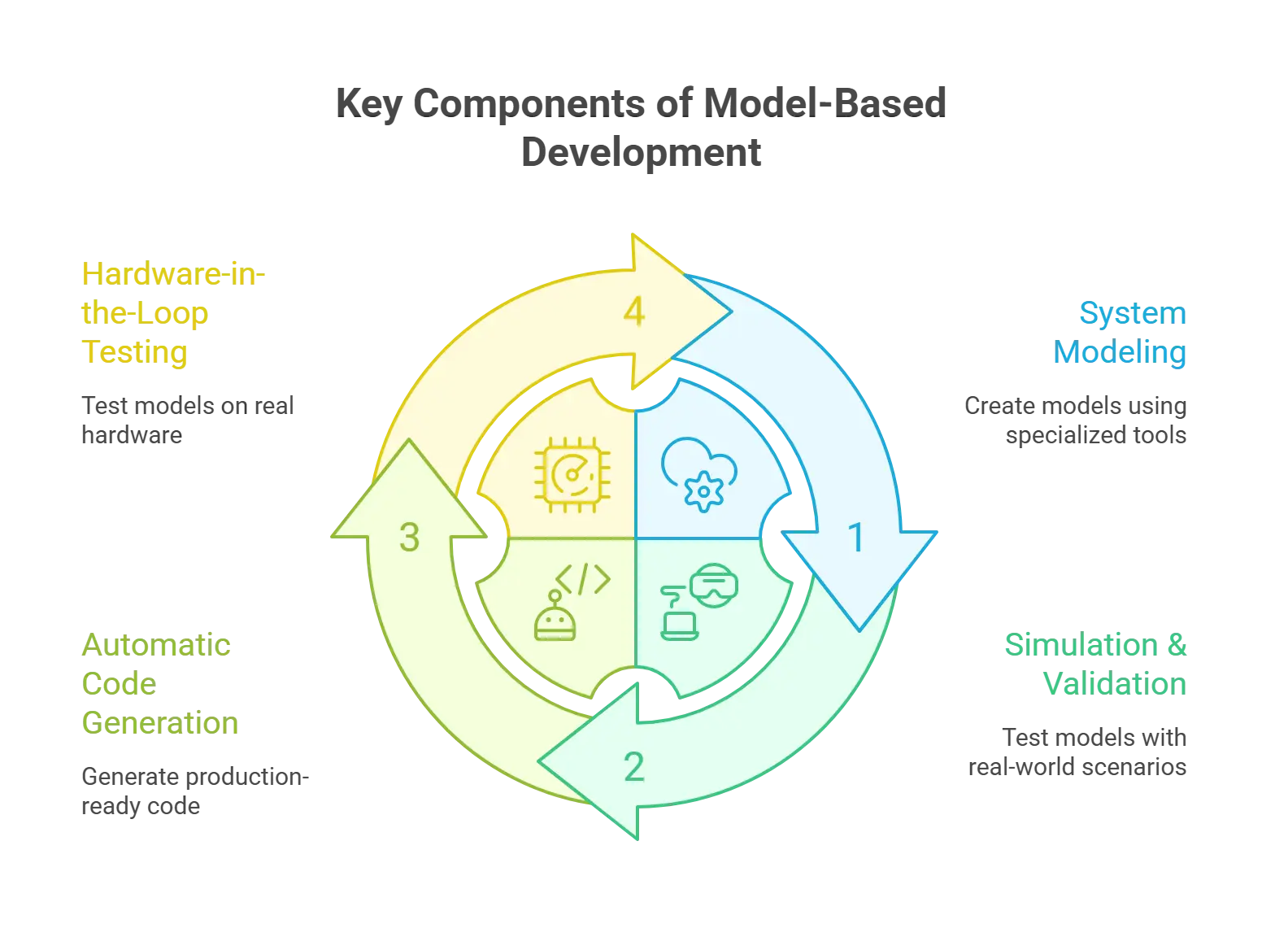
Key Components of Model-Based Development
1. System Modeling
Tools like MATLAB/Simulink, Stateflow, or Enterprise Architect are used to model system behavior, algorithms, control logic, state machines, and signal flow.
2. Simulation & Validation
Run simulations using real-world scenarios or test vectors. This helps validate requirements and ensure the model behaves correctly.
3. Automatic Code Generation
Generate production-ready C/C++ code directly from the model using tools like Simulink Coder, TargetLink, or Embedded Coder.
4. Hardware-in-the-Loop (HIL) Testing
Models can be tested on real hardware (controllers, sensors, actuators) using real-time testing platforms.
Why Use Model-Based Development?
Model-Based Design offers several benefits.
Faster Development
Simulations and code generation eliminate redundant manual coding and debugging.
Improved Quality & Reliability
Models can be verified against system requirements, reducing integration issues and system-level bugs.
Enhanced Collaboration
Engineers across disciplines (software, electrical, mechanical) can collaborate on a shared model.
Early Testing & Validation
Even before hardware is available, models can be tested and tuned.
Standards Compliance
MBD is aligned with standards like ISO 26262 (Functional Safety), ASPICE, and DO-178C.
Real-World Case Study: Bosch’s EPS System
Objective
Bosch, a global automotive leader, wanted to design a high-performance Electric Power Steering (EPS) system with strict safety, performance, and time-to-market goals.
Challenges
- Complex sensor-actuator integration
- ISO 26262 ASIL D compliance
- High real-time performance
- Costly hardware testing cycles
MBD-Based Solution
Bosch adopted a complete Model-Based Development workflow using:
- Simulink + Stateflow for control logic modeling
- MIL, SIL, and PIL simulations to validate algorithms early
- Embedded Coder to generate optimized C code
- dSPACE HIL systems for real-time controller validation
- Polyspace for static analysis and MISRA C compliance
Validation
- Model-In-the-Loop (MIL) for concept validation
- Software-In-the-Loop (SIL) for code behavior comparison
- Processor-In-the-Loop (PIL) for MCU-specific performance tuning
- HIL Testing to simulate sensor noise, road conditions, and load dynamics
Results
- Development time: cut by 35% using reusable model libraries
- Early bug detection: 90% of integration issues found before hardware testing
- Platform reuse: a single model reused across 3 vehicle variants
- Compliance: full ISO 26262 traceability via model artifacts
- Cost saving: major savings in ECU testing and rework effort
“Model-Based Development helped us move from reactive testing to proactive system design. We could simulate edge cases, perform safety assessments, and deliver reliable EPS systems faster than ever before.” — Senior Systems Engineer, Bosch EPS
This real-world success illustrates the impact MBD can make in safety-critical, embedded control systems.
MBD Workflow: From Model to Deployment
Here’s a simplified MBD workflow used in embedded systems and automotive development.
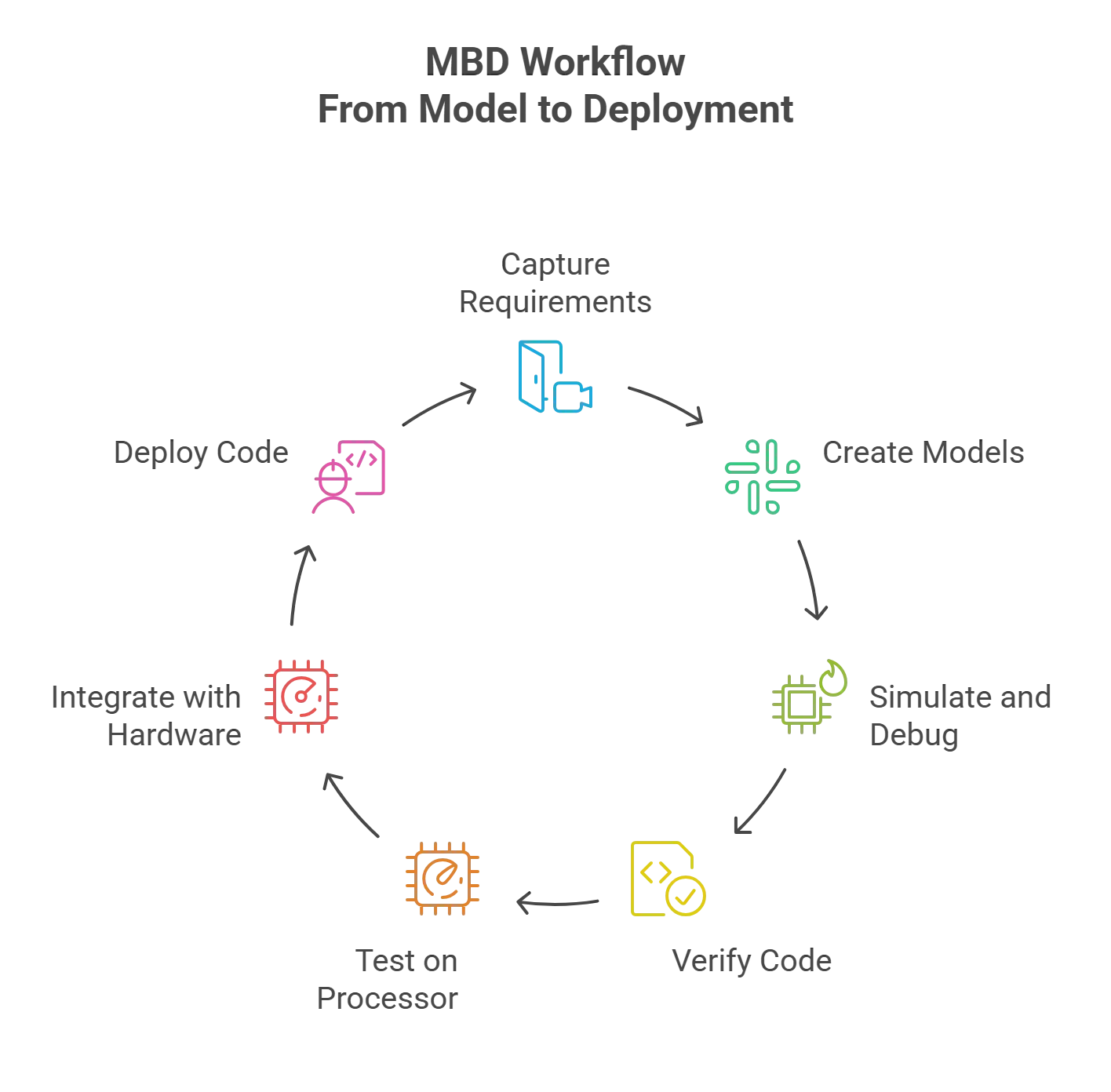
- Requirement Capture: use tools like IBM DOORS or SysML to capture functional requirements.
- Modeling: create models in Simulink, Stateflow, or equivalent platforms.
- Simulation & Debugging: perform Model-In-the-Loop (MIL) testing to validate algorithm behavior.
- Software-In-the-Loop (SIL): run generated code on a PC to verify numerical consistency.
- Processor-In-the-Loop (PIL): test generated code on the target microcontroller or processor.
- Hardware-In-the-Loop (HIL): integrate the model with actual hardware to simulate real-time operation.
- Code Deployment: the final, verified code is flashed onto the embedded ECU.
Popular Tools Used in Model-Based Development
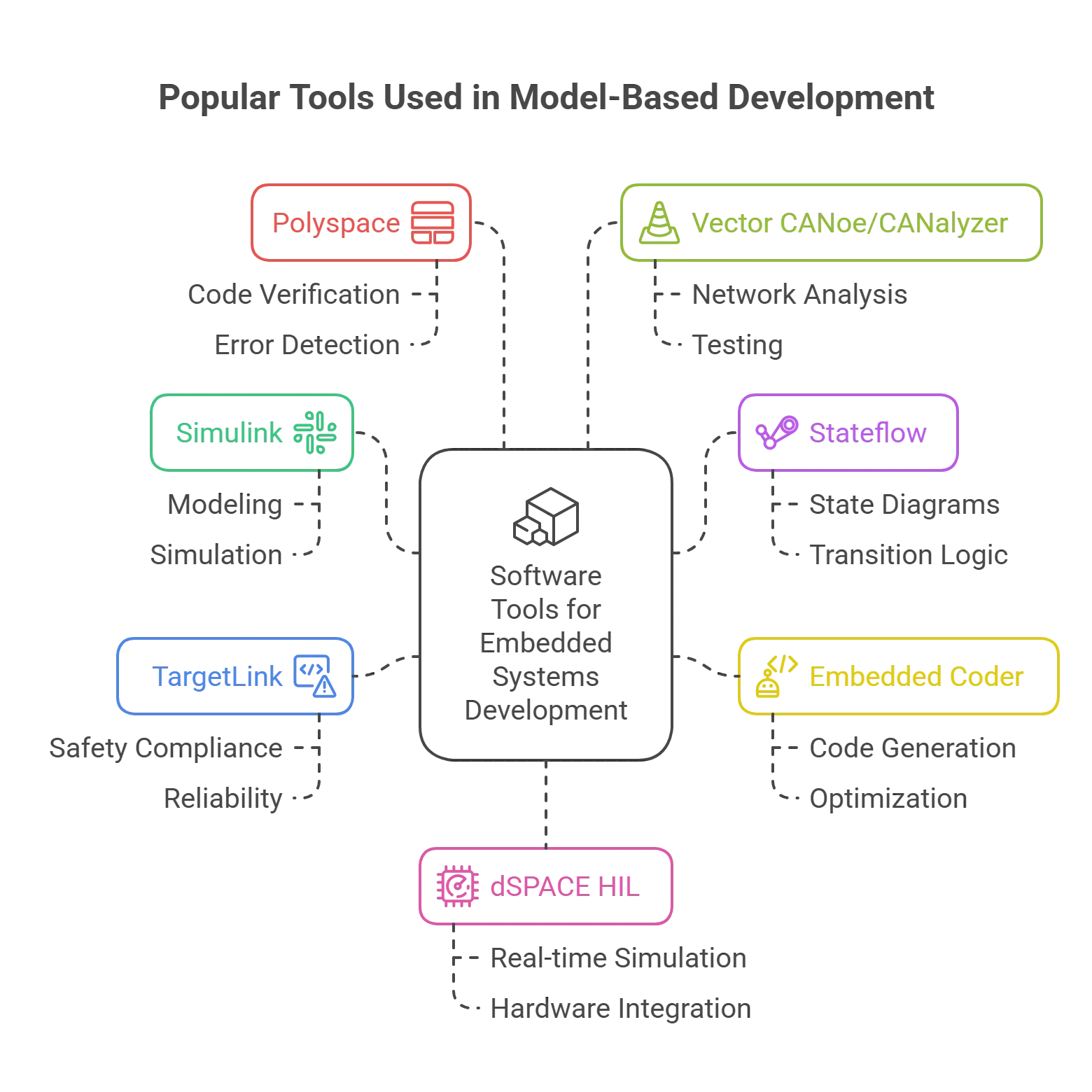
- Simulink: system modeling and simulation
- Stateflow: state machine modeling
- Embedded Coder: auto code generation
- TargetLink: code generation for safety-critical systems
- Polyspace: static code analysis
- Vector CANoe/CANalyzer: communication and test environment
- dSPACE HIL: real-time hardware-in-the-loop testing
MBD in the Automotive Industry
OEMs and Tier-1s use MBD to design:
- Engine control modules (ECUs)
- Battery management systems (BMS)
- ADAS/Autonomous systems
- Transmission, ABS, and brake control systems
Using MBD enables faster compliance with ISO 26262, reduced time-to-market, and fewer field failures.
Benefits of Model-Based Development (Recap)
- Reuse of validated models across projects
- Traceability from requirement to code
- Early debugging saves cost and time
- Easier stakeholder communication
- Scalability from prototype to production
Who Should Learn Model-Based Development?
- Embedded Software Developers
- Control System Engineers
- Automotive and Aerospace Engineers
- Robotics Developers
- Engineering Students interested in Simulink, STM32, or vehicle ECUs
Getting Started with MBD: Learning Resources
- MathWorks Simulink Tutorials
- NXP Model-Based Design Toolbox
- dSPACE MBD Training
- MBD blogs and forums
- Reynlab MBD Courses
Summary
Model-Based Development is changing embedded system design by shifting the focus from writing code to building and simulating models. With tools like Simulink and workflows proven by industry leaders like Bosch, MBD delivers better quality, faster time-to-market, and compliance with modern safety standards.
Where to start
Want to master MBD for automotive, robotics, or embedded systems? Check out hands-on Model-Based Development courses at https://reynlab.com/course/model-based-development/