Piggyback ECU for bike: how it works, fitting and common faults
9 min read ·
In this guide · 7 parts
For off-highway and racing use only. The modifications discussed here are permitted only on vehicles used off the highway or in racing. They are not intended for on-road use.
A piggyback ECU for a bike is a small box that sits in the wiring between the factory ECU (engine control unit) and the injector or sensors. It changes the injector pulse, or the signals the ECU reads, so the engine gets more or less fuel. The stock ECU stays in the bike and still runs the engine. The piggyback only corrects some of its decisions.
A road-registered bike must keep meeting the emission standard it was approved to, BS-VI, and pass PUC. Changing fuelling or ignition on a road bike can break that. It can also void the warranty and cause insurance problems. This post is about how these units work and how to set them up properly on off-highway and race bikes.
What a piggyback ECU does on a fuel-injected bike
The stock ECU reads engine speed, throttle position, intake pressure (MAP), air temperature (IAT) and engine temperature. From those it works out how long to hold the injector open. That time is the injector pulse width, in milliseconds. A longer pulse means more fuel.
At idle and light cruise, most BS-VI bikes also read the oxygen (O2) sensor in the exhaust and trim the fuel to keep the mixture chemically correct. This is closed loop. At bigger throttle openings the ECU ignores the O2 sensor and follows its maps. That is open loop.
Two ways a piggyback changes fuelling
- Injector interceptor. The box sits between the ECU and the injector. It reads the pulse the ECU sends, then lengthens or shortens it using its own table of engine speed against throttle position. On most units, a cell set to +5 means about 5% more fuel at that point, and zero means no change.
- Signal modifier. The box changes a sensor signal before the ECU sees it. Change what the O2 sensor or air temperature sensor reports, and the ECU's own maths ends up adding fuel. These are simpler but give you less control.
Some units also move ignition timing. Many touch fuel only. Check what yours controls before you promise anything.
The O2 sensor problem
This is the part that catches people out. If the piggyback adds fuel in the closed-loop zone, the stock ECU sees a richer mixture on the O2 sensor and pulls fuel back. Your change disappears at idle and cruise. It only shows up where the ECU is in open loop.
Each kit handles this its own way, and its instructions say how. On a race or off-highway bike, the installer decides how the closed-loop zone is handled. On a road bike, disabling or faking the O2 sensor breaks emission compliance.
Piggyback vs flash vs standalone ECU
| Piggyback | Flash (remap) | Standalone | |
|---|---|---|---|
| Where the change lives | Extra box in the wiring | Inside the stock ECU's memory | A new ECU replaces the stock one |
| Stock ECU | Stays in charge | Stays, with edited maps | Removed |
| What you can change | Fuel, sometimes ignition | Whatever maps the tool can reach | Everything, and you must set up everything |
| Removing it | Unplug and refit stock connectors | Write the original file back | Refit the stock ECU and harness |
| Usual reason to choose it | The ECU cannot be flashed | Tool support exists for that ECU | Project and race builds |
A piggyback is often the only choice when no flash tool can read the ECU. Our posts on bike ECU remapping software and the Speeduino standalone ECU on a motorcycle cover the other two routes. For a piggyback and a standalone compared, read Speeduino vs PowerTRONIC.
What a piggyback can and cannot fix
A piggyback corrects fuelling, nothing more. On a race bike with a changed intake or exhaust, it can fix a lean flat spot or a lean full-throttle area.
It cannot fix:
- A misfire from a weak coil, bad plug cap or wet spark plug.
- An air leak at the intake rubber or throttle body.
- A weak fuel pump or blocked pump filter.
- A faulty TPS, MAP or temperature sensor. The piggyback reads some of the same signals and will be wrong too.
- An injector already open almost the whole cycle at high rpm. There is no time left to add fuel.
If the bike does not run right on the stock map, it will not run right with a piggyback. Diagnose it first.
Installing a piggyback ECU properly
Harness and connectors
Good units use plug-in harnesses. The piggyback's lead fits between the injector and the stock plug, and the same at any sensor it taps. Do not cut and splice the stock harness. Plug-in means you can remove the unit in minutes to test the bike stock.
Check every connector is fully latched with its seal in place. A half-pushed injector plug gives a misfire or a cut-out on a bump later.
Ground
Most kits want their ground lead on the battery negative terminal, not the nearest frame bolt. A poor ground makes the unit read signals wrong. With the engine running, measure the voltage between the piggyback's ground lead and battery negative. It should be close to zero, typically under 0.1 V.
Routing
Keep the unit and wiring away from the exhaust and the HT lead. Mount the box where water does not collect, usually under the seat. Turn the handlebar lock to lock and check nothing pulls or rubs.
Throttle position setup
Many units must learn the throttle position sensor (TPS) range in their software. Key on, engine off: set the closed position, then fully open. Skip this and the piggyback adds fuel in the wrong cells.
Checking fuelling with a wideband sensor
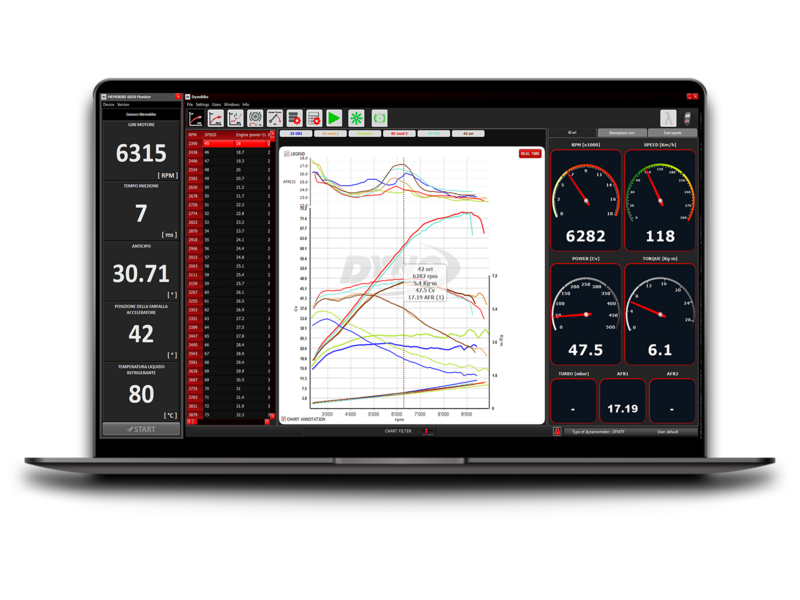
Never judge a map by feel. The stock O2 sensor on most bikes is a narrowband type. It only says "richer than correct" or "leaner than correct", switching roughly between 0.1 V and 0.9 V. It cannot tell you how rich.
A wideband sensor with its own controller reads the actual mixture. Fit it through a bung welded in the header, or use a tailpipe sniffer on a dyno.
- Read lambda if your gauge shows it. Lambda 1.0 is the chemically correct mixture for any fuel. The air-fuel ratio (AFR) for lambda 1.0 is 14.7:1 for pure petrol but lower for ethanol blends.
- Typical targets on a naturally aspirated petrol engine: around lambda 1.0 at idle and light cruise, and richer at full throttle, typically about 0.85 to 0.90. Air-cooled singles are often run a little richer at full load to help cooling.
- Log, don't glance. Record rpm, throttle and lambda together, so you know which cell each reading belongs to.
The top piggyback ECUs in India post compares the units themselves. Our guide on AFR in ECU tuning explains mixture targets further.
Common faults after fitting a piggyback, and how to diagnose them
First test, always: remove the piggyback and refit the stock connectors. If the fault goes, the cause is the unit, its wiring or its map. If it stays, the bike had a problem before.
| Symptom | Likely cause | First check |
|---|---|---|
| Surge or jerk at steady small throttle | Lean cells at light load, or the ECU's closed loop fighting the piggyback | Log lambda at that rpm and throttle; look at those cells |
| Idle hunts up and down | Idle cells changed, TPS range not set, or an air leak | Redo TPS setup; set idle cells to zero; spray-test the intake rubber |
| Check-engine light after fitting | Injector or sensor plug not fully seated, or the ECU sees a circuit fault | Read the code with a scanner; check every connector the kit touched |
| Cuts out on bumps | Loose plug or poor ground | Wiggle-test connectors with the engine running; measure ground voltage drop |
| Popping on closed throttle | Lean on overrun, or an exhaust leak letting air in | Check the header joint and any wideband bung for leaks |
| Hesitation when throttle is snapped open | Lean on transient; some units have an acceleration setting | Log lambda during a throttle snap |
A map downloaded for "your model" was made for someone else's exhaust and air filter. If you are unsure, start from zero and build the map from logs.
If you want to learn fuel maps, logging and wideband work with a trainer, see the ECU Tuning & Remapping course.
Questions technicians ask
What is a piggyback ECU for a bike?
An add-on module that plugs in between the stock ECU and the injector or sensors. It changes the fuel delivered, sometimes ignition timing too, while the stock ECU keeps running the engine. Unplug it and the bike is back to factory setup.
Is a piggyback ECU better than a remap?
Neither is better in general. A remap can reach more settings and adds nothing to the wiring. A piggyback is used when no tool can flash that ECU, or when it must be easy to remove. On a road bike, both change the approved setup.
Why does the check-engine light come on after fitting a piggyback?
Usually a connector is not fully pushed home, or the ECU has detected something it does not expect in the injector or sensor circuit. Read the code first. Then remove the unit, refit the stock plugs, clear the code and see if it returns.
Can a piggyback ECU damage the engine?
The box itself does not, but a bad map can. A lean full-throttle area makes the engine run hot and can lead to detonation and piston damage. Check the map with a wideband before the bike is ridden hard.