Speeduino motorcycle build: a standalone ECU on a project or race bike
9 min read ·
In this guide · 7 parts
For off-highway and racing use only. The modifications discussed here are permitted only on vehicles used off the highway or in racing. They are not intended for on-road use.
Speeduino on a motorcycle means replacing the bike's ignition and carburettor, or its factory ECU, with an open-source standalone ECU (engine control unit). It runs on Arduino-based hardware and you tune it on a laptop with TunerStudio. It is used on project and race bikes: old bikes, carburettor-to-injection conversions and heavily changed engines. You set up every sensor and output yourself.
A road-registered bike must keep meeting the emission standard it was approved to, BS-VI, and pass PUC. Replacing the fuel or ignition system on a road bike breaks that approval. It can also void the warranty and cause insurance problems. Build a Speeduino bike for the track or off-highway use only.
What Speeduino is
Speeduino is a community project. The firmware is open source and the board designs are published. Most builds run on an Arduino Mega 2560, and newer ones can use Teensy boards. You can solder a kit, buy a ready-built board, or make one to the published design.
The tuning software is TunerStudio. It shows the fuel and ignition tables and all settings, logs data and shows live gauges. The free version is enough to start.
No maker stands behind it. Support is the forum and the project documentation. Our post comparing Speeduino with PowerTRONIC explains how it differs from a plug-in piggyback.
Why people put Speeduino on a bike
- Carburettor to fuel injection. An old single or twin gets a throttle body, injector, pump and sensors, and Speeduino runs them.
- Old bikes with failed ignition parts. When the original CDI unit is no longer available, a standalone can run the ignition.
- Race engines. A big-bore kit, a hot cam or a different intake can move the engine far from what the factory map expects.
- Learning. You set every value, so you learn exactly how an ECU decides fuel and spark.
If the bike already has a factory ECU that a tool can flash, remapping is usually less work. See our post on bike ECU remapping software.
What a single-cylinder build needs
Crank trigger wheel and sensor
The ECU needs to know crank position and speed. The usual way is a toothed wheel on the crank with one or more teeth missing, such as a 12-1 or 36-1 wheel, read by a sensor. The gap tells the ECU where top dead centre is. Many stock bike pickups read one raised tab on the flywheel. Speeduino can run on that, but a missing-tooth wheel gives a steadier rpm reading.
On a four-stroke, the crank turns twice per cycle. With a crank signal only, the ECU cannot tell the compression stroke from the exhaust stroke. So a simple single-cylinder build usually fires the spark every revolution (wasted spark) and splits the fuel across both revolutions. Adding a cam signal allows timed sequential injection.
Load sensing: MAP or throttle
Most builds use a MAP sensor (manifold absolute pressure) to measure engine load. Fit it with a short hose to the intake between the throttle and the valve. On a single, the pressure swings hard with each intake stroke, so the reading jumps. Speeduino has MAP sampling options, such as taking the lowest or the average value over each cycle, to steady it. On engines with a big cam or a very short intake, MAP signal can be poor at small throttle. Those builds often use throttle position as the load input instead, called Alpha-N.
Injector, pump and regulator
- Use a high-impedance injector, typically about 12 Ω, which Speeduino drives directly. Low-impedance injectors need current limiting.
- Size the injector for the engine. Too small runs out of time at high rpm; too large makes idle hard to control.
- A carburettor fuel tap cannot feed an injector. You need an electric pump, a filter and a pressure regulator. Small bike systems typically run at about 3 bar. Use the pressure the injector's flow rating is given at.
Ignition coil
On most Speeduino boards, the ignition output is a low-current logic signal. Some boards have igniter drivers fitted; check which you have. A logic output cannot drive a plain coil. Use a coil with a built-in igniter, or put an igniter module between the board and the coil. A plain coil wired straight to a logic output will damage the board.
Temperature sensors and wideband
- An air temperature sensor in the intake.
- An engine temperature sensor. On water-cooled bikes this is the coolant sensor. On air-cooled bikes, use a cylinder head or oil temperature sensor in its place.
- A throttle position sensor on the throttle body.
- A wideband oxygen sensor with its own controller. Feed its analogue output into Speeduino and set the matching calibration in TunerStudio. Without a wideband, you cannot tune the fuel table properly.
Charging system
Many older bikes have a weak charging system, and some run lights on AC straight from the alternator. Fuel injection needs steady DC power for the ECU, pump, injector and coil. Check the charging system can supply that with the lights on before you build anything.
Wiring and grounding
Most Speeduino faults are wiring faults. Do this part slowly.
- Separate grounds. Run power grounds (injector, coil) and sensor grounds separately. Sensor grounds go back to the ECU's sensor ground pin, not to the frame.
- Good main ground. Take the ECU's main ground to the engine or battery negative with a short, thick wire. Measure the voltage drop between the ECU ground and battery negative while cranking. It should be typically under 0.1 V.
- Shielded crank sensor cable. Use shielded cable for the crank sensor and ground the shield at the ECU end only.
- Relays and fuses. Power the pump, injector and coil through relays with their own fuses. The board should not carry that current.
- Route away from heat and HT. Keep signal wires away from the spark plug lead and exhaust.
Our guide to checking ECM grounds explains the voltage-drop test in detail.
First start and base map
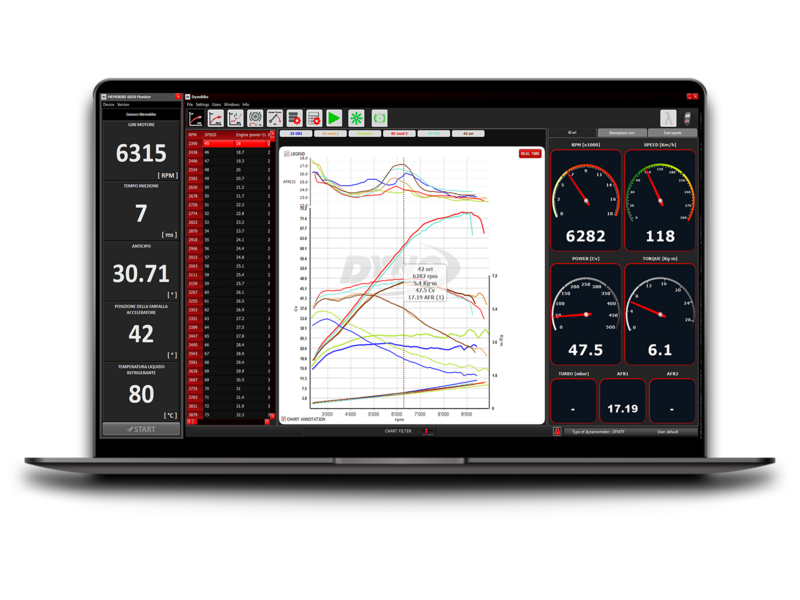
Do not crank the engine until the ECU sees the engine correctly. Work in this order:
- Check every sensor reading in TunerStudio with the key on. On a cold engine, air and engine temperatures should be near room temperature. MAP should read atmospheric, about 100 kPa near sea level and less at altitude. Throttle should read 0% closed and 100% open.
- Enter the engine and injector data: engine size, number of cylinders, injector flow and injector opening time. TunerStudio calculates the base fuel amount from these.
- Check the trigger. Unplug the injector, take the spark plug out, put it back in its cap and rest it on the engine so it is grounded. Then crank. Watch the tooth logger: the pattern should be clean and rpm should read steadily.
- Set the trigger angle with a timing light. Lock the timing to a fixed value and read the timing mark with the strobe. Adjust the trigger angle in the software until the two match.
- Set priming and cranking fuel, then start the engine.
- Idle and warm-up next. Get a steady idle, then tune warm-up enrichment as the engine heats up.
- Tune the fuel table with the wideband, cell by cell, from light load upward. Keep ignition timing conservative until fuelling is right, and do full-load work on a dyno.
Our guide to ECU fuel maps explains how the fuel and ignition tables are laid out.
The limits of Speeduino on a bike
- No factory diagnostics. There is no OBD, no fault code memory a workshop scanner can read, and no check-engine light unless you set one up. You diagnose with TunerStudio and a multimeter.
- Weather. A bike's ECU sits in the open. Use a sealed enclosure, sealed connectors and drip loops on the wiring. A bare board under the seat will not survive rain or a wash.
- Vibration. Singles shake. Mount the box on rubber and support the harness so connectors do not work loose.
- Reliability is yours. Solder joints and crimps decide whether it lasts. Recheck them after the first few runs.
- Not road legal. It replaces the type-approved system, so it belongs on track and off-highway bikes only.
For other standalone ECUs and how they compare, see the post on standalone ECUs in India. To learn fuel maps, logging and dyno work with a trainer, see the ECU Tuning & Remapping course.
Questions technicians ask
Can Speeduino run a motorcycle?
Yes. It can run fuel and ignition on single and twin-cylinder bike engines, given a usable crank signal and the right sensors. It replaces the stock system rather than working alongside it.
Can I convert a carburettor bike to fuel injection with Speeduino?
Yes, for off-highway and race use. You need a throttle body with a TPS, an injector, an electric pump with a regulator, MAP and temperature sensors, a crank trigger, a coil with an igniter, and a wideband sensor. Check the charging system can power it all first.
Is Speeduino better than a piggyback for a bike?
It does a different job. A piggyback corrects the stock ECU and plugs in. Speeduino replaces the whole system and needs you to wire and set up everything. For a factory fuel-injected bike that only needs a fuel correction, a piggyback is much less work.
Which software is used to tune Speeduino?
TunerStudio. The free version covers setup, tuning and logging. The paid version adds tools such as automatic fuel table correction from wideband logs.