AI ECU Tuning Explained: Advanced Future of Car Tuning
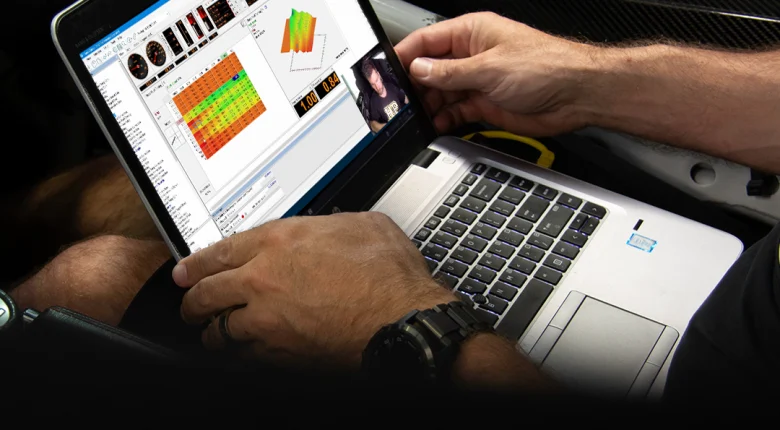
Artificial Intelligence (AI) is transforming industries across the globe, from healthcare to finance, and it is now entering the automotive tuning world.
One of the newer concepts is AI ECU Tuning (AI Remap or i-Map). This guide covers what it is, whether it is available today, and how it may affect ECU tuning in India, including its current limitations and future potential.
What is AI ECU tuning?
AI ECU Tuning (AI Remap or i-Map) means using artificial intelligence to analyse ECU data, generate optimised tuning files and automate remapping processes. In simple terms, instead of a human tuner manually editing ECU maps, AI can assist with the tuning or perform it automatically.
What is Artificial Intelligence?
Artificial Intelligence is the science of making machines learn, analyse and make decisions. It combines data, algorithms and computing power. AI is already used in chatbots, image generation and automation systems, and it is now entering automotive tuning.
Machine Learning
Machine Learning (ML) is a subset of AI. Systems learn from data and improve their performance over time, for example by learning from thousands of ECU files.
Deep Learning
Deep Learning is a subset of ML. It uses neural networks that mimic the human brain, which helps with complex analysis.
How AI ECU tuning works
In theory, AI ECU tuning works in these steps:
- Collect large ECU data (original and tuned files).
- Train a machine learning model.
- Identify patterns in the maps.
- Generate an optimised tuning file.
- Apply the changes automatically.
The goal is faster and more accurate tuning.
Current use of AI in the automotive industry
Today, AI is already used in customer support, through chatbots and automated responses, and in design optimisation, through vehicle design improvements and simulation. Full AI remapping, however, is still evolving.
Is AI ECU tuning available today?
The short answer is not fully. The current limitations are the lack of large ECU databases, complex ECU variations and the need for accurate training data. Most current "AI tools" are predefined solutions rather than true machine learning systems, so true AI remapping needs more development.
Why AI ECU tuning is difficult
To build a real AI tuning system, you need four things:
- Massive data. Thousands of ECU files from different vehicles.
- Accurate labelling. Correct map identification.
- Advanced algorithms. ML and deep learning models.
- Continuous learning. The system improves over time.
This takes years to develop.
AI remap vs traditional ECU tuning
| Feature | Traditional Tuning | AI ECU Tuning |
|---|---|---|
| Speed | Moderate | Fast |
| Accuracy | Depends on tuner | Data-driven |
| Control | Manual | Automated |
| Availability | Widely available | Limited |
AI aims to enhance tuners, not replace them.
Can AI do Stage 2 and Stage 3 tuning?
It is technically possible, but there is a practical challenge. Stage 2 and 3 involve different aftermarket parts and unique setups. There are no identical datasets, so it is hard to train an AI, and the work is more complex than Stage 1 tuning.
Is AI ECU tuning safe?
AI tuning can be safe if it is trained with accurate data, verified by professionals and double-checked manually. Human supervision is still required.
Future of AI ECU tuning
In the future, AI could reduce tuning time, improve accuracy, automate basic remaps and provide predictive tuning. It may also lead to real-time adaptive tuning and cloud-based tuning systems.
Will AI replace ECU tuners?
No, but it will change the industry. Workflows will get faster and basic tasks will be automated, while human expertise, problem-solving and advanced tuning will remain. Tuners who adapt will grow.
Think of it like AI in architecture, which does not replace architects, and AI in coding, which does not replace developers. AI in tuning will assist professionals, not replace them. Human and AI together give the best results.
AI ECU tuning in India
The current status is early stage, with limited adoption. The future potential is high, with a growth opportunity and increasing interest. The challenges are data availability and a lack of AI integration. India has huge potential.
Business opportunity
AI combined with ECU tuning can create faster service delivery, a scalable tuning business and automated file services. Early adopters will benefit.
Who should learn AI ECU tuning?
ECU tuners, automotive engineers and tech enthusiasts. It is a future-ready skill.
Key takeaways before using AI
- Do not fully rely on AI.
- Always verify results.
- Use professional tools.
- Maintain safety limits.
Responsible use is critical.
Summary
AI ECU tuning is the future, but not the present. Today human tuning is essential, and tomorrow it will be AI and humans working together. That is the winning formula.
AI ECU tuning is an exciting innovation with the potential to change the automotive tuning industry. While it is still in its early stages, its future looks promising. For Indian tuners, the best strategy is to learn traditional tuning first, understand AI basics and adapt to new technologies.
Watch our workshop videos on the Reynlab YouTube Channel. You can also explore our automotive training programs at www.reynlab.com/our-courses.