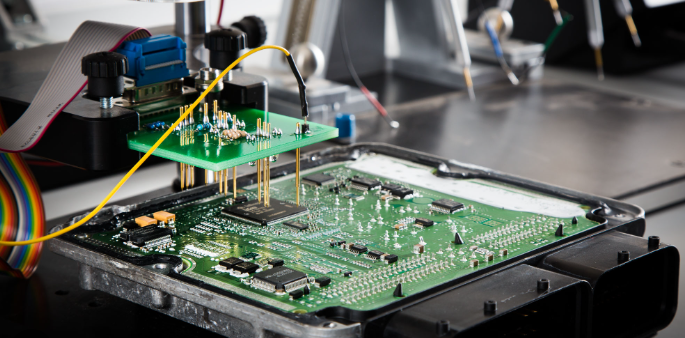
Enhancing Turbocharger Performance with ECU Tuning

Enhancing turbocharger performance with ECU tuning
Turbochargers are a popular choice for enthusiasts who want more engine performance and higher power outputs. These forced-induction devices compress the incoming air, so the engine takes in more air and runs more efficiently. A turbocharger only reaches its full potential, though, when it is paired with optimised engine control. Electronic Control Unit (ECU) tuning plays a major part in turbocharger performance, because it integrates the turbo properly and maximises the power gains.
This post looks at how turbochargers and ECU tuning work together in a turbocharged engine.
1. The role of turbochargers in engine performance
A turbocharger is a forced induction system that increases the amount of air supplied to the engine, allowing better combustion and more power. Exhaust gases pass through the turbine side, which spins the turbine wheel. That compresses the incoming air and forces it into the intake manifold. The denser air gives more efficient combustion and a significant boost in power and torque.
2. Why turbo engines need ECU tuning
Turbochargers give large performance gains, but integrating one with the engine needs precise control and calibration. The ECU manages fuel delivery, ignition timing and air-to-fuel ratios. When a turbocharger is added, these parameters must be adjusted for the increased airflow to get the best performance. That is the job of ECU tuning.
3. Turbocharger ECU mapping
ECU tuning remaps the engine control system to optimise performance under various conditions, including the presence of a turbocharger. The mapping process adjusts fuel delivery, ignition timing and boost pressure settings so they match the turbo's operation. The engine then gets the right amount of fuel and air for the power you want, without compromising reliability.
4. Boost pressure control
Boost pressure is the level of compressed air the turbocharger delivers to the engine, and controlling it is one of the key parts of tuning. ECU tuning lets the tuner set boost precisely for different driving conditions and power demands. Well-tuned boost control gives smooth power delivery and prevents problems such as over-boosting and turbocharger lag.
5. Fuel delivery and air-to-fuel ratios
With the extra airflow from the turbo, the engine needs a matching increase in fuel to hold the ideal air-to-fuel ratio. ECU tuning adjusts fuel delivery and air-to-fuel ratios to suit the higher air intake, which allows efficient combustion and the best performance. Proper fueling prevents lean conditions, which can damage the engine, and rich conditions, which waste fuel and reduce power.
6. Ignition timing
Correct ignition timing is vital in turbocharged engines. ECU tuning makes the spark fire at the right moment for the most efficient combustion. Advancing or retarding the timing has a significant effect on power output and turbo performance. The key to turbo efficiency is calibrating the timing carefully together with boost pressure control and fuel delivery.
7. Real-time data logging and fine-tuning
Tuning a turbocharged engine often involves real-time data logging, on the dyno or on the road. The logs let the tuner analyse engine performance under various conditions and make fine adjustments to the engine map. Repeating this cycle gives the most precise calibration and gets the most out of the turbocharger.
8. Safety measures
Turbo tuning must include safety measures to protect the engine. Many ECU tuning programs have safeguards against over-boosting, excessive exhaust gas temperature and other harmful conditions. These keep the engine within safe limits, even in aggressive driving or extreme conditions.
9. Aftermarket turbocharger upgrades
For even more power, an aftermarket turbocharger upgrade is a common modification. ECU tuning is necessary when you install one, because it needs different calibration settings from the stock turbo. A well-tuned ECU lets the new turbocharger reach its full potential and deliver substantial power gains.
10. Benefits of ECU tuning for turbocharger performance
- Increased power and torque: a properly tuned ECU lets the turbocharger deliver more air to the engine.
- Improved throttle response: the engine responds to throttle inputs with instant, smooth power delivery.
- Better fuel efficiency: efficient fuel delivery gives better economy despite the added power.
- Customisation: the engine's performance can be tailored to the driver's preferences and the vehicle setup.
- Better drivability: the turbocharger is integrated harmoniously, which improves overall drivability.
Related courses
ECU Tuning & Remap – Master Performance
Rated 4.7/5. Webinar with certificate. ₹59,000.

ECM Repair Course – Diagnostics Training
Rated 4.7/5. Webinar with certificate. ₹59,000.

Ecu Tuning & Remap Online – Advanced
Rated 4.7/5. Webinar with certificate. ₹19,999.

Ecu Tuning & Remap Online – Basic
Rated 4.7/5. Webinar with certificate. ₹4,999.