Everything You Need to Know About ECU Tuning, Chip Tuning & Remapping (2025)
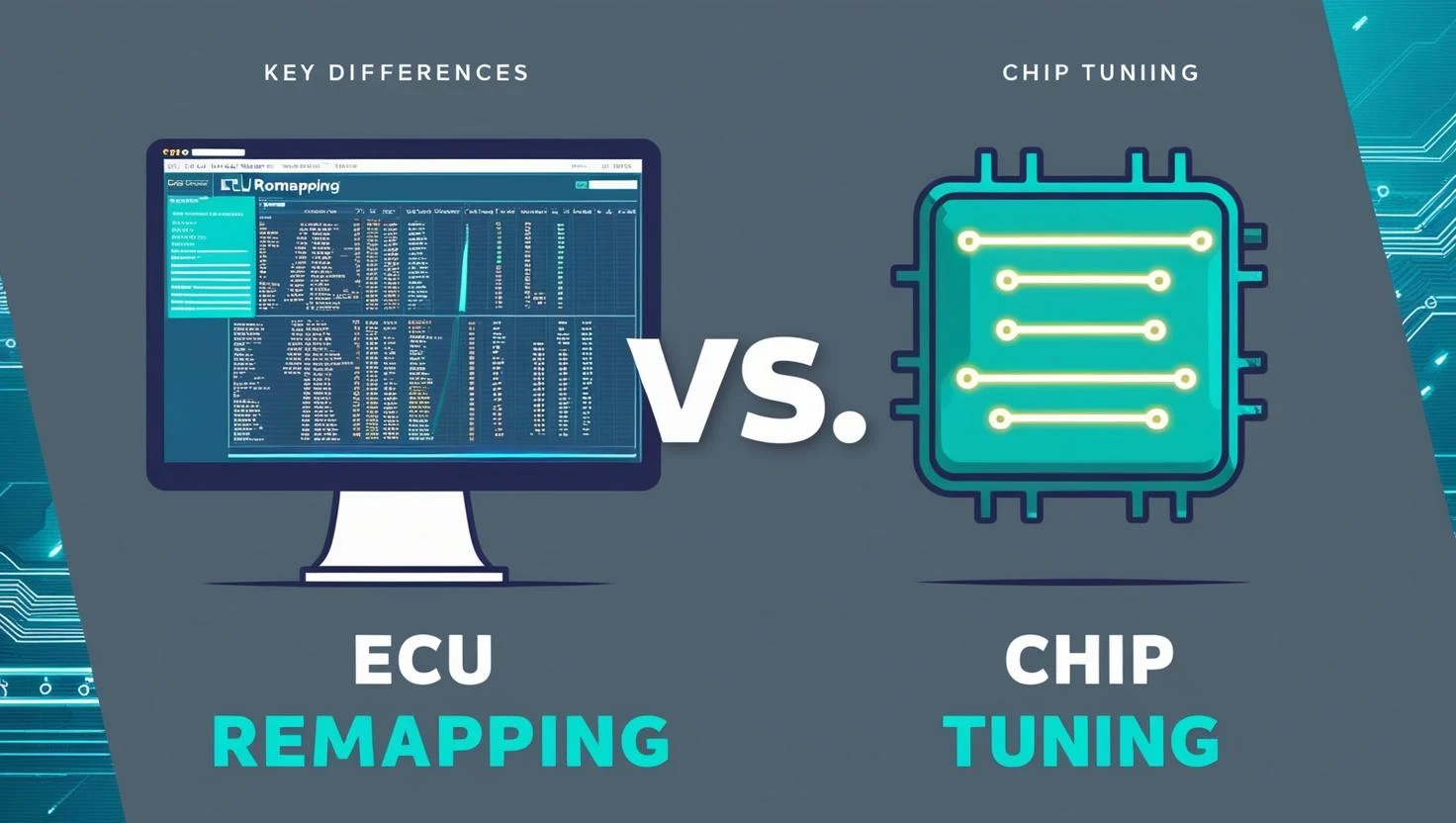
This 2025 guide is for anyone new to automotive performance, where the terms ECU tuning, chip tuning and remapping can seem confusing and interchangeable. Understanding the differences between them matters if you want to improve your vehicle’s performance, fuel efficiency or drivability. This beginner’s guide explains each approach so you can decide which one suits your needs and budget.
Understanding the basics: what controls your engine?
The Electronic Control Unit (ECU) is your engine’s brain. It constantly monitors and adjusts parameters to optimize performance, emissions and fuel efficiency. It processes information from dozens of sensors and controls actuators throughout the engine system.
Its key functions are:
- Fuel injection timing and quantity
- Ignition timing optimization
- Boost pressure control (turbocharged engines)
- Emissions system management
- Idle speed control
- Temperature management
ECU tuning: the modern approach
ECU tuning, also known as engine tuning or performance tuning, means modifying the software parameters inside the ECU to optimize engine performance. It is the most comprehensive and flexible way to modify an engine.
How ECU tuning works
The tuner connects to the vehicle’s ECU through the OBD-II port or by direct connection. Specialized software reads the existing calibration, the tuner modifies specific parameters, and the updated calibration is written back to the ECU.
- Method: software-based modification
- Access: OBD-II port or direct ECU connection
- Reversibility: fully reversible
- Customization: highly customizable
- Time required: 2-6 hours depending on complexity
ECU tuning process
- Vehicle diagnostics: check for existing issues.
- ECU reading: extract the current calibration file.
- Analysis: understand the current parameters.
- Modification: adjust maps and parameters.
- Writing: upload the modified calibration.
- Testing: road test and fine-tune.
Advantages and disadvantages
The advantages are comprehensive control with access to all engine parameters, customization to specific requirements, easy return to stock settings, easy updates and no hardware changes, since it is purely software-based.
The disadvantages are cost (it needs expensive software and equipment), complexity (it needs technical expertise), time (it can be time-intensive) and risk (the engine can be damaged if the work is done incorrectly).
ECU tuning is best for performance enthusiasts who want maximum customization, professional tuners and workshops, vehicles that need specific optimization, and users who want reversible modifications.
Chip tuning: the traditional hardware approach
Chip tuning is the original method of engine modification. It involves physically replacing or modifying the ECU’s memory chip that holds the engine calibration.
How chip tuning works
Traditional chip tuning requires physical access to the ECU. The original EPROM (Erasable Programmable Read-Only Memory) chip is removed and replaced with a modified version containing new calibration data.
- Method: hardware-based modification
- Access: the ECU must be opened physically
- Reversibility: possible, but you must keep the original chip
- Customization: limited to pre-programmed options
- Time required: 1-3 hours
Types of chip tuning
- EPROM replacement. The original chip is removed and replaced. It is used on older vehicles (1990s-early 2000s). The modification is permanent, but the ECU must be opened and flexibility is limited.
- Piggyback chips. An additional chip is installed alongside the original, and it is used on various vehicle types. It is non-invasive and easily removable, but the scope of modification is limited.
- Flash chip modification. The existing flash memory is reprogrammed on modern vehicles that use it. No physical chip replacement is needed, but specialized equipment is required.
Advantages and disadvantages
The advantages are permanence (the modifications remain after battery disconnection), simplicity (often plug-and-play), a cost that can be lower than full ECU tuning, and a reliable technology with a long track record.
The disadvantages are limited flexibility (pre-programmed options only), hardware risk (the ECU can be damaged during installation), a possible void of the manufacturer warranty, and difficulty in modifying anything after installation.
Chip tuning is best for older vehicles without OBD-II ports, users who want a simple, permanent solution, budget-conscious modifications, and vehicles with limited ECU tuning support.
Remapping: the bridge between old and new
Remapping is essentially a modern term for ECU tuning, but it refers specifically to rewriting the ECU’s memory maps. The term comes from the practice of modifying “maps”, the data tables that control engine parameters.
How remapping works
Remapping involves connecting to the ECU and rewriting the specific data maps that control various engine functions. It is similar to ECU tuning but focuses on the lookup tables (maps) the ECU uses to make decisions.
- Method: software-based map modification
- Access: OBD-II port or direct connection
- Reversibility: fully reversible
- Customization: moderate to high
- Time required: 1-4 hours
Types of engine maps
- Fuel maps control fuel injection quantity and timing. Their parameters are injector pulse width, fuel pressure and lambda targets, and they affect power, efficiency and emissions.
- Ignition maps control spark timing across the RPM and load ranges. Their parameters are ignition advance, knock control and idle timing, and they affect power delivery and engine smoothness.
- Boost maps (turbocharged engines) control turbocharger boost pressure. Their parameters are wastegate control and overboost protection, and they affect power output and turbo response.
- Limiters and safety maps protect the engine from damage. Their parameters are the rev limiter, speed limiter and temperature limits, and they affect maximum performance and safety.
Remapping process
- ECU connection: connect to the vehicle’s ECU.
- Map reading: extract the current calibration maps.
- Analysis: analyze the existing parameters.
- Map modification: adjust specific data tables.
- Validation: check for errors and consistency.
- Writing: upload the modified maps.
- Testing: verify performance and safety.
Advantages and disadvantages
The advantages are a focused approach that targets specific performance areas, established techniques with proven results, wide availability of professional services, and easy return to stock.
The disadvantages are limited scope (it may not cover every tuning possibility), standardization (generic maps are often used), the cost of professional services, and dependency on ongoing professional support.
Remapping is best for users who want proven performance improvements, those who prefer professional services, vehicles with established remapping support, and users who want moderate customization.
Detailed comparison: ECU tuning vs chip tuning vs remapping
The first four rows below compare technical complexity. The last four compare customization capability.
| Aspect | ECU Tuning | Chip Tuning | Remapping |
|---|---|---|---|
| Skill level required | High | Medium | Medium |
| Equipment needed | Expensive | Moderate | Moderate |
| Time investment | High | Low | Medium |
| Learning curve | Steep | Moderate | Moderate |
| Feature | ECU Tuning | Chip Tuning | Remapping |
| Parameter control | Complete | Limited | Good |
| Custom calibration | Full | Preset | Moderate |
| Vehicle-specific | Yes | Limited | Yes |
| Update flexibility | High | Low | Medium |
Cost analysis
- ECU tuning: software ₹50,000-₹150,000, hardware ₹30,000-₹100,000, training ₹25,000-₹75,000, and a service price of ₹15,000-₹40,000.
- Chip tuning: equipment ₹20,000-₹60,000, chips ₹2,000-₹10,000 each, installation ₹5,000-₹15,000, and a service price of ₹8,000-₹25,000.
- Remapping: professional service ₹10,000-₹30,000, DIY equipment ₹25,000-₹75,000, map files ₹3,000-₹10,000, and training ₹15,000-₹50,000.
Performance gains
- Power: ECU tuning can give a 15-30% increase, chip tuning a typical 10-20% and remapping a common 12-25%.
- Fuel efficiency: ECU tuning has a 5-15% improvement potential, chip tuning a typical 3-10% and remapping a common 5-12%.
- Torque: ECU tuning can give a 20-35% increase, chip tuning a typical 15-25% and remapping a common 18-30%.
Risk assessment
- ECU tuning: engine damage risk is high if done incorrectly, ECU corruption is a moderate risk, a warranty void is highly likely and detectability is moderate to high.
- Chip tuning: ECU damage risk is high during installation, component failure is a moderate risk, a warranty void is highly likely and detectability is low to moderate.
- Remapping: engine damage risk is moderate if done incorrectly, ECU issues are a low to moderate risk, a warranty void is highly likely and detectability is moderate.
Vehicle compatibility guide
- Modern vehicles (2015-present): ECU tuning or remapping works best, because the ECU systems are advanced and have OBD-II access. Security protocols may limit access.
- Mid-range vehicles (2005-2015): ECU tuning or remapping again, with a good balance of features and accessibility. Some models may require BDM access.
- Older vehicles (1995-2005): chip tuning or ECU tuning, since the ECU systems are simple and easier to reach. OBD-II functionality is limited.
- Classic vehicles (pre-1995): chip tuning, because the ECU systems are simple or absent. Carburetor tuning may be needed instead.
Indian market considerations
Popular vehicle applications
- Maruti Suzuki: ECU tuning or remapping is recommended, with tools such as Galletto 1260 and KESS V2. Typical gains are 10-20% power and 8-15% efficiency.
- Hyundai: ECU tuning or remapping, with KESS V2 and ECM Titanium. Typical gains are 12-22% power and 6-12% efficiency.
- Tata Motors: ECU tuning, which needs professional equipment. Typical gains are 15-25% power and 10-18% efficiency.
- Mahindra: ECU tuning or remapping, which needs specialized software. Typical gains are 18-30% power and 12-20% efficiency.
Legal and regulatory considerations
- BS6 compliance: the vehicle must keep meeting emissions standards, which limits aggressive tuning. Conservative tuning approaches are the solution.
- Insurance: the policy may be voided. Inform your insurance provider, or choose reversible modifications.
- RTO regulations: the vehicle must pass fitness tests, so avoid visible modifications and stick to software-only changes.
Choosing the right approach
- Beginners: a professional remapping service has the lowest risk and proven results. It costs ₹10,000-₹25,000, takes 2-4 hours, and reversibility is usually included.
- Enthusiasts: ECU tuning with training gives maximum control and learning. It costs ₹75,000-₹150,000 including equipment, has a 3-6 month learning curve and builds long-term skills.
- Professionals: a comprehensive ECU tuning setup is a business opportunity built on expertise. It costs ₹200,000-₹500,000 for a complete setup, takes 6-12 months to establish and has a monthly return potential of ₹50,000-₹200,000.
- Budget-conscious users: chip tuning or basic remapping costs ₹8,000-₹20,000 and takes 1-2 hours. The results are acceptable, but customization is limited.
Future trends and developments
- Hybrid and electric vehicles bring new tuning requirements and an opportunity in battery and motor optimization, which needs electrical system knowledge.
- Advanced Driver Assistance Systems (ADAS) involve complex sensor integration, so they need a comprehensive understanding of the system, specialized training and specialized equipment.
- Over-the-air updates mean remote ECU updates, which affect traditional tuning methods and call for new approaches.
- Artificial intelligence is being used for tuning optimization, with automated parameter adjustment. Mainstream adoption is expected in 2-5 years.
Common mistakes to avoid
Beginner mistakes
- Skipping diagnostics. Always check for existing issues.
- Ignoring backups. Create backups before modification.
- Aggressive tuning. Start with conservative changes.
- Inadequate testing. Proper road testing is essential.
Professional mistakes
- Generic maps. Always customize for the specific vehicle.
- Ignoring safety. Maintain safety margins.
- Poor documentation. Keep detailed records.
- Inadequate tools. Invest in quality equipment.
Business mistakes
- Underpricing services. Maintain profitable margins.
- Inadequate insurance. Protect against liability.
- Poor customer communication. Explain processes clearly.
- Ignoring regulations. Stay compliant with the law.
Summary
Each approach has its place, and the best choice depends on your needs, budget and technical expertise. ECU tuning gives maximum flexibility and control with the highest complexity, chip tuning is the traditional approach and suits older vehicles, and remapping is the modern standard with a balance of features and accessibility.
For beginners, a professional remapping service is the best introduction with the least risk. As experience grows, ECU tuning offers maximum control. The Indian market offers good opportunities for skilled tuning professionals, with growing demand for performance and fuel efficiency improvements.
All forms of engine modification carry risks and need proper knowledge, equipment and safety precautions. When in doubt, consult experienced professionals and put safety ahead of maximum performance.
Ready to start your engine tuning journey? Explore our training programs covering ECU tuning, chip tuning and remapping techniques designed for Indian market vehicles and regulations.
Watch our workshop videos on the Reynlab YouTube Channel. You can also explore our automotive training programs at www.reynlab.com/our-courses.
For blog on Ecu tuning & remap
For course on Ecu tuning & remap
Related posts
Expert Methods for ECU Tuning in High-Altitude Driving
Powerful Techniques to Balance Vehicle Stability with ECU Tuning
Powerful Ways AFR Improves ECU Tuning and Engine Performance